Distress signals and liens
Open complaints and violations, unpaid charges, the distress score, foreclosure sales and federal tax liens, read from the public record.
Several parts of the property page gather the signs of trouble the public record shows at a building: open violations and complaints, unpaid tickets and charges, court and vacate records, foreclosure sales and federal tax liens. Use them to judge a building's condition before you act, or to find owners who may be under pressure.
Everything here is a record a public agency published. It is not a judgment about the building's owner or the people who live there, and a record can be out of date. Check the underlying records before you rely on one.
The distress score
At the top right of the page, beside the address, a pill reads something like Distress 34 / 100 · elevated. The bands are low, moderate, elevated and severe. A line under the address, starting Why:, names what drives the score.
The score is BlockLot's own, not published by any agency. It weighs signals such as open violations per unit, open housing-court cases, active vacate orders, tax-lien listings, HPD repair charges, recent evictions, 311 complaint volume and enrolment in HPD's program for the worst-maintained buildings, then caps and adds them up to 100. A live federal tax lien against an owner can add up to 10 more, still capped at 100. It ranks buildings against one another. It is not a safety rating, a credit assessment, or a prediction that the owner will sell.
Click the pill (breakdown) to open every component, including the ones that score zero. A low score means something only when you can see what was checked and found absent.
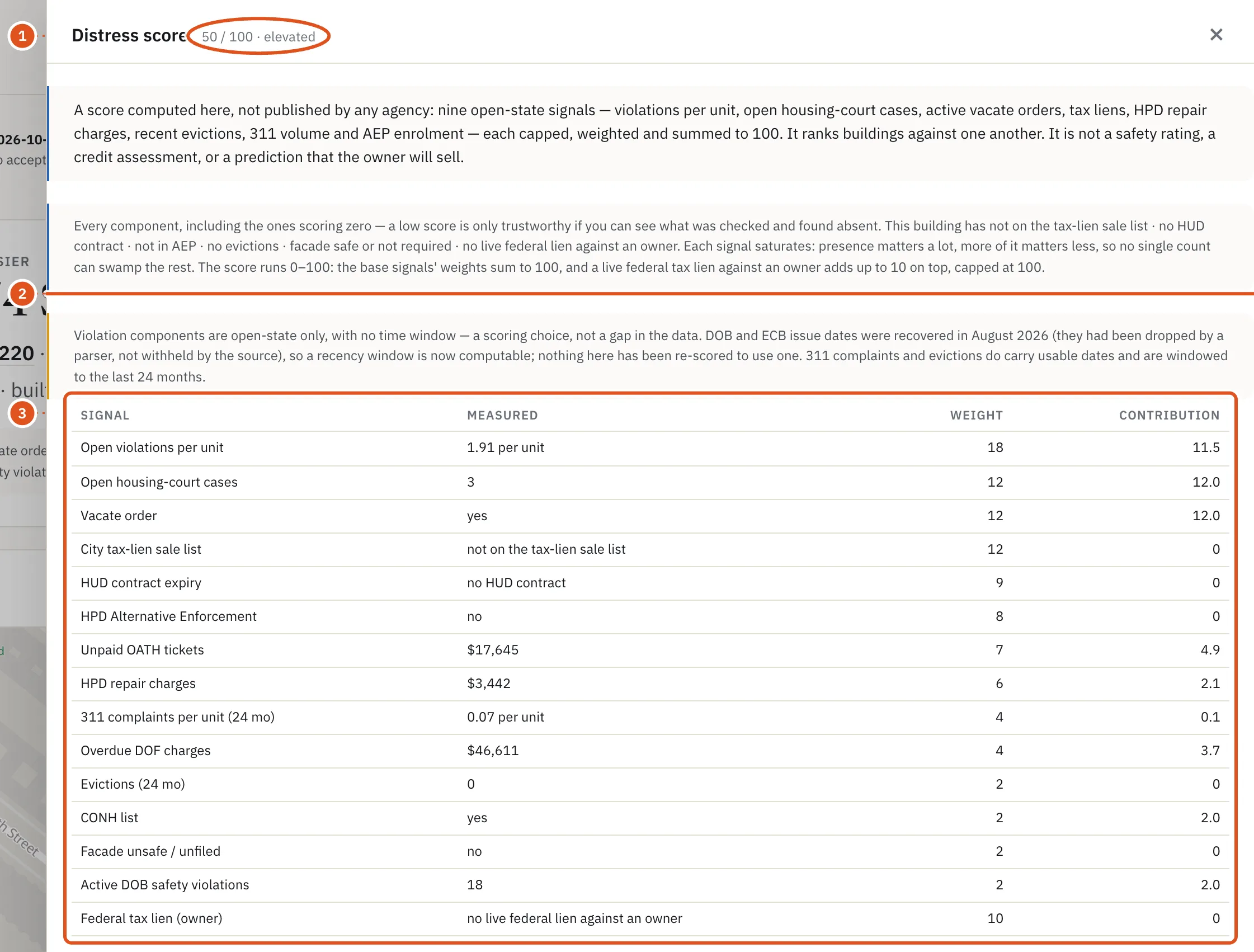
- The score and its band
- What was checked
- Every component
How open violations are counted
Violations come from three agencies: HPD (Housing Preservation and Development), DOB (the Department of Buildings) and ECB (the Environmental Control Board, whose cases are now heard at OATH). Each spells "open" its own way, and most violations ever issued have since been closed. BlockLot counts only open violations in the score and in the badge. Counting every row would rank a building by its history rather than its current condition. The full history is still in the Violations drawer, with open rows first.
Compliance & distress signals
This card gathers what is open or owed on the lot right now. Each line appears only when there is something to report:
- Overdue property charges owed to DOF, with the oldest due date.
- Unpaid OATH tickets, with how many have a court judgment docketed.
- Open DOB complaints and Open HPD complaints.
- Active DOB safety violations.
- Facade (FISP), the latest facade inspection status.
- Boiler inspections with defects or civil penalties due, and Elevators.
- Certification of No Harassment, when the building is on HPD's list. Demolition or major alteration then needs that certification first.
- LL159 relocation charges billed to the owner.
- Energy (LL84 / LL33), the building's energy grade.
When nothing is open, the card says so in one sentence and lists what it checked.
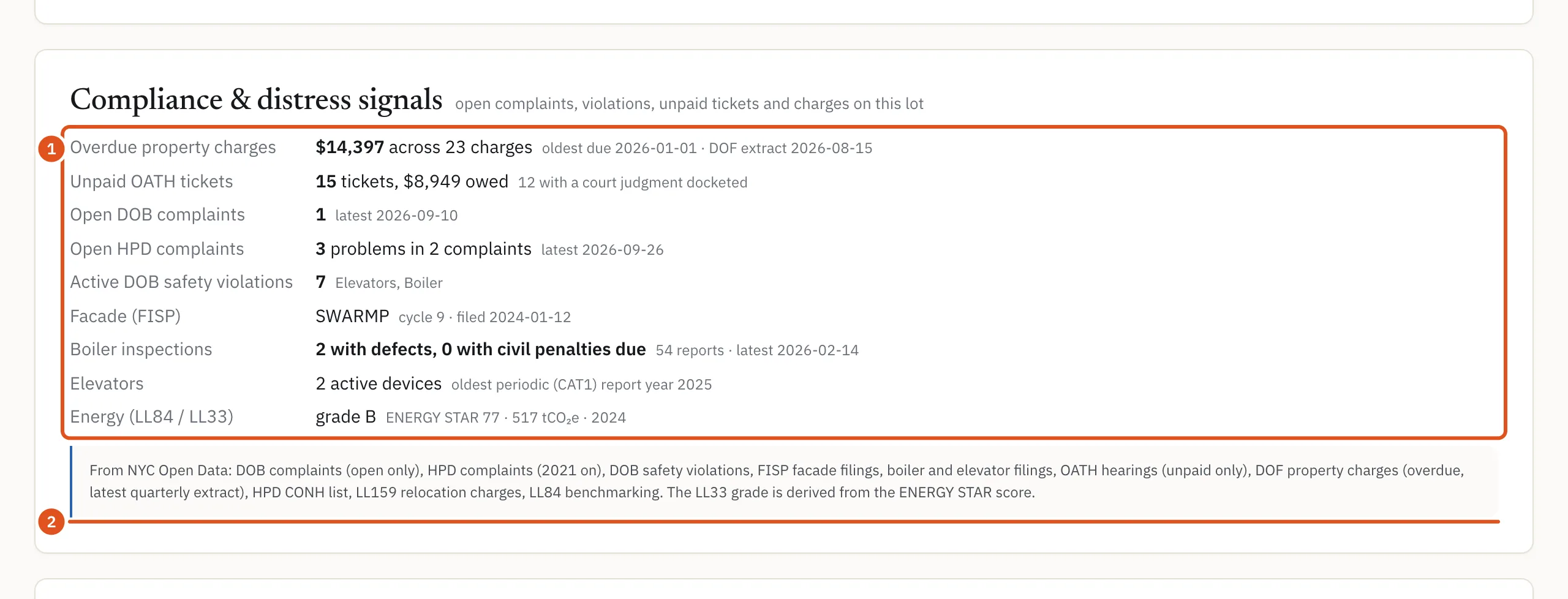
- Open or owed now
- Where each signal comes from
Foreclosure sales
In Sales history, a deed whose seller is a court-appointed referee carries the tag foreclosure sale (referee's deed). That is how a court-ordered foreclosure sale is recorded, and the buyer, often the foreclosing lender, owns the property after it. See Sales history, timeline and changes.
Federal tax liens
A federal tax lien is the IRS's claim against a taxpayer for unpaid federal tax. It is filed under that person's or company's name and address, never against a building. This card shows liens linked to the building in two ways, each under its own heading:
- Federal tax lien against an owner of this property: the debtor named on the lien matches a current owner, and the lien gives this address. A lien that names a person is shown without the name or the amount.
- Filed against someone at this address: only the address matches, on a one- to four-family house. It may be a tenant or a former resident, and it is not a lien on the property. No name or amount is shown.
The status describes the record: no release on record, or released with a date. A recently paid lien may not show its release yet. Liens past the IRS's 10-year limit are not shown. None found means no lien was linked by these rules. ACRIS does not hold Staten Island records, so there the card says Not covered.
Courts, vacate orders and evictions
The Distress group of the Records card opens the rows behind each signal: Violations, 311 complaints, Housing court (litigations), Vacate orders, FDNY vacate orders, HPD Alternative Enforcement, HPD repair charges, Tax liens, Evictions and Exemption removed. Each button shows the total ever recorded, and where a record can be open or closed it spells both out, such as "(3 open; 41 closed)" for violations or active and rescinded vacate orders.
Who sees what
Visitors who are not signed in and free accounts see the cards with values hidden, and the federal liens card asks them to sign in. With a plan, opening the building's full report counts once against your monthly allowance and shows everything here. To find buildings with these signals across the city, use Distressed buildings.