Learn NYC property · Violations and enforcement
HPD emergency repairs, repair charges and 7A administrators
How HPD's Emergency Repair Program fixes hazards an owner ignores and bills the owner, how repair charges become liens, and what a 7A administrator does.
When an owner does not fix a dangerous condition in time, the City's Department of Housing Preservation and Development (HPD) can fix it instead — and send the owner the bill. That is HPD's Emergency Repair Program, or ERP. It is how a tenant without heat gets heat back when the landlord will not act, and it is why a building's tax bill can carry charges for a door, a boiler repair or a lead-paint cleanup the owner never ordered.
For a buyer or lender, HPD's repair charges matter because unpaid ones become a tax lien on the property, which stays with the building when it is sold.
When HPD steps in
ERP acts on immediately hazardous conditions the owner has not corrected: HPD's own Class C violations and orders, DOB's emergency orders and declarations, some elevator violations, and Health Department orders. A Class C violation usually gives the owner 24 hours to correct it, and heat and hot water none at all (see HPD violations).
ERP is busy. In fiscal year 2026 HPD issued 278,252 Class C violations and started the emergency repair process for 63% of them. Owners corrected about half of those violations themselves and HPD corrected 8%; ERP work reached 200,631 apartments, up 13% in a year, mostly because of repairs to self-closing doors in public halls.
Who does the work
HPD gives the job either to a private contractor or to its own staff. An Open Market Order (OMO) is work contracted out — to a contractor from HPD's pre-qualified list, for up to $100,000 a job (demolitions can cost more). A Handyman Work Order (HWO) is work done by HPD's own crews. Both record what was ordered, at which building, and its cost. HPD also arranges electricity and heating fuel for buildings left without them, and seals or demolishes buildings DOB declares an emergency.
HPD warns owners that its repairs can cost much more than the owner would pay: City procurement, contracting and wage rules apply to every job.
By BlockLot Intelligence's count of HPD's records, HPD gave contractors 23,948 Open Market Orders in the last 12 months, worth $64,494,116, at 11,115 buildings. The typical order is small — a median $675 — but a few demolitions are very large: 89 of them came to $25,461,097.
Open Market Orders HPD gave to private contractors in the last 365 days, by the kind of work. HPD's own Handyman Work Orders and its 7A loans are not in the bars. BlockLot Intelligence, computed October 11, 2026.
Most orders are general repairs — doors, windows, window guards, seal-ups — and lead-paint work. These are the amounts awarded to contractors; the bill an owner receives adds HPD's administrative fee and sales tax.
How repair charges are billed
HPD repair charges — emergency repair charges, on most statements — are the cost of the work HPD ordered, or of a contractor's attempt to do it, plus HPD's fees. The Department of Finance bills them on the property's statement of account, labelled as Emergency Repair Program, Alternative Enforcement Program or demolition charges. HPD must record every repair order within 30 days in a public record by building, which counts as notice to everyone, a buyer included.
- Interest. An unpaid charge earns interest from its due date, at the higher of 7% a year or the rate on overdue property tax.
- Lien. It becomes a tax lien on the building and lot, ranking ahead of everything except taxes, and can be sold in the City's tax lien sale or foreclosed. An owner of a one- to three-family home who lives there and owes only repair charges can ask to be left out of a sale for a year.
- Paperwork blocked. While HPD charges are pending at the Department of Finance, the owner cannot certify violations or request a dismissal inspection.
- Disputes. An owner who disagrees must send HPD a written objection by the payment due date on the statement. Miss the date and the charge can no longer be contested anywhere.
A worked example
A 26-unit walk-up on Creston Avenue in the Bronx, owned by a company, shows what ordinary ERP work looks like. Between September 2024 and January 2025 HPD's records show it sending contractors to the building six times: to install window guards in two apartments, to fit a new fire-rated entrance door to one apartment for $1,800, and to test lead dust samples for $25 to $50 a time. None of these is dramatic, and each completed order comes back to the owner as a charge on the property's statement, with HPD's fees on top.
The Underlying Conditions Program
Some buildings keep generating the same violations — leaks, mold — because of a deeper problem in the building itself. Under the Underlying Conditions Program (Local Law 6 of 2013) HPD selects roughly 50 to 100 such buildings a year and orders the owner to fix the cause within four months, extendable by two. If the owner does not, HPD can do the work itself, bill it like any repair charge, and impose a penalty of $1,000 per apartment, at least $5,000.
7A administrators
When a building is so neglected that its tenants' life, health or safety is in danger and the owner will not act, Housing Court can take its management away from the owner and give it to a 7A administrator — named after Article 7-A of the State's Real Property Actions and Proceedings Law. One-third or more of the tenants, or HPD, can ask for one, on grounds such as no heat, water, light or electricity, rodents, or harassment, lasting at least five days.
The administrator — an organization on HPD's approved list, never the owner — collects the rents and uses them first for the repairs the court ordered, then its own fee, then the City's tax liens and emergency repair liens, with anything left over going to the owner. Through its 7A program, HPD can also lend money for major repairs (7A Financial Assistance); that money becomes a debt of the owner and a lien on the building. The court releases the building back to the owner only once the owner has paid, or agreed to pay, the City's tax, emergency repair, Alternative Enforcement Program and 7A liens. In fiscal year 2026, 52 apartments left 7A administration or a 7A consent order.
Where you see this in BlockLot
On a building's page, HPD repair charges lists every Open Market Order and Handyman Work Order HPD recorded at the building: the date, the kind of work, the amount and HPD's description of the job. The building's distress score counts its repair charges, and an area's page counts the lots carrying them.
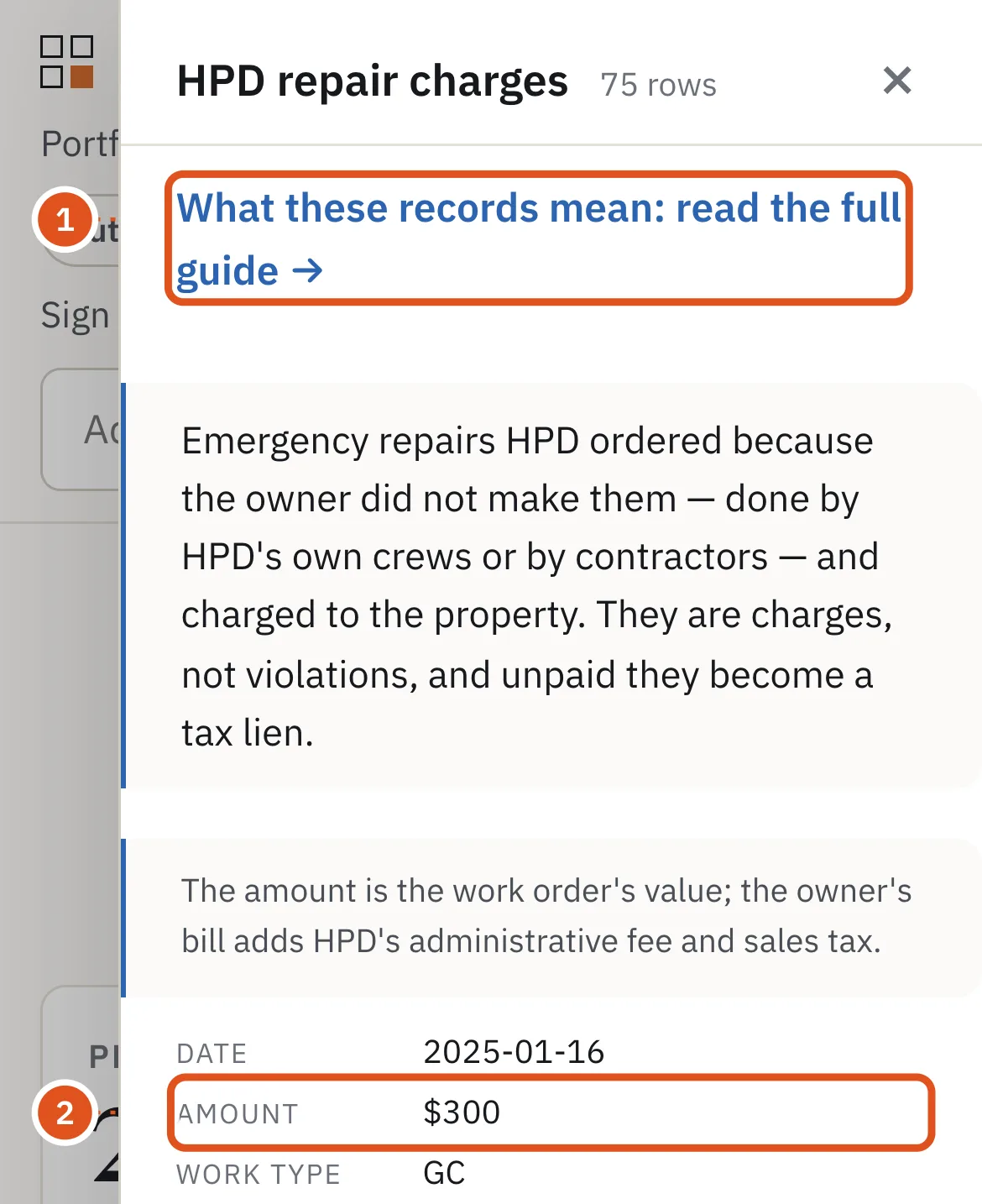
- Leads to this page
- What the work order cost
Questions people ask
What is an HPD emergency repair charge? The cost of a repair HPD made because the owner did not — plus HPD's fees — billed to the owner by the Department of Finance. Unpaid, it becomes a tax lien on the property.
Can HPD really fix my building and bill me? Yes. When an immediately hazardous condition is not corrected in time, the Housing Maintenance Code lets HPD do the work through its own crews or a contractor and charge the building.
How do I dispute an ERP charge? Send HPD a written objection by the payment due date on your Department of Finance statement. If you miss that date, the law does not let you contest the charge later.
Do repair charges stay with the building when it is sold? Yes. They are a lien on the building and lot, ahead of everything but taxes, and HPD's public record of repair orders counts as notice to a buyer.
What is a 7A administrator? A manager Housing Court appoints to run a dangerously neglected building in the owner's place, collecting rents to pay for repairs, until the owner settles the City's liens.
Related
- HPD violations: Class A, B, C and I — What HPD housing violations are, what Class A, B, C and I mean, how long an owner has to fix and certify each, how a violation is closed or dismissed, and what happens when a Class C is ignored.
- The Alternative Enforcement Program (AEP) — How HPD picks 250 distressed buildings a year for its Alternative Enforcement Program, the four months to act, the fees and orders, and discharge.
- Housing Court, HP actions and HPD litigation — Housing Court for owners and buyers: HP actions, the cases HPD brings, harassment findings, marshal evictions and HPD's Speculation Watch List.
- Vacate orders: HPD, DOB and FDNY, and who pays for relocation — HPD, DOB and FDNY vacate orders: partial or full, how they are lifted, tenants' rights, and the relocation charges an owner can be billed.
Sources
- BlockLot Intelligence — BlockLot's own analysis of the public records below, computed October 11, 2026.
- HPD — Emergency Repair Program
- HPD — Disputing charges at HPD
- HPD — Penalties and fees
- HPD — Emergency repair contractors (pre-qualified list)
- HPD — Underlying Conditions Program (Local Law 6 of 2013)
- HPD — 7A Program
- NYC Housing Maintenance Code (HPD's published text, §§27-2125 to 27-2147)
- DOF — Property tax lien sale
- NYS Real Property Actions and Proceedings Law §770 (7A petitions)
- NYS Real Property Actions and Proceedings Law §778 (7A administrators)
- Mayor's Management Report, Fiscal 2026 — HPD
- NYC Open Data — HPD Open Market Order (OMO) Charges
- NYC Open Data — HPD Handyman Work Order (HWO) Charges