Learn NYC property · Building systems and inspections
Facade inspections (FISP, Local Law 11) and sidewalk sheds
How New York City's Facade Inspection & Safety Program works — which buildings, who inspects, the Safe, SWARMP and Unsafe ratings, the cycles and their 2025 changes, penalties, and why sidewalk sheds stay up.
The Facade Inspection & Safety Program (FISP) is New York City's rule that every building taller than six stories must have its outside walls examined, up close, by a licensed architect or engineer on a fixed schedule, and the result filed with the Department of Buildings (DOB). Most people still call it Local Law 11, after the 1998 law that shaped it. DOB says its facade inspections cover almost 16,000 buildings.
The program exists because pieces of buildings fall. It began as Local Law 10 of 1980, passed after a college student was killed in 1979 by masonry falling from a building in Morningside Heights. Local Law 11 of 1998 widened the inspection from the street walls to every wall, required hands-on inspection from a scaffold, and introduced the three ratings used today. Stronger rules — closer inspection and higher penalties — took effect on February 20, 2020.
Which buildings, and who inspects
A building is covered if it is taller than six stories — counting a cellar as a story when more than half of it stands above the ground at any outside wall. All its exterior walls and the things attached to them are covered, except wall within 12 inches of a neighboring building. There is no other exemption.
The inspection is made by a Qualified Exterior Wall Inspector (QEWI): a New York State licensed architect or professional engineer with at least seven years of relevant experience with facades of buildings over six stories. Since February 20, 2020 the inspector must examine the walls close up — from a scaffold dropped at least every 60 feet of facade facing a street. A drone may help, but DOB's rule says it does not replace the close-up inspection. The report is due within 60 days of the inspection.
By BlockLot Intelligence's count, the reports of the last two cycles were filed a median 15 days after the inspection.
The ratings
A building takes its worst condition: one unsafe spot makes the whole building unsafe.
- Safe — nothing needs repair, and nothing is expected to become unsafe before the next inspection.
- SWARMP — safe with a repair and maintenance program: safe now, but with conditions that need repair. The inspector sets a completion date between one and five years away. A SWARMP condition cannot be SWARMP twice: if it is still there at the next inspection it must be reported unsafe, and the owner owes a $2,000 penalty.
- Unsafe — a condition dangerous to people or property, an unsafe facade. The inspector reports it to DOB at once, the owner must put up protection immediately — a sidewalk shed, a fence or netting — and the repairs are due within 90 days, with extensions possible for the scope of the work but not for money. After the repair the inspector files an amended report, and only then may the shed come down.
- No Report Filed — DOB's own entry for a building that missed its window. It counts against the owner like a rating, with penalties every month.
The owner must post the result in the lobby within 30 days of filing.
How the last cycle came out
Cycle 9 covered 16,523 buildings. By their latest report, 41.4% are rated safe, 35.9% SWARMP and 9.0% unsafe, and 13.8% never filed, by BlockLot Intelligence's count of DOB's filings.
Every building with a cycle-9 facade filing in DOB NOW: Safety, by the rating its latest report gave it. "No report filed" is DOB's own entry for a building that missed its window. BlockLot Intelligence, computed October 10, 2026.
Repairs take far longer than the 90 days the rule sets. Of the buildings whose initial report rated them unsafe between October 11, 2020 and October 10, 2024, 69.9% have since filed a report saying the facade is safe again — a median 567 days (about 19 months) after the unsafe report. The rest are still unsafe on paper.
Buildings whose initial facade report rated them unsafe 2 to 6 years ago and that have since filed a report rating them safe or safe with a repair program: days between the two reports. Facades never reported repaired are not in the bar. The bar ends at the median; the pale band covers the middle half. BlockLot Intelligence, computed October 10, 2026.
The cycles, and the 2025 changes
So far the rule has required one report every five years, filed within a two-year window set by the last digit of the building's block number: sub-cycle A for blocks ending in 4, 5, 6 or 9; B for 0, 7 or 8; C for 1, 2 or 3. Cycle 10, the current one, runs from February 21, 2025 to February 21, 2030: window 10A closes on February 21, 2027, 10B on February 21, 2028 and 10C on February 21, 2029. Owners whose last status is No Report Filed may file a safe or SWARMP report early to stop penalties running. By BlockLot Intelligence's count, 2,816 buildings have filed for cycle 10 so far, and 25.1% of those initial reports rated the building unsafe.
Local Law 49 of 2025 took effect on October 1, 2026. It replaces the fixed five years with an interval DOB sets by rule, between 6 and 12 years, and moves a new building's first inspection to its eighth year. In March 2026 the Mayor's Office announced that DOB will move to a six-year cycle, with a 12-year track for lower-risk, well-kept buildings. As of October 9, 2026 the rule has not been adopted: DOB's rule and its web pages still say every five years, and Cycle 10's windows stand.
Penalties
| Failure | Penalty |
|---|---|
| Not filing | $5,000 a year |
| Filing late | $1,000 a month |
| Not fixing an unsafe facade | $1,000 a month, plus a shed surcharge |
| Not fixing a SWARMP condition | $2,000 |
The amounts have applied since February 20, 2020. The surcharge for an unsafe facade left unrepaired grows with the shed: $10 per linear foot of shed a month in the second year, rising to $40 in the fifth. Filing a report costs $425 in DOB NOW: Safety.
Sidewalk sheds
A sidewalk shed is the covered walkway of steel or wood put up over a sidewalk to catch anything that falls. A shed is required over the sidewalk when a building over 40 feet is being built or a building over 25 feet demolished, and when a facade is unsafe. The City's 2023 Get Sheds Down plan counted about 9,000 sidewalk sheds averaging nearly 500 days, a plurality of them for facades.
The Get Sheds Down laws of 2025 changed the rules. Local Law 47 sets the colors, a minimum ceiling height of 12 feet and brighter lighting. Local Law 48 limits a shed permit to 90 days, and from the second renewal charges an owner whose repair work is not under way — $10 per linear foot a month for a shed under three years old, $100 for three to four years, $200 after that, up to $6,000 a month. Local Law 51 adds milestones for sheds put up for an unsafe facade after January 12, 2026: plans within 5 months, a repair permit within 8, the repair finished within 2 years. New buildings, enlargements and demolitions are exempt from the renewal penalties.
On August 17, 2026 the City counted 7,427 permitted sheds, more than 1,000 fewer than a year earlier. By BlockLot Intelligence's count of DOB's permits, 6,711 sheds are standing today; half have stood for more than about 11 months, and 318 have stood for more than five years.
Sidewalk-shed jobs in DOB NOW with an unexpired permit and no permit signed off, by the time since the first permit was issued. BlockLot Intelligence, computed October 11, 2026.
A worked example: the Empire State Building
The Empire State Building, owned by a company, is on block 835, so it files in sub-cycle A. Its facade history in DOB's filings shows the ratings at work: an unsafe initial report in December 2006, amended to SWARMP two months later; SWARMP reports in cycles 7, 8 and 9 (filed 2012, 2019 and 2022); and, in August 2026, a cycle-10 report rating the building safe — filed in the first half of its window, which closes in February 2027.
Where you see this in BlockLot
A building's Compliance & distress signals card shows its latest facade filing: the rating, the cycle and the date filed. An unsafe rating or No Report Filed is shown in bold. Area pages count the buildings by their latest facade rating, and the sheds appear among the area's permits.
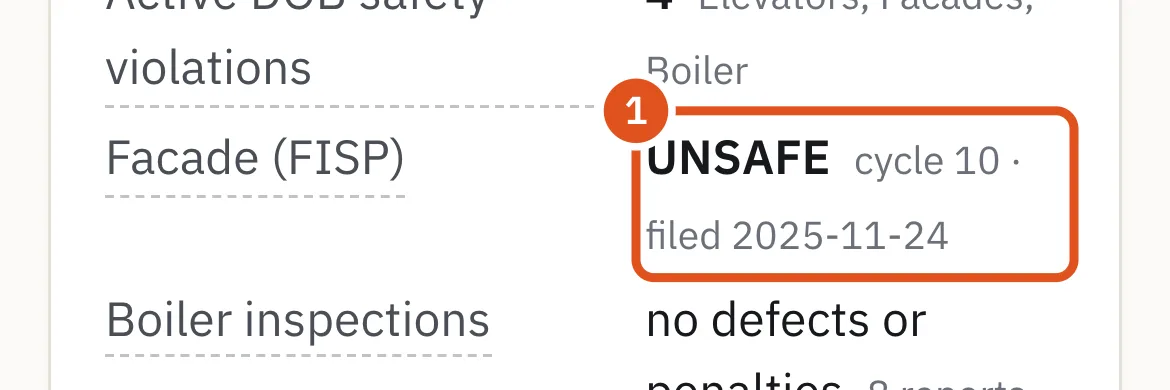
- The latest rating, cycle and filing date
Questions people ask
What is Local Law 11? The common name for the Facade Inspection & Safety Program: buildings over six stories must have their facades inspected close up by a licensed architect or engineer and the report filed with DOB.
How often are facade inspections? Every five years under the rule in force on October 9, 2026. Local Law 49 of 2025 lets DOB set an interval of 6 to 12 years, and the City has announced a move to six years, but no rule has been adopted yet.
What does SWARMP mean? Safe with a repair and maintenance program: safe now, with repairs due by a date the inspector sets. If the condition is still there at the next inspection, it must be reported unsafe.
Why has this sidewalk shed been up for years? A shed put up for an unsafe facade must stay until the repair is done and DOB accepts an amended report. By BlockLot Intelligence's count, unsafe facades take a median about 19 months to be reported repaired. The 2025 laws add monthly penalties for sheds whose repair work is not moving.
Who pays for the shed and the inspection? The owner. Every requirement and every penalty in the rule falls on the owner.
Does a drone inspection count? Drones can help, but DOB's rule says they do not replace the close-up inspection from a scaffold.
Related
- Department of Buildings (DOB) — What New York City's Department of Buildings does, how a building permit works from filing to sign-off, what a Certificate of Occupancy is, and how DOB violations and stop work orders are issued and cleared.
- Gas piping inspections (Local Law 152) and parapet inspections — New York City's Local Law 152 gas piping inspections — which buildings, who inspects, the community-district schedule, the 60-day filing, corrections and penalties, the 2025–2026 changes — and the yearly parapet observation.
- Construction sites: after-hours work, fences, stalled sites and city projects — The rules a New York City construction site follows next door — permitted work hours and after-hours variances, construction fences and sheds, what happens when a job stalls, and the city's school construction projects.
- DOB violations and ECB summonses: classes, cures and penalties — DOB violations and ECB summonses explained: Class 1, 2 and 3, cures, penalties and defaults, and why paying a fine does not close a violation.
- Certificate of Occupancy, temporary CO, Letter of No Objection and Letter of Completion — What a New York City Certificate of Occupancy says, when a building needs one, how temporary COs are renewed until the final one, and what a Letter of No Objection or a Letter of Completion is for.
Sources
- BlockLot Intelligence — BlockLot's own analysis of the public records below, computed October 11, 2026.
- DOB — Facade Inspection & Safety Program (FISP)
- DOB — Facade compliance
- DOB — Facade fees and penalties
- DOB — FISP rule, 1 RCNY §103-04
- DOB — 1 RCNY §103-04 promulgation history
- DOB — Qualified Exterior Wall Inspector, 1 RCNY §101-07
- DOB — Cycle 10 service notice (February 2025)
- DOB — Cycle 10 filing windows
- DOB — Cycle 10 early filing, service notice (December 2025)
- DOB — FISP statistics
- DOB — FISP history presentation (2021)
- DOB — FISP Recommendations Report (December 2025)
- Local Law 49 of 2025 (inspection intervals)
- Local Law 47 of 2025 (shed design)
- Local Law 48 of 2025 (shed permits and penalties)
- Local Law 51 of 2025 (facade repair milestones)
- City Council — Get Sheds Down package (March 26, 2025)
- DOB — Sidewalk shed permits, service notice (January 2026)
- Mayor's Office — sidewalk shed plan (March 6, 2026)
- Mayor's Office — sidewalk shed update (August 20, 2026)
- Mayor's Office — Get Sheds Down plan (July 24, 2023)
- DOB — Sidewalk sheds
- DOB — Active sidewalk shed map
- NYC Open Data — DOB NOW: Safety Facades Compliance Filings