Learn NYC property · Deeds, mortgages and sales
UCC filings, federal tax liens, mechanic's liens and other liens on property
The claims besides mortgages that can sit on a New York City property — UCC financing statements on co-op loans and fixtures, IRS federal tax liens, mechanic's liens, condominium common-charge liens and judgments — where each is filed, how long it lasts and how it ends.
A lien is a creditor's legal claim against property, as security for a debt: until the debt is paid, the claim stays with the property, and the creditor may be able to force a sale to collect. A mortgage is a lien the owner agrees to. The others on this page are claims a lender records on personal property, or that the law gives to the IRS, to a contractor, to a condominium board or to someone who won a court case.
A buyer's title search looks for every one of them, because a lien can survive a sale. Where each is filed decides where you can find it — and in New York City, that is not always ACRIS.
Documents the City Register recorded in the twelve months to the newest recording published, in Manhattan, the Bronx, Brooklyn and Queens. Most UCC filings go to the State's Department of State and are not here; mechanic's liens and judgments are filed with the County Clerk. BlockLot Intelligence, computed October 10, 2026.
UCC financing statements
A UCC financing statement — a UCC-1 — is a lender's public notice that it holds, or may hold, a security interest in a debtor's personal property: equipment, inventory, shares. The name comes from Article 9 of the Uniform Commercial Code, the State law that governs these loans. The financing statement is the notice, not the loan, and it never says how much is owed. Later changes are filed as a UCC-3: a continuation, an amendment, an assignment to another lender, or a termination.
Most UCC filings in New York go to the State's Department of State. Two kinds go to the office that records mortgages — in Manhattan, the Bronx, Brooklyn and Queens, the City Register — and so appear in ACRIS against a block and lot:
- Co-op loans. A co-op apartment is not real property: the owner holds shares in the building's corporation and a lease on the apartment. So a co-op loan is secured by a UCC filing on those shares, not by a mortgage, and pays no mortgage recording tax. It is filed against the building's lot, with a cooperative addendum naming the apartment.
- Fixture filings. A fixture filing covers equipment that becomes part of a building — a boiler, an elevator, solar panels — financed separately from the building itself.
A financing statement lapses five years after it is filed unless the lender files a continuation in the last six months, which adds five more years. A co-op loan filed with a cooperative addendum lasts fifty years. When a co-op loan is paid off at a sale or a refinance, the lender must bring a termination to the closing if the borrower asks; paid off any other way, it must file one within a month.
By BlockLot Intelligence's count, in the twelve months to September 25, 2026 the City Register recorded 9,849 co-op loan filings and 11,759 other UCC-1s, and 22,419 terminations.
Federal tax liens
A federal tax lien is the government's claim against everything a taxpayer owns, once the IRS has assessed a tax, sent a demand for payment, and the taxpayer has not paid. It arises by law and covers all the taxpayer's property — real estate, financial accounts, property acquired later. To warn other creditors, the IRS files a public Notice of Federal Tax Lien. New York's Lien Law sends notices on real property in the four ACRIS boroughs to the City Register, which is why they are in ACRIS, and Staten Island's to the Richmond County Clerk.
The lien is filed against a person or company, not a building: it names the taxpayer and the taxpayer's address. It attaches to a property only because the taxpayer owns it, so a lien naming someone at an address says nothing about the building unless that someone owns it.
Because of that, BlockLot shows a Federal tax lien against an owner on a building's page only when the taxpayer's name matches a current owner of the building and the lien's address is the building's address — our reading of the record, matched on both. The distress score's breakdown counts the same match as Federal tax lien (owner). On a building of one to four homes, a lien filed at the address but not matched to an owner is shown as that and nothing more, without the name.
How it ends:
- Release. The IRS must release the lien within 30 days after the tax is paid, becomes legally unenforceable, or a bond is accepted, and files a certificate of release where the notice was filed. A release ends the lien, not the debt.
- Self-release. The IRS generally has ten years from the assessment to collect. The notice carries a last day for refiling, ten years and thirty days after the assessment; if the IRS does not refile by then, the lien releases itself, with no new document on the record.
- Discharge, withdrawal, non-attachment. A certificate of discharge frees one property from the lien, so it can be sold; a withdrawal removes the public notice but not the lien; a certificate of non-attachment tells the world that a lien naming a similar name does not reach someone else.
How long it takes, by BlockLot Intelligence's count of ACRIS's records:
Top: liens filed in the last twelve months, from the IRS's assessment date written on the lien to its filing. Bottom: liens filed in 2015–2019, for those with a recorded release, from filing to release. The bar ends at the median; the pale band covers the middle half. BlockLot Intelligence, computed October 10, 2026.
Of the 3,364 federal tax liens filed in the twelve months to September 25, 2026, the median was for $68,549, and the IRS had assessed the tax a median about 9 months before filing. Of the liens filed in 2015–2019, 43.0% have a release on record, 32.1% within five years. The rest have no release on record: some are still being collected, and a lien the IRS does not refile lapses on its own, with no document.
Mechanic's liens
A mechanic's lien is the claim of someone who improved a property and was not paid: a contractor, a subcontractor, a laborer, a supplier of materials. The work must have been done with the owner's consent or at the owner's request, directly or through a contractor.
- It is filed with the County Clerk of the county where the property is — not with the City Register, so it is not in ACRIS. The City's Department of Finance handles liens only on City public-works projects.
- It must be filed during the work or within eight months after the last work or materials — four months for a single-family home — and served on the owner.
- It lasts one year, unless the contractor sues to foreclose it, or files an extension (on a single-family home, a court must order it).
- It can be discharged by a release, by a bond of 110% of the claim, by a court order, or by running out of time.
Condominium common-charge liens
A Condo common-charge lien is the board's claim on a unit for unpaid common charges — the unit's share of the building's costs — plus interest. A condominium's board has this lien by law, and a common-charge lien ranks ahead of every other claim on the unit except tax liens and a first mortgage of record. It takes effect when the board files a sworn notice where the condominium's declaration is recorded, so in the four ACRIS boroughs it appears in ACRIS. It lasts six years, and the board may foreclose it the way a lender forecloses a mortgage, after 90 days' notice.
In the twelve months to September 25, 2026 the City Register recorded 1,498 of them, by BlockLot Intelligence's count.
Judgments
A court judgment for money becomes a judgment lien on the debtor's real property in a county once it is docketed with that county's clerk, and lasts ten years. Like mechanic's liens, judgments are kept by the County Clerk, not in ACRIS. City tax and water debts are liens of their own, sold in the tax lien sale.
Where you see this in BlockLot
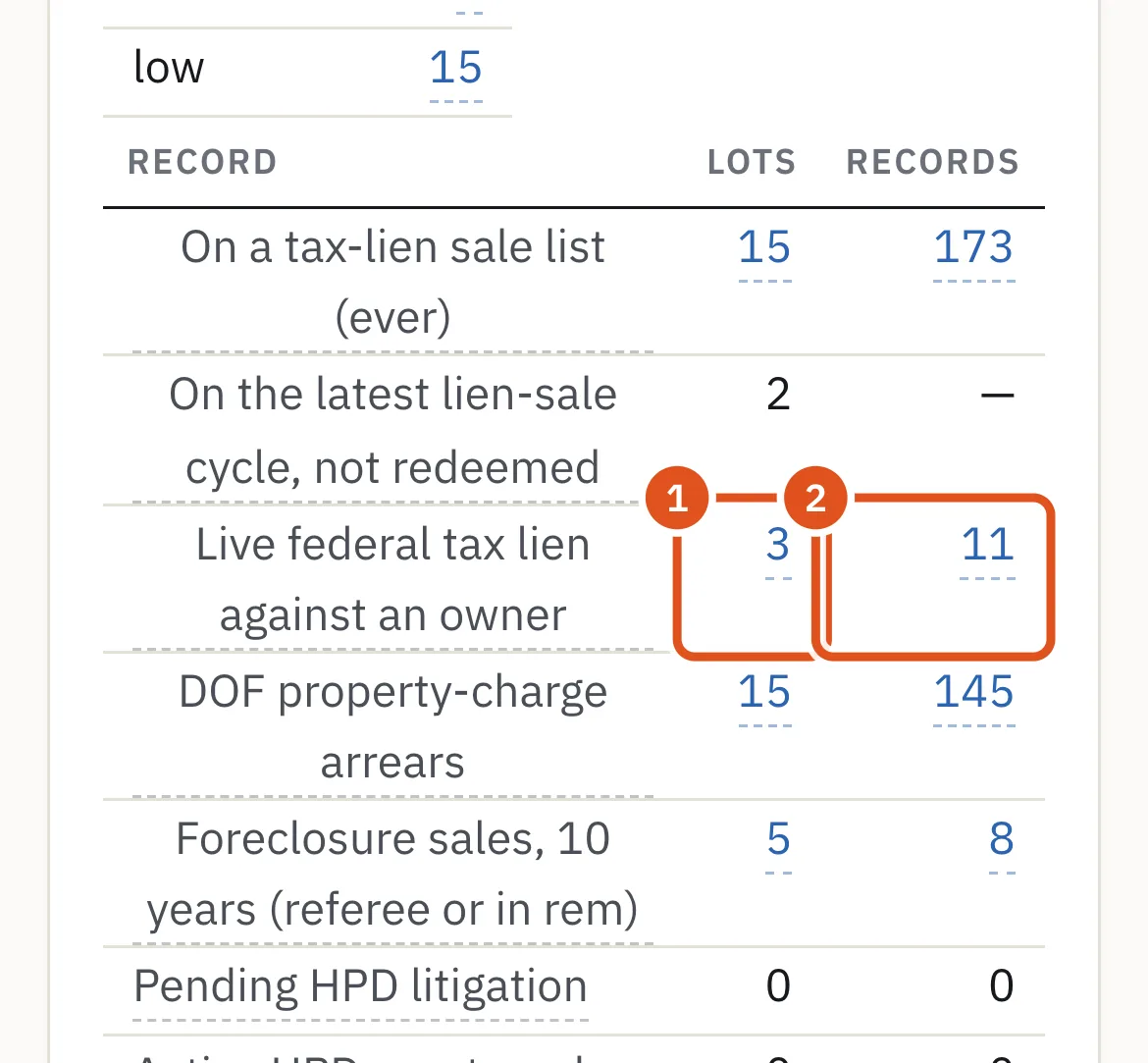
A building's page has a UCC financing statements section listing the co-op loans and fixture filings recorded against its lot, and a Federal tax liens section linking liens to the property only when the taxpayer is an owner of it, or — on a small building — when the lien names the building's address. Each says, where a feed does not cover Staten Island, that it cannot show it. An area's page counts the lots with federal tax liens in its Liens, distress and legal table.
- Lots
- Liens
Questions people ask
Can I search for liens on a property in New York City? Mortgages, co-op loans, fixture filings, federal tax liens and condominium liens are in ACRIS, searchable by block and lot. Mechanic's liens and judgments are with the County Clerk of each borough, and most UCC filings are with the State's Department of State. A title search covers all of them.
Does a federal tax lien go away? Yes — when the tax is paid, the IRS must release it within 30 days; and if the IRS does not refile it, it releases itself ten years and thirty days after the assessment.
Why is there a UCC filing on my co-op building? Each co-op apartment loan is filed as a UCC financing statement against the building's lot, because a co-op owner holds shares rather than real property. A large co-op can carry thousands of them, one per loan.
How long does a mechanic's lien last in New York? One year from filing, unless the contractor starts a lawsuit to foreclose it or extends it. It must be filed within eight months of the last work, or four months on a single-family home.
What happens if a condo owner stops paying common charges? The board can file a lien on the unit, which ranks ahead of almost everything but taxes and the first mortgage, and can foreclose it like a mortgage.
Is a lien the same as a judgment? No. A judgment is a court's decision that money is owed; once it is docketed with the County Clerk, it becomes a lien on the debtor's real property in that county.
Related
- Mortgages, satisfactions, assignments and CEMAs — What a mortgage is and who the mortgagor and mortgagee are, the mortgage recording tax, and the documents that follow a loan in ACRIS — assignments when it is sold, CEMAs when it is refinanced, satisfactions when it is paid off — plus reverse mortgages, HMDA and loan-to-value.
- Foreclosure in New York: from the 90-day notice and lis pendens to the referee's deed — How a foreclosure works in New York, a judicial state — the 90-day pre-foreclosure notice, the lawsuit and its lis pendens, the settlement conference, the judgment and the referee's auction, the referee's deed — plus deeds in lieu, short sales, tenants' rights and how often foreclosure sales happen in New York City.
- Overdue property charges, interest and the tax lien sale — Overdue NYC property charges: late interest for FY 2026/27, payment plans, how the tax lien sale works, and why there was no sale in 2026.
- Deeds in New York City: the kinds of deed, and grantor and grantee — What a deed is, the kinds New York law describes — bargain and sale, quitclaim, executor's, referee's — transfer-on-death and life estate deeds, who the grantor and grantee are, and what party 1 and party 2 mean on any document in ACRIS.
- ACRIS and the City Register: where deeds and mortgages are recorded — What the Office of the City Register records, what ACRIS is and how to search it, how long a deed or mortgage takes to reach the record, what is not in ACRIS — Staten Island, lis pendens, records before 1966 — and how owners can be alerted when something is recorded against their property.
Sources
- BlockLot Intelligence — BlockLot's own analysis of the public records below, computed October 10, 2026.
- DOF — UCC financing statements and recording fees
- NYS Department of State — File a UCC financing statement
- NYS Department of State — Filing under Article 9 of the UCC
- New York UCC § 9-501 (where a financing statement is filed)
- New York UCC § 9-515 (how long a financing statement lasts)
- New York UCC § 9-513 (termination statements)
- IRS — Understanding a federal tax lien
- IRS — Internal Revenue Manual 5.17.2, federal tax liens
- IRS — Internal Revenue Manual 5.12.3, lien release
- IRS — Publication 1450, requesting a certificate of release
- New York Lien Law § 240 (where federal liens are filed)
- New York Lien Law § 3 (who may file a mechanic's lien)
- New York Lien Law § 10 (filing a mechanic's lien)
- New York Lien Law § 17 (how long a mechanic's lien lasts)
- New York Lien Law § 19 (discharging a mechanic's lien)
- DOF — Public improvement liens
- New York Real Property Law § 339-z (the condominium's lien)
- New York Real Property Law § 339-aa (filing and foreclosing it)
- New York CPLR § 5203 (a judgment as a lien on real property)
- NYC Open Data — ACRIS Personal Property Master