Learn NYC property · Agencies and the basics
Department of Finance (DOF)
What New York City's Department of Finance does for property — the yearly assessment roll, the property tax bill and its calendar, the City Register that records deeds and mortgages, the transfer taxes, exemptions and the charges other agencies put on a property's account.
The Department of Finance, or DOF, is the New York City agency that collects the City's taxes and keeps its property records. For property it does four things: it values every lot in the city each year, it bills and collects the property tax, it records deeds and mortgages through the Office of the City Register, and it runs the tax exemptions and abatements that lower an owner's bill.
DOF does more than property — business taxes, parking tickets, the City's bank accounts, and the Sheriff, who enforces court orders and investigates deed fraud — but for anyone who owns, buys or lends against a building, its property work is what matters.
The assessment roll
The assessment roll, often called the tax roll, is DOF's list of every property in the city with its market value, its assessed value, its tax class and its exemptions. DOF publishes it twice a year: a tentative roll in mid-January and a final roll at the end of May. The final roll is what the year's tax is billed on.
DOF's official counts of the roll differ because they count different things: its annual report for fiscal year 2026 counted 1,157,301 parcels, 46,877 of them fully exempt; its general pages speak of about 1.1 million taxable properties; and in June 2026 the Commissioner told the Council the FY 2027 final roll covered more than 1.2 million. A condominium apartment is a parcel of its own, which is why the roll is larger than the city's count of lots in City Planning's file. The FY 2026/27 tentative roll valued the city at $1.659 trillion.
The Department of Finance's market values on the FY 2026/27 assessment roll, summed by BlockLot over every tax lot in each class that is not fully exempt, as DOF's own summary counts them. Class 3, utility property, is not shown. BlockLot Intelligence, computed October 9, 2026.
Market value explains how DOF arrives at a value, and Assessed value and property tax how a value becomes a bill.
The property-tax year
- January 5 — the taxable status date. A property's condition and use on this day set its value for the coming year.
- Mid-January — the tentative roll and the Notice of Property Value. DOF mails each owner a notice of the property's market value, assessed value and description. It is not a bill.
- March 1, or March 15 for class 1 — the appeal deadline. An owner who disagrees asks the NYC Tax Commission, a separate agency, to review the value. When the date falls on a weekend it moves to the next business day: in 2026 the deadlines were March 2 and March 16.
- End of May — the final roll.
- July 1 — the fiscal year begins, and with it the first payment.
The property tax bill is called the Statement of Account. It shows what is owed, how the tax was worked out, and the exemptions and credits applied, and it is mailed about four weeks before it is due. A property assessed at $250,000 or less pays quarterly, on July 1, October 1, January 1 and April 1, with 15 days' grace; above $250,000 the tax is due twice a year, on July 1 and January 1. An owner whose bank pays the tax from an escrow account gets no bill, unless other charges are due.
A worked example. The Empire State Building is owned by a company and taxed in class 4. On the FY 2025/26 roll its market value is $1,186,766,000, and its tax before abatements is $49,839,505, billed in two halves of $24,919,753.
Recording deeds and mortgages
DOF's Office of the City Register records the documents that create and transfer rights in property — deeds, mortgages, leases — for Manhattan, the Bronx, Brooklyn and Queens. They are filed and searched through ACRIS, which holds the four boroughs' records from 1966 on. Staten Island's documents are recorded by the Richmond County Clerk. See ACRIS and the City Register.
By BlockLot Intelligence's count, the City Register recorded 57,985 deeds and 46,203 mortgages in the twelve months to September 30, 2026. The Mayor's Management Report for fiscal 2026 says recording took 1.4 days on average, and 88.4% of recordings were made online.
Two taxes are paid through the City Register. The City's Real Property Transfer Tax is due on sales and transfers over $25,000 — including transfers of co-op shares and of half or more of a company that owns property — at 1% to 2.625% depending on the property and the price. The Mortgage Recording Tax, State and City combined, is charged when a mortgage is recorded; on Staten Island the County Clerk collects it.
Exemptions, abatements and other charges
DOF runs the City's property-tax benefits, among them the senior and disabled homeowner exemptions, veterans' and clergy exemptions, the co-op and condominium abatement, and the rent-freeze programs for seniors and people with disabilities. For J-51 and 421-a, HPD decides who qualifies and DOF applies the benefit. DOF no longer administers STAR: new applicants get a State credit instead, and only existing recipients keep the old City exemption.
A property's DOF account also carries other agency charges that DOF collects for the rest of the City: HPD's emergency repairs and registration fee, sidewalk repairs, some water and sewer items, Department of Buildings permit fees, fire inspection fees and Business Improvement District charges. DOF cannot change them; a dispute goes to the agency that made the charge. Unpaid property charges can be sold in the City's tax lien sale, which DOF runs; the mayor paused the 2026 sale for a review.
Looking a property up
- Property tax account — bills, payments and the balance, by borough, block and lot.
- Notices of Property Value — the current and past notices for a lot.
- Property Information Portal — DOF's digital tax map, with each lot's lines, history of changes and condominium units.
- ACRIS — recorded deeds, mortgages and other documents.
- Rolling sales and annual sales — DOF's own record of sale prices, for the last twelve months and back to 2003.
Where you see this in BlockLot
A building's Value & tax card shows DOF's market and assessed values, the tax class and the annual tax; under Records, Assessment history and Exemptions list the roll year by year, and Deeds & sales and Mortgages & liens show what the City Register recorded.
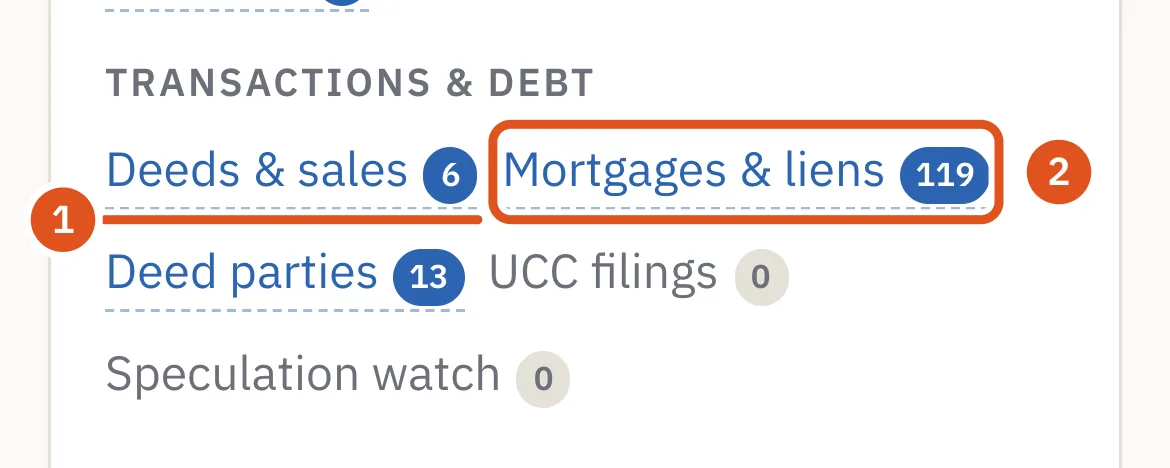
- Deeds, with their prices
- Mortgages, satisfactions and other documents
Questions people ask
What does the Department of Finance do? For property, it values every lot each year, sends the tax bills and collects the tax, records deeds and mortgages through the City Register, and runs exemptions such as the senior homeowner exemption.
When are New York City property taxes due? The fiscal year starts July 1. Properties assessed at $250,000 or less pay quarterly — July 1, October 1, January 1 and April 1; larger ones pay on July 1 and January 1.
Is the Notice of Property Value a bill? No. It tells the owner the value DOF has set for the coming year, in mid-January. The bill — the Statement of Account — comes before each due date.
How do I challenge my property's value? Apply to the NYC Tax Commission by March 1, or March 15 for a one- to three-family home. DOF itself corrects factual errors in the property's description.
Does DOF bill water? No. Water and sewer charges are billed by the Department of Environmental Protection, at rates the Water Board sets — though some water and sewer items can appear among the other agency charges on a DOF account.
Related
- Market value (NYC property tax) — What the Department of Finance's "market value" is, why it is not what a property would sell for, how DOF estimates it for each tax class — with the income formula — and how and when an owner can challenge it.
- Assessed value and how the NYC property tax is calculated — How New York City turns a market value into a tax bill — the four tax classes, the 6% and 45% assessment ratios, the yearly caps and five-year phase-ins, exemptions and abatements, the tax rates — worked through on a real building.
- ACRIS and the City Register: where deeds and mortgages are recorded — What the Office of the City Register records, what ACRIS is and how to search it, how long a deed or mortgage takes to reach the record, what is not in ACRIS — Staten Island, lis pendens, records before 1966 — and how owners can be alerted when something is recorded against their property.
- BBL, block and lot: how New York numbers its land and buildings — What a BBL is, how borough, block and lot make up its ten digits, why condominiums have billing lots and unit lots, how lots are merged and split, and how the BIN that identifies a building differs.
- Department of Housing Preservation and Development (HPD) — What New York City's housing agency does — enforcing the Housing Maintenance Code, financing affordable homes, running the lotteries and Section 8 — and how every rental building must register with HPD each year, naming its owner and a managing agent.
Sources
- BlockLot Intelligence — BlockLot's own analysis of the public records below, computed October 11, 2026.
- DOF — About the Department of Finance
- DOF — Divisions
- Mayor's Management Report, Fiscal 2026
- DOF — Annual Report of the NYC Property Tax, Fiscal Year 2026
- DOF — FY 2027 tentative assessment roll (press release, January 15, 2026)
- DOF — Property tax bills and payments
- 311 — Notice of Property Value
- 311 — Property tax bill (Statement of Account)
- NYC Tax Commission — Challenging your Notice of Property Value
- DOF — Recording property documents
- DOF — Real Property Transfer Tax
- DOF — Mortgage Recording Tax
- DOF — Property tax benefits
- DOF — STAR
- DOF — Other agency charges
- DOF — Property assessments (roll data)
- DOF — Rolling sales data
- DOF — Commissioner's FY 2027 executive budget testimony (June 9, 2026)