Learn NYC property · Local Laws
Energy benchmarking and grades: Local Laws 84 and 33
New York City's benchmarking law (Local Law 84, widened by Local Law 133) makes large buildings report their energy and water use every year; Local Law 33 turns the ENERGY STAR score into an A to F grade posted at the door.
Benchmarking — energy benchmarking, in full — is measuring a building's energy and water use each year and comparing it with similar buildings. In New York City it is the law for large buildings: every year the owner reports the past year's use to the City, the City publishes it, and the score it produces becomes a letter grade the owner must post at the building's entrance.
It matters because it is the public record of how efficiently a building runs. A tenant or buyer can look up any large building's energy use; the same data is the starting point for the City's emissions limits under Local Law 97; and a low grade at the front door is visible to everyone who walks in.
The laws
Local Law 84 of 2009 (LL84) created benchmarking. It covered buildings over 50,000 square feet, and two or more buildings on one lot or under one condominium board over 100,000 together. Local Law 133 of 2016 lowered the single-building line to more than 25,000 square feet and brought in City buildings. Garden-style housing whose homes are heated separately is left out. The duty sits in Article 309 of the City's Administrative Code, and the Department of Buildings (DOB) runs it under its rule, 1 RCNY § 103-06. The Council record shows no change to the size thresholds since 2016; bills to lower them to 10,000 square feet died in 2023 and 2025.
What an owner reports
The report is made in ENERGY STAR Portfolio Manager, the free federal tool, and filed with DOB: each building's electricity, gas, oil, steam and water use for the past calendar year, with its floor area and uses. Portfolio Manager compares the building with similar buildings across the country and, where it can, gives it an ENERGY STAR score from 1 to 100, where 50 is the national median. Some uses, such as small apartment buildings and parking garages, cannot be scored.
The report is due May 1, for the calendar year before. For 2024's data DOB moved the deadline to June 30, 2025 (August 29 for owners also filing under Local Law 97); for 2025's data it was back to May 1, 2026. Since 2025 data has gone through DOB's sustainability portal, building by building. A report that is substantially inaccurate counts as not filed.
The City publishes the results as Open Data — every reporting property's energy use, score and emissions. By BlockLot Intelligence's count of that file, 39,090 properties reported for 2024, 24,338 of them with an ENERGY STAR score.
Properties in the City's published benchmarking results, one per property and calendar year of energy use. A property is a building, or several buildings reported together. BlockLot Intelligence, computed October 11, 2026.
The energy grade
Local Law 33 of 2018 (LL33) added the energy grade — energy grades are the City's energy efficiency grade for a building: a letter, set from the ENERGY STAR score, that the owner must post at every public entrance. Local Law 95 of 2019 set the scale that applies today:
| Grade | ENERGY STAR score |
|---|---|
| A | 85 or more |
| B | 70 to 84 |
| C | 55 to 69 |
| D | below 55 |
| F | did not benchmark |
| N | no score possible, or exempt |
DOB releases each building's label, with its score and grade, on October 1, and it must be posted by October 31, where the public can see it. In 2025 the posting window moved to December; in 2026 it is back to October.
On the list DOB published for 2024's energy use — one row per tax lot, grades A to F — 5,551 lots got an A, 4,270 a B, 3,426 a C, 7,336 a D and 1,479 an F. The D is the most common grade: about a third of the lots on the list.
Penalties
- Not benchmarking: $500 a violation. DOB issues the first after the May deadline and more each quarter the report is still missing.
- Not posting the grade: $1,250.
By BlockLot Intelligence's count of DOB's violations, DOB issued 2,689 benchmarking violations in the last 12 months, on 1,220 buildings, and 933 for not posting the grade.
Violations the Department of Buildings issued in each whole calendar year, whatever reporting year they were for. BlockLot Intelligence, computed October 11, 2026.
DOB does not inspect buildings for the posted label. When the State Comptroller's auditors visited a sample of buildings in an audit published in April 2026, 24% had no label up and 31% of those that did had it where it could not be seen.
A worked example: the Empire State Building
The Empire State Building's owner, a company, benchmarks it every year. For 2024 it reported an ENERGY STAR score of 78 — a B — and total greenhouse gas emissions of 16,678 metric tons, over 2,852,257 square feet.
| Year | ENERGY STAR | Grade | Tons CO₂e |
|---|---|---|---|
| 2022 | 80 | B | 14,048 |
| 2023 | 79 | B | 15,470 |
| 2024 | 78 | B | 16,678 |
350 Fifth Avenue as its owner reported it under Local Law 84: the ENERGY STAR score, the grade that score earns, and total greenhouse-gas emissions as ENERGY STAR Portfolio Manager computes them, per calendar year. BlockLot Intelligence, computed October 11, 2026.
A score in the high 70s puts the building well above the national median of 50, but short of the 85 an A requires.
Where you see this in BlockLot
On a building's page, the Compliance & distress signals card has an Energy (LL84 / LL33) row for every building that benchmarks: the grade its latest ENERGY STAR score earns, the score, its reported emissions and the year. Unfiled benchmarking reports and unposted grades show among the building's active DOB safety violations.
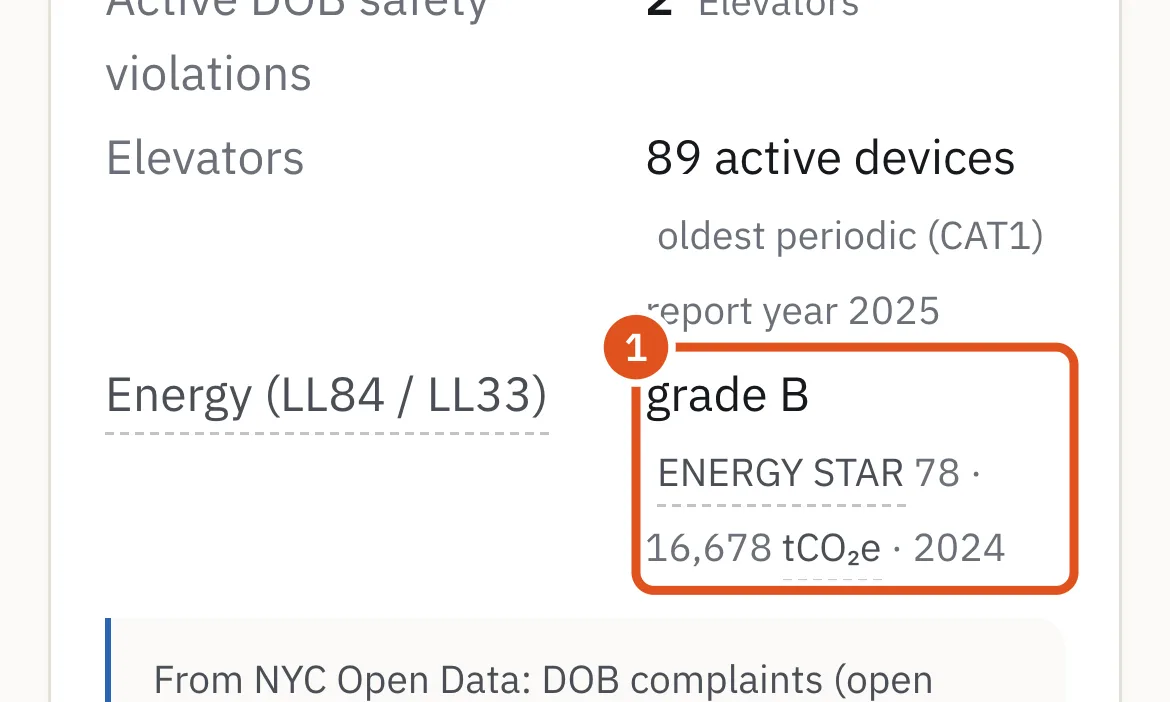
- Grade B, ENERGY STAR 78, tons of CO₂e
Questions people ask
Which buildings must benchmark? Buildings over 25,000 square feet, two or more buildings on one lot or under one condominium board totalling more than 100,000 square feet, and City buildings. DOB's Covered Buildings List names them each year.
When is benchmarking due? May 1 each year, for the calendar year before, through ENERGY STAR Portfolio Manager.
How is the energy grade worked out? From the ENERGY STAR score: A for 85 or more, B for 70 to 84, C for 55 to 69 and D below 55. A building that does not benchmark gets an F; one that cannot be scored gets an N.
Where must the grade be posted? At every public entrance, by October 31, where people can see it. Not posting it costs $1,250.
What is the penalty for not benchmarking? $500 a violation, issued after the May deadline and again each quarter it is still missing.
Can I see another building's energy use? Yes. The City publishes every benchmarking report as Open Data, and BlockLot shows each building's latest grade, score and emissions on its page.
Related
- NYC Local Laws for building owners — What a New York City Local Law is, how one is made and numbered, and the Local Laws that put duties on building owners — energy and emissions, facades and gas piping, lead paint, mold and pests, storefronts, short-term rentals and broker fees.
- Local Law 97: building emissions limits — New York City's Local Law 97 caps the greenhouse gas emissions of buildings over 25,000 square feet: who is covered, how the limit is set, the annual report, the $268-a-ton penalty, and what changes in 2030.
- Energy audits and retro-commissioning: Local Law 87 — New York City's Local Law 87 makes buildings over 50,000 square feet audit their energy use and tune their systems every ten years, in a year set by the tax block; with Local Law 88's lighting and sub-meter duties.
- Department of Buildings (DOB) — What New York City's Department of Buildings does, how a building permit works from filing to sign-off, what a Certificate of Occupancy is, and how DOB violations and stop work orders are issued and cleared.
Sources
- BlockLot Intelligence — BlockLot's own analysis of the public records below, computed October 11, 2026.
- City Council — Local Law 84 of 2009 (Int 0476-2006)
- City Council — Local Law 133 of 2016 (Int 1163-2016)
- City Council — Local Law 33 of 2018 (Int 1632-2017)
- City Council — Local Law 95 of 2019 (Int 1251-2018)
- DOB — Admin Code chapter 3, Article 309 (2022 construction codes)
- DOB — 1 RCNY § 103-06, benchmarking and grades rule
- DOB — LL84 benchmarking law
- DOB — LL84 benchmarking violations
- DOB — LL33 energy grading
- DOB — LL33 energy grading violations
- DOB — Energy grades for calendar 2024 (the published list)
- DOB — 2025 benchmarking extension (service notice)
- DOB — Deadlines for sustainability laws in 2026 (service notice)
- New York State Comptroller — Audit of DOB's benchmarking and energy grades (April 2026)
- NYC Open Data — Building energy and water data disclosure for Local Law 84