Learn NYC property · Building systems and inspections
Boiler inspections: who files, when, defects and penalties
Which New York City boilers must be inspected every year, who may inspect them, the 14-day filing deadline, how defects are corrected and affirmed, the penalties for late or missing reports, and how DEP's boiler rules differ.
A boiler inspection is the yearly check New York City requires of the boilers that heat most apartment, commercial and mixed-use buildings. The owner hires a qualified inspector, the inspector examines the boiler, and the report is filed with the Department of Buildings (DOB) in its online system, DOB NOW: Safety. Boiler inspections are how the City checks, boiler by boiler, that each one is safe to run.
For an owner the program is a yearly deadline with a fee and a penalty attached. For a buyer or lender, a building's boiler record shows whether the paperwork has been kept up — and unfiled reports become DOB violations that stay with the building until someone pays and files.
Which boilers
- Low-pressure boilers — the usual heating boiler, which makes steam at low pressure or hot water — are inspected once a year if they serve a residential building with six or more families, any commercial building, a mixed-use building (commercial space with one to five apartments), or a single-room-occupancy building, whatever their size. Boilers in residential buildings of five families or fewer are exempt, and so is a single boiler inside one apartment that heats only that apartment.
- High-pressure boilers are inspected twice a year: an internal inspection with the boiler shut down and opened, and an external one while it runs, about six months apart. Electric high-pressure boilers have been covered since January 1, 2022.
A new or replaced boiler must pass DOB's own first test before it is used. The inspection year is the calendar year, January 1 to December 31, and a low-pressure boiler's annual inspections must be at least six months apart.
Who inspects
The owner hires the inspector and is responsible for the filing. DOB's rule calls the inspector a qualified boiler inspector: someone holding a New York State Department of Labor certificate of competence who works for an insurance company authorized to insure boilers, or for a licensed oil-burner installer, a licensed high-pressure boiler operating engineer or a licensed master plumber. A high-pressure boiler must be inspected by an insurance company's inspector. Before an internal inspection the inspector notifies DOB at least ten days ahead, and the owner warns the tenants at least 48 hours before the boiler is shut down.
The report and its deadlines
- The report is due within 14 days of the inspection, with a $30 fee per boiler. (The deadline was 45 days until 2022; DOB's fee-and-penalty page still shows the old numbers.)
- A report filed late, up to January 14 of the next year, costs $50 a month per boiler, up to $600.
- After January 14 the report has expired: DOB will not accept it, the owner owes a penalty of at least $1,000 per boiler, and the boiler must be inspected again for the current year.
When the inspector finds boiler defects, the owner has 90 days from the inspection to correct them. A dangerous condition is reported to DOB's Boiler Unit within 24 hours.
The correction is proved with an affirmation of correction — in DOB NOW a Subsequent report — filed within 14 days of the repair, and no later than 104 days after the inspection. Owners may ask for up to two 45-day extensions. Not correcting and affirming costs $1,000 per boiler.
How common defects are
In 2025, inspectors examined 94,379 boilers, by BlockLot Intelligence's count of DOB's reports, and 6.7% of the reports found defects — 6.7% for low-pressure boilers and 9.3% for high-pressure ones.
| Year | Boilers | Reports | With defects |
|---|---|---|---|
| 2025 | 94,379 | 95,593 | 6.7% |
| 2024 | 92,988 | 94,311 | 7.2% |
| 2023 | 95,015 | 96,646 | 7.6% |
| 2022 | 90,433 | 92,771 | 7.9% |
Initial (annual) inspection reports filed in DOB NOW: Safety, by the year of the inspection. A boiler counts once a year; a high-pressure boiler files two reports. BlockLot Intelligence, computed October 10, 2026.
Fixing them often takes longer than the rule allows, and many corrections are never affirmed at all. Of the inspections with defects between October 10, 2024 and October 10, 2025, 44.7% have since been followed by an affirmation of correction — a median 68 days after the inspection — and only 32.3% within the 104 days the rule allows.
Initial boiler inspections 12 to 24 months ago that found defects and have since been followed by an affirmation of correction: days from the inspection to the correction report. Defects never reported corrected are not in the bars. The bar ends at the median; the pale band covers the middle half. BlockLot Intelligence, computed October 10, 2026.
Boiler violations
A missed report turns into a DOB violation. DOB lists the boiler violations under the codes LL6291, LBLVIO and HBLVIO, named for Local Law 62 of 1991, the law on annual low-pressure boiler inspection reports. In November 2023 DOB also issued violations for corrections never affirmed in the 2018 to 2022 cycles. These violations appear in DOB NOW, not in DOB's older BIS system.
A boiler violation has no payment deadline and earns no interest, but it does not go away: it is dismissed only when the penalty is paid (or waived) and an accepted report for the current year is on file. Open boiler violations hold up a final Certificate of Occupancy and can complicate a sale or refinancing. DOB waives penalties in a few cases — a new owner with a recorded deed dated after the penalties arose, government ownership, bankruptcy, a boiler removed before the cycle — and offers a one-time waiver to small businesses, but a waiver cancels the penalty, not the violation.
Heat, fuel and the other boiler rules
DOB's inspection is about safety. Two other agencies regulate the same boiler:
- HPD enforces heat and hot water. From October 1 to May 31, an apartment must be at least 68°F between 6 a.m. and 10 p.m. when it is below 55°F outside, and at least 62°F overnight; hot water must reach 120°F all year. See HPD violations.
- DEP, the Department of Environmental Protection, regulates emissions: boilers of 350,000 BTU an hour or more are registered with DEP, the largest need a DEP certificate to operate, and after January 1, 2030 those certificates must name No. 2 oil or natural gas.
A worked example: 1402 Brooklyn Avenue
1402 Brooklyn Avenue is a 420-apartment building in Brooklyn owned by a housing development fund corporation. Its two low-pressure boilers have a report in DOB's records for every year since 2017. In 2021 both reports were accepted with civil penalties due. In August 2023 the inspection found defects on both boilers, and the affirmations of correction followed in January 2024 — past the 104-day limit. In January 2025 one boiler had defects again; this time the correction was affirmed on April 1, 2025, 76 days after the inspection, inside the limit. Both boilers passed without defects in February 2026.
Where you see this in BlockLot
A building's Compliance & distress signals card has a Boiler inspections row: how many reports DOB holds for the building's boilers, the latest inspection date, and — in bold — how many reports found defects and how many carry civil penalties. Active boiler violations are counted in the row above, Active DOB safety violations.
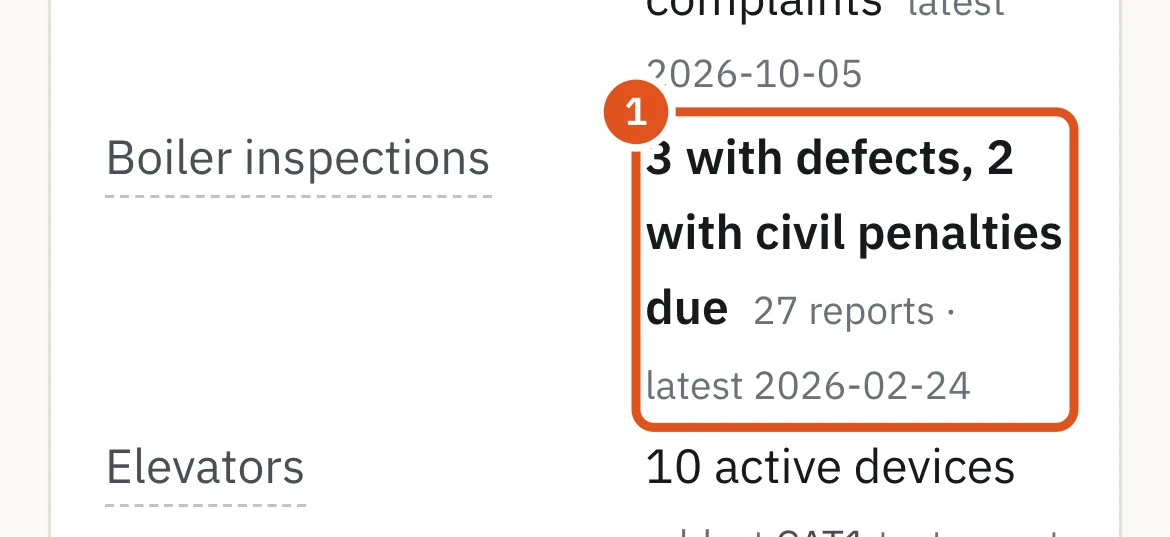
- Reports, defects and penalties
Questions people ask
Does my two-family house need a boiler inspection? No. Residential buildings of five families or fewer are exempt — unless the building also has commercial space, which makes it mixed-use and covered.
Who pays for the inspection? The owner hires the inspector and files the report, with a $30 fee per boiler.
What happens if I miss the inspection? A late report costs $50 a month per boiler, up to $600. After January 14 of the next year the report is refused, the penalty is at least $1,000 per boiler, and the boiler must be inspected again.
What is an affirmation of correction? The filing that proves defects found by the inspector were fixed. It is due within 14 days of the repair, and no later than 104 days after the inspection.
Is the boiler inspection the same as the gas piping inspection? No. The gas piping inspection under Local Law 152 is a separate program, done by a licensed master plumber every four years.
Does a boiler violation stay after the building is sold? Yes. It stays until the penalty is paid or waived and a current report is filed; a new owner can ask for the penalties to be waived with a deed recorded after they arose.
Related
- Department of Buildings (DOB) — What New York City's Department of Buildings does, how a building permit works from filing to sign-off, what a Certificate of Occupancy is, and how DOB violations and stop work orders are issued and cleared.
- Elevator inspections: CAT1 and CAT5 tests, periodic inspections and penalties — How New York City inspects elevators, escalators and lifts — the yearly periodic inspection, the Category 1 no-load test, the five-year Category 5 full-load test, the filing deadlines, the penalties and the retrofit deadlines.
- Gas piping inspections (Local Law 152) and parapet inspections — New York City's Local Law 152 gas piping inspections — which buildings, who inspects, the community-district schedule, the 60-day filing, corrections and penalties, the 2025–2026 changes — and the yearly parapet observation.
- HPD violations: Class A, B, C and I — What HPD housing violations are, what Class A, B, C and I mean, how long an owner has to fix and certify each, how a violation is closed or dismissed, and what happens when a Class C is ignored.
- DOB violations and ECB summonses: classes, cures and penalties — DOB violations and ECB summonses explained: Class 1, 2 and 3, cures, penalties and defaults, and why paying a fine does not close a violation.
Sources
- BlockLot Intelligence — BlockLot's own analysis of the public records below, computed October 10, 2026.
- DOB — Boiler compliance
- DOB — Boiler frequently asked questions
- DOB — DOB NOW: Safety boiler FAQs
- DOB — Resolving boiler violations
- DOB — Low-pressure boilers, 1 RCNY §103-01
- DOB — High-pressure boilers, 1 RCNY §103-05
- DOB — Qualified boiler inspectors, 1 RCNY §101-07
- DOB — Fees, 1 RCNY §101-03
- DOB — 1 RCNY §103-01 promulgation history
- DOB — New periodic boiler inspection requirements, service notice (December 30, 2021)
- DOB — Changes to boiler reports in DOB NOW: Safety (January 2022)
- DOB — Violations for unfiled corrections, 2018–2022 cycles (November 2023)
- HPD — Heat and hot water
- DEP — Clean Air Tracking System
- DEP — Boiler filing requirements (February 2022)
- NYC Open Data — DOB NOW: Safety Boiler