Learn NYC property · Violations and enforcement
The Alternative Enforcement Program (AEP)
How HPD picks 250 distressed buildings a year for its Alternative Enforcement Program, the four months to act, the fees and orders, and discharge.
The Alternative Enforcement Program — AEP — is how the City's Department of Housing Preservation and Development (HPD) takes on the worst-kept apartment buildings in New York. Each year, on or about January 31, HPD names 250 multiple dwellings with the most serious open violations and the heaviest use of its emergency repair crews. Their owners get four months to put things right; buildings that are not fixed by then face building-wide inspections, fees per apartment, orders to replace whole building systems, and HPD's own contractors doing the work at the owner's expense.
For a buyer or lender, a building in AEP is a building with a documented history of hazardous conditions, charges that become tax liens and, if it stays past four months, an HPD order on file with the County Clerk. BlockLot's records label these buildings HPD Alternative Enforcement.
How buildings are chosen
AEP was created by Local Law 29 of 2007 and amended in 2011 and 2014. HPD now selects 250 buildings a year by criteria set in its rules, looking back five years:
- 15 or more apartments: at least three open hazardous (Class B) or immediately hazardous (Class C) violations per apartment, and at least $2,500 of emergency repair charges, paid or unpaid;
- 3 to 14 apartments: at least five such violations per apartment and at least $5,000 of emergency repair charges — and no more than 25 buildings with fewer than six apartments.
Qualifying buildings are ranked by their emergency repair charges, highest first. If fewer than 250 qualify, HPD fills the round from buildings of six or more apartments with at least four open B and C violations per apartment. Buildings being rehabilitated with an HPD or Housing Development Corporation loan are excluded.
The owner is notified and must post a sign at the building's entrance within 15 days, in English and Spanish, saying the building is in AEP and how tenants can report problems.
The first four months
To be discharged from AEP in the first four months, the owner must:
- correct all heat and hot-water violations, all Class C mold violations and at least 80% of Class B mold violations, at least 80% of pest violations, and at least 80% of all other Class B and C violations — and have HPD reinspect them, which costs $1,000 for the building in AEP;
- pay HPD's outstanding charges and liens, or agree a payment plan with the Department of Finance;
- file a current property registration with HPD.
A building discharged this way is watched by HPD for a year afterwards. Lack of money is not a reason to be discharged, though HPD offers low-interest loans for repairs. A building can also leave the program if it has been vacant for a year — unless it has six or more apartments and is empty because of a City vacate order.
If the four months pass
A building still in the program becomes subject to an AEP Order to Correct: a list of the conditions to fix — often including replacing whole building systems, and integrated pest management — mailed to the owner, posted at the building and filed with the County Clerk. From then on the owner pays:
- $500 per apartment every six months, from the building-wide inspection, up to $1,000 per apartment in all;
- $200 for each complaint inspection that finds a Class B or C violation;
- $100 for each reinspection that finds a certified correction was not made.
If the owner still does not act, HPD's contractors make the repairs or replace the systems, and the cost is billed with the property tax and, unpaid, becomes a tax lien. HPD can also take the owner to Housing Court, and some buildings are handed to a 7A administrator. Once the order is complied with and the fees are paid, the building is discharged. Time in AEP can also put a building on the Certification of No Harassment list, which restricts demolition and major alterations.
How long it takes
By BlockLot Intelligence's count of HPD's list, of the 750 buildings that entered AEP between January 31, 2022 and January 31, 2024, 46.8% were discharged within a year and 40.0% are still in the program today. Those discharged took a median 142 days — just past the four-month window.
Every building HPD placed in the Alternative Enforcement Program in the rounds that began 2 to 5 years ago, by its status on HPD's list today. BlockLot Intelligence, computed October 9, 2026.
Days from a building's AEP start date to its discharge, for the buildings from the rounds 2 to 5 years ago that have been discharged. The bar ends at the median; the pale band covers the middle half. BlockLot Intelligence, computed October 9, 2026.
Today 862 buildings, with 17,809 apartments, are in the program. HPD's own report to the City Council counts the long run: by January 31, 2024, 3,637 buildings had spent at least a year in AEP and 3,015 of them had been discharged — 1,616 within the first four months, 1,014 after complying with an AEP order, and the rest because they stood vacant, were handed to a 7A administrator, or HPD finished the work itself. BlockLot's copy of HPD's list agrees: 3,636 buildings and 3,014 discharged by that date.
A worked example
Two company-owned Bronx buildings from recent rounds show how differently it can go. A 25-apartment building on East 181st Street entered AEP on January 31, 2025 and was discharged on June 30, 2025 — five months later, about as fast as the program allows. It did not stay out: on February 2, 2026 HPD selected it again, and as of October 2026 it is still in the program. Had its owner missed the four-month window the first time, the building-wide inspection would have started the fees — $500 for each of its 25 apartments, $12,500 for the building every six months, up to $25,000 in all — on top of any repairs HPD made and billed.
A 21-apartment building on East 159th Street took the slow road. It entered on January 31, 2024 and was not discharged until July 22, 2026 — almost two and a half years in the program. HPD reports that most discharged buildings are not selected again: more than 80% from each round.
Where you see this in BlockLot
On a building's page, HPD Alternative Enforcement lists the building's AEP rounds — when it entered, the round and whether it is still active or was discharged. The distress score counts a building in AEP as one of its strongest signals, and an area's page counts the lots in the program.
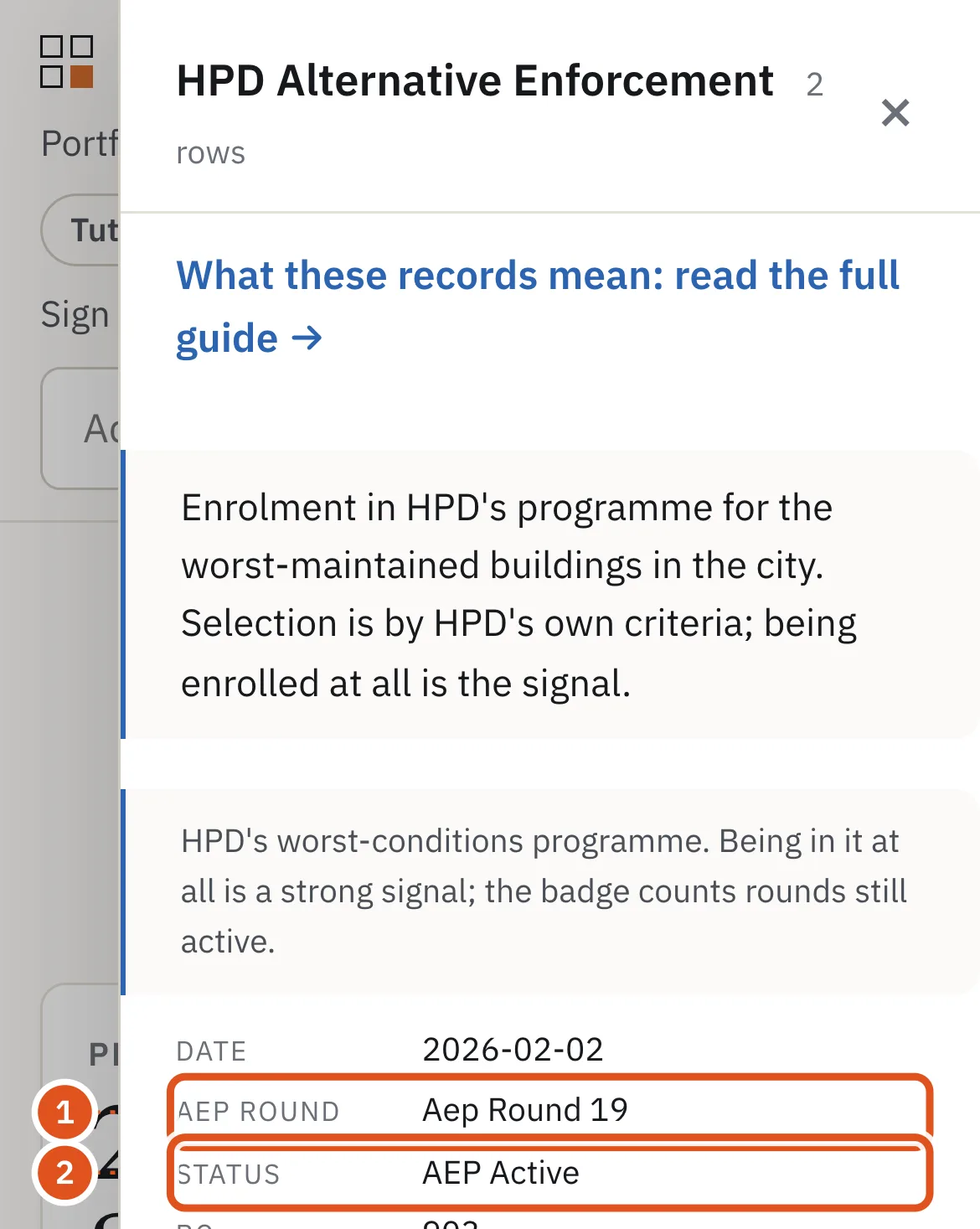
- The AEP round
- Active or discharged
Questions people ask
What is the Alternative Enforcement Program? HPD's program for the 250 apartment buildings each year with the most open hazardous violations and emergency repair charges. Owners must fix them fast or face fees, orders and HPD's own repairs at their expense.
How does a building get into AEP? By its record over the past five years: open Class B and C violations per apartment, and emergency repair charges. HPD ranks qualifying buildings by those charges and names them on or about January 31.
How do I get my building out of AEP? In the first four months: correct the required share of violations and have HPD reinspect, pay or agree to pay HPD's charges, and register the building. After that, comply with the AEP Order to Correct and pay the fees.
How long do buildings stay in AEP? By BlockLot Intelligence's count, discharged buildings took a median about 5 months, but 40.0% of the buildings selected two to five years ago are still in the program.
Does AEP affect a sale? An AEP Order to Correct, once issued, is filed with the County Clerk, its fees and HPD's repair charges become tax liens on the property, and AEP history can put it on the Certification of No Harassment list.
Related
- HPD emergency repairs, repair charges and 7A administrators — How HPD's Emergency Repair Program fixes hazards an owner ignores and bills the owner, how repair charges become liens, and what a 7A administrator does.
- HPD violations: Class A, B, C and I — What HPD housing violations are, what Class A, B, C and I mean, how long an owner has to fix and certify each, how a violation is closed or dismissed, and what happens when a Class C is ignored.
- Certification of No Harassment (CONH) — What a Certification of No Harassment is, which buildings need one and for what work, how HPD investigates, what happens if harassment is found — and why the program became permanent in 2026.
- Housing Court, HP actions and HPD litigation — Housing Court for owners and buyers: HP actions, the cases HPD brings, harassment findings, marshal evictions and HPD's Speculation Watch List.
- OATH hearings, unpaid tickets and docketed judgments — What OATH is, the tickets it hears, what a default costs and how to reopen one, and what a docketed judgment means for an owner and a building.
Sources
- BlockLot Intelligence — BlockLot's own analysis of the public records below, computed October 9, 2026.
- HPD — Alternative Enforcement Program
- HPD — AEP rules, 28 RCNY Chapter 36
- HPD — AEP statute, Admin Code §27-2153
- HPD — Alternative Enforcement Program, Year 17 report to the City Council (July 2024)
- HPD — AEP Round 19 report to the City Council (2026)
- HPD — Certification of No Harassment
- NYC Open Data — Buildings Selected for the Alternative Enforcement Program