Comparable sales
How BlockLot picks comparable sales for a building, how it turns them into an implied value, and how to read the card without over-reading it.
The Comparable sales card shows what similar buildings nearby sold for recently, and turns those sales into an implied value for this one. Its job is a fast, honest answer to "is this owner sitting on more than they think?" — an opening for a conversation, not a price for a deal.
The card is part of the full report, so you need a plan to see its figures. It needs recorded deeds, so it is not available on Staten Island, whose deeds are not in ACRIS, the City Register's online records.
How the comparable sales are chosen
BlockLot starts from every deed recorded in ACRIS and keeps only sales that say something about market value:
- One deed, one lot. A deed that conveyed several lots for one price is left out, because nothing in the record says how that price splits between them.
- The same kind of building. Comparables share the first letter of this building's class — walk-ups with walk-ups, elevator buildings with elevator buildings, houses with houses. Click a class code to read what it means.
- A real market price. Deeds with no price or a nominal one, implausibly large amounts, sales of a partial interest, garages and rear lots, and one price repeated across many lots (a portfolio sold in bulk) are all dropped.
Then it looks for at least four such sales, starting close and widening one step at a time:
- Same building, last 36 months — for a condominium apartment, the other apartments in the same building. This is the strongest comparison there is.
- Same block, last 18 months.
- Same census tract, last 18 months, then 24, then 36.
The first step with four or more sales is used. It stops at the census tract and three years: past that, a sale is no longer a fair comparison. If even that finds fewer than four, the card lists the sales it found and gives no value.
Reading the card
The grey line after the heading names the peer set, for example same block · class C · last 18 months. When the answer did not come from the block, a highlighted band above the figures repeats it with the number of sales — same census tract · 24 months · 6 sales — no block-level peer set was large enough — so a weaker comparison never passes for a strong one.
The large figure is one of four things:
- This building's own sale. If it sold at arm's length in the last 18 months, that price is the estimate, marked last sale and arm's length. No gain is shown against a price the market has just set.
- An implied value. Usually the median price per square foot of the comparables times this building's floor area. For houses and condominium apartments it is the median sale price. Where floor area is missing, it falls back to the median price per unit times the number of units. When the building has a priced earlier sale, the gain since then follows, for example +38% on the $1,200,000 paid in 2015.
- A range, marked methods disagree, when price per square foot and price per unit point to values more than twice apart. A single number there would claim a precision the sales do not have.
- No value estimated, with the reason, when there are too few sales.
Beside it, Median $/sq ft shows the median with its low–high range, and Median $/unit the median with the number of sales. For stores, offices and other commercial classes, $/unit reads not applicable: their units are commercial space, not homes.
The table lists the most recent comparables: Sold, Address (with the apartment for condominium units), Class, Units, Price, $/unit and $/sq ft. Each address opens that building's page. The medians use every qualifying sale in the peer set, not only the rows shown.
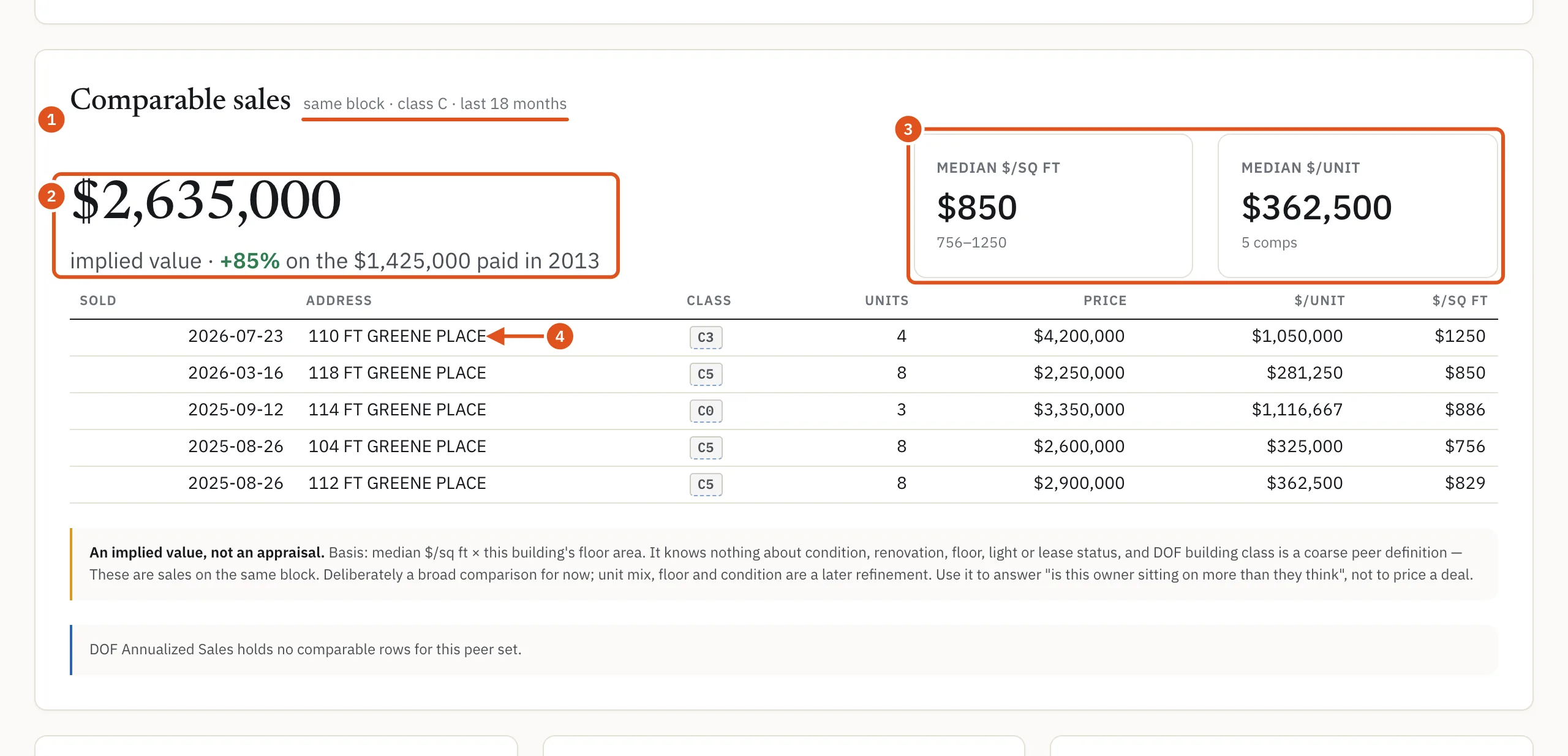
- Which sales were compared
- The implied value
- The medians
- Open a comparable
Under the table, a note headed An implied value, not an appraisal. states the basis used and what the comparison cannot see.
What to be careful about
- It knows nothing about the building itself — condition, renovation, floor, light, leases or rent roll. Two buildings of the same class on the same block can differ by a lot.
- The building class is a coarse match. A small walk-up and a large one share a letter, and so do a renovated building and a neglected one.
- A census tract is wider than a block and can cross into a different era of buildings. Check the band above the figures.
- Older sales come in on the wider steps. A 36-month window includes sales from a different market; the window is always named.
- Fewer sales than you expect is normal. Many deeds state no price, and package and bulk deals are excluded, so a busy block can yield few comparables.
- The gain is not profit. It compares today's implied value with a past price, before costs, debt and the years in between.

- A wider, weaker peer set