Learn NYC property · Violations and enforcement
BlockLot's distress score: what it measures
How BlockLot's distress score turns violations, court cases, vacate orders, liens and unpaid charges into one number from 0 to 100, and what it is not.
The distress score is BlockLot's own measure of how much trouble a building is in, according to the public record. It reads more than a dozen signals the City publishes about every tax lot — open violations, pending housing-court cases, vacate orders, tax liens, unpaid tickets and charges, complaints, evictions — and combines them into one number from 0 to 100. The higher the number, the more of those signals the building carries, and the stronger they are.
No City agency publishes this score. It is BlockLot's reading of the record, built so that someone looking at a building, a portfolio or a neighborhood can see at a glance where the problems are — and then open each one and check it against the agency's own data.
The four bands
Every score falls in one of four distress bands, so the colour on a page is never the only thing that carries the meaning:
| Band | Score |
|---|---|
| Severe | 60 to 100 |
| Elevated | 30 to 59 |
| Moderate | 10 to 29 |
| Low | 0 to 9 |
Most of the city is quiet. By BlockLot Intelligence's count, of the 494,127 tax lots it scores, 69.4% are in the low band and only 14,832 — 2.9% elevated and 256 severe — score 30 or more.
Every tax lot BlockLot scores, by the band its distress score falls in. The score is BlockLot's reading of the public record, not an official rating. BlockLot Intelligence, computed October 11, 2026.
The signals
The score reads these distress signals, each from the agency that publishes it:
- Open violations at HPD, DOB and the Environmental Control Board, counted by each agency's own idea of open — see how BlockLot counts open violations;
- open housing-court cases in HPD's records;
- an active vacate order from HPD or the Fire Department;
- the building's place on the City's tax lien sale list in the latest cycle, or a lien already sold and not yet paid off;
- a HUD assisted-housing contract close to expiring;
- selection for HPD's Alternative Enforcement Program;
- unpaid OATH tickets;
- HPD repair charges;
- 311 complaints and evictions in the last 24 months;
- overdue Department of Finance charges;
- a place on HPD's Certification of No Harassment list;
- a facade reported unsafe or never reported, and active DOB safety violations;
- a live federal tax lien against an owner.
Tax lots where each of the score's signals is present today. A lot can carry several. BlockLot Intelligence, computed October 11, 2026.
A lot can carry several signals at once; most carry none of the strong ones.
How the signals add up
Each signal has a weight, and the weights of the main signals add up to 100, so the score reads as a share of the worst case. A live federal tax lien against an owner can add up to 10 more, but the score never passes 100.
Each signal saturates: having it at all counts for a lot, and having more of it counts for less and less, up to a level beyond which more makes no difference. Without that, one building with hundreds of open violations would outrank a building under a vacate order, which says far more about trouble. And most signals count only while they are live — an open violation, a pending case, an active vacate order, a lien not yet redeemed — because a building's closed history says more about its past than its present. Complaints and evictions count over the last 24 months, and HPD repair charges in total.
Two signals are measured per apartment — open violations per unit and 311 complaints per unit (24 mo) — so that a 200-unit building is not punished for being large. A vacant lot has no apartments, so those signals are not scored there at all rather than guessed. Others are counted over a window: evictions (24 mo) are marshal evictions carried out at the lot in the last 24 months.
The score is recomputed every night, after the night's data refresh, so a violation closed today lowers the score by tomorrow.
What the score is not
- Not an official rating. HPD has its own "distress" measure for the Certification of No Harassment program; it is a different thing, computed by HPD from violations and repair charges.
- Not a safety rating. A high score means many open problems on the record, not that a building is unsafe today; a low one does not mean it is safe.
- Not a prediction. It does not say an owner will sell, default or be foreclosed on. It ranks buildings against one another by what the record shows now.
- Only as good as the record. Agencies close violations late, records lag, and some feeds are refreshed monthly. Each signal on a building's page links to the records behind it so it can be checked.
A worked example
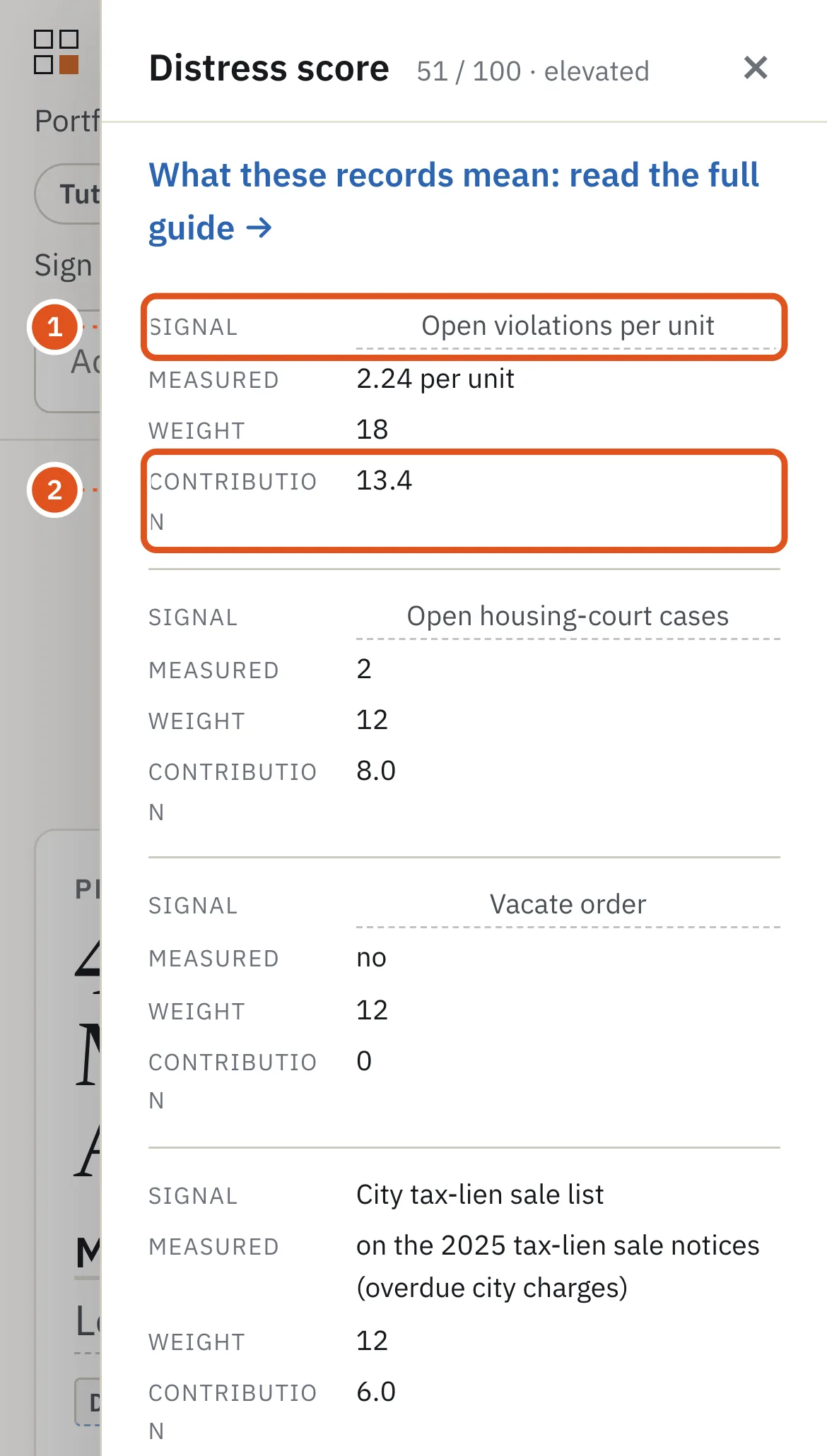
A 53-apartment building on Manhattan Avenue in Harlem, owned by a company, scored 51 in October 2026 — elevated. Its building page lists why, biggest first: 2.2 open violations per apartment; two open housing-court cases; $118,175 in unpaid OATH tickets; the City's 2025 tax-lien sale notices; $54,681 in HPD repair charges; 4.3 complaints to 311 per apartment in two years; $25,780 of overdue City charges; a place on HPD's Certification of No Harassment list; and 23 active DOB safety violations. It also lists what it checked and did not find — no vacate order, no evictions — because a low contribution is only believable when you can see what was looked for. The building had been in HPD's Alternative Enforcement Program earlier in 2026 but was discharged, so that signal no longer counts.
Where you see this in BlockLot
A building's page shows its score and band at the top, and Distress score opens the breakdown: every signal, what was measured, its weight and what it contributed — zeros included. Owner pages rank a portfolio's buildings by distress, area pages count the lots in each band, and the distress search finds buildings by band and by the signals behind them.
- The signal
- Points it adds
Questions people ask
What is a distress score? BlockLot's 0-to-100 summary of the problems on a building's public record — open violations, court cases, vacate orders, liens, unpaid tickets and charges, complaints and evictions. It is our reading of the record, not an official rating.
What do the bands mean? Low is 0 to 9, moderate 10 to 29, elevated 30 to 59 and severe 60 to 100. By BlockLot Intelligence's count, most tax lots are low and only 256 are severe.
Why does a building with few violations have a high score? Because violations are only one signal. A vacate order, pending court cases, liens and unpaid charges can each count for more than a long list of violations.
How do I lower a building's score? By clearing what it counts: closing violations properly, resolving court cases, paying tickets and charges, lifting vacate orders. The score follows the agencies' records, so it falls once they do.
Does a high score mean the building is for sale? No. It describes the record, not the owner's plans.
Related
- BlockLot Intelligence: how our figures are made — Where the live counts and timeframes in BlockLot's guides come from — the public records they are computed from, how often they are refreshed, how a waiting time is measured, and what the numbers can and cannot tell you.
- DOB violations and ECB summonses: classes, cures and penalties — DOB violations and ECB summonses explained: Class 1, 2 and 3, cures, penalties and defaults, and why paying a fine does not close a violation.
- HPD violations: Class A, B, C and I — What HPD housing violations are, what Class A, B, C and I mean, how long an owner has to fix and certify each, how a violation is closed or dismissed, and what happens when a Class C is ignored.
- Housing Court, HP actions and HPD litigation — Housing Court for owners and buyers: HP actions, the cases HPD brings, harassment findings, marshal evictions and HPD's Speculation Watch List.
- OATH hearings, unpaid tickets and docketed judgments — What OATH is, the tickets it hears, what a default costs and how to reopen one, and what a docketed judgment means for an owner and a building.
Sources
- BlockLot Intelligence — BlockLot's own analysis of the public records below, computed October 11, 2026.
- NYC Open Data — HPD Housing Maintenance Code Violations
- NYC Open Data — DOB ECB Violations
- NYC Open Data — HPD Housing Litigations
- NYC Open Data — HPD Order to Repair/Vacate Orders
- NYC Open Data — OATH Hearings Division Case Status
- NYC Open Data — 311 Service Requests
- NYC Open Data — Evictions
- DOF — Property tax lien sale