Owner and contacts
Who owns the building according to the tax roll and the latest deed, whether they live there, and the phone numbers and e-mails on record.
The Owner and Contacts cards answer the two questions most people open a property page for: who owns this building, and how do I reach them. They sit in one row with Value & tax between them.
Owner names and contacts come with the larger plans. Without them, the cards keep their rows but hide the values, and a line under the heading says so, such as Owner names are hidden on the free view. or Owner contacts are not in your plan., with a link to the plans that include them. See Plans and billing.
The Owner card
- Roll owner — the owner named on the City's latest assessment roll. Click the name to jump to the owner's other buildings on this page, or, when there are none, to search for the name.
- Last sold — the date of the latest deed, and its price when that deed conveyed this property alone.
- Mailing — the buyer's mailing address on that deed.
- Occupancy — Owner-occupied or Absentee, from comparing the deed's mailing address with the building's address. An absentee owner, whose mail goes elsewhere, is a common starting point for outreach.
- Deed parties — a count; click it to see the buyers and sellers on the deeds, with their addresses.
- City-owned — shown only when a City agency owns the lot, marked exclude from mail.
Below these, BlockLot lists the companies in the New York State business registry that match the owner on the deed, each with its process address (where the State sends legal papers) and a chip saying how sure the match is: DOS-matched, a number of name matches when several companies share the name, or registered-agent address when the address is a filing service. Click a company to open its page — see Company pages.
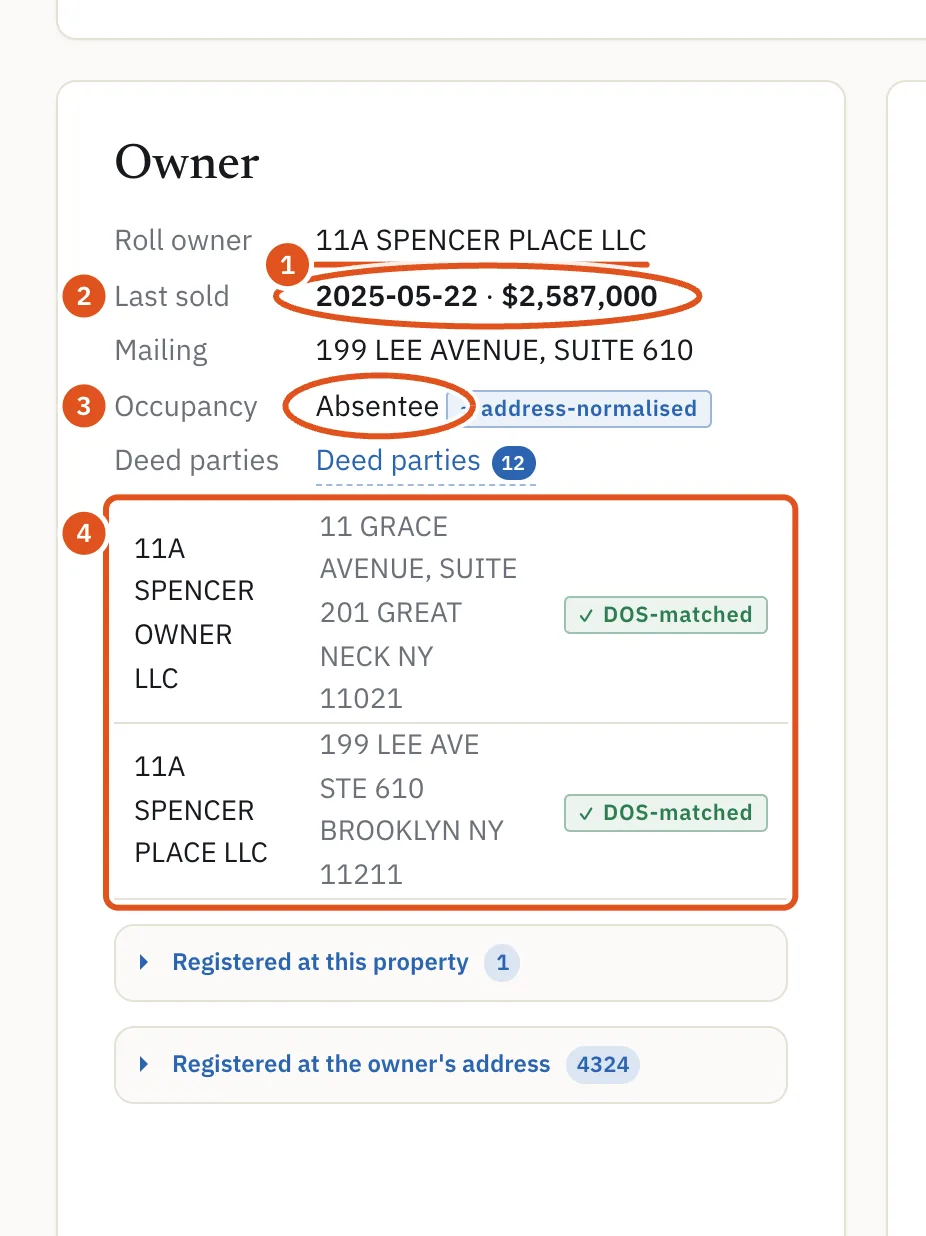
- Owner on the tax roll
- Latest deed
- Lives there or not
- Registered companies
The roll is not the deed
The tax roll is published once a year and can lag a sale by a year or more, while a deed is recorded within days. So the Roll owner may still name someone who has sold. Last sold and Mailing come from the latest deed — from its buyer, never its seller — and when deed and roll disagree, the Owner's portfolio card says so in a note headed Holder per the latest recorded deed.
Reading Last sold
A sale is often less tidy than one date and one price. The line may say:
- No price stated on the deed — common for family, estate and internal company transfers. The last priced sale follows where there is one.
- One deed conveyed … lots — a package. The total is shown, but no part of it is presented as this building's price.
- conveyed together — one deed conveyed two or more buildings; the others are listed and linked.
- inferred · Likely conveyed together — separate deeds recorded the same day between the same seller and buyer. An inference, and often an owner moving property between their own entities.
- DOF sales record — there is no deed in ACRIS, the City Register's online records (Staten Island is not in it), so the Department of Finance's sales record is used.
The full list of sales is in Sales history — see History.
Tax-exempt owners
When the owner's name matches the IRS file of tax-exempt organizations, a block headed Tax-exempt organization appears, marked name-matched to the IRS file: the EIN, the type of organization and the year of its ruling, then revenue, assets and the officers, directors and trustees from its latest e-filed Form 990. When several organizations share the name, no officers are shown. The match is on the name alone, so confirm it on the deed.
The Contacts card
- Owner contact — one phone and one e-mail, worked out from the building's own Buildings Department permits filed in the owner's role. Numbers that belong to professionals (expediters, architects, contractors who appear on many buildings) are left out, and so is anything filed before the last sale. A chip says how sure it is — likely owner or possible — verify — and a sentence says why. When this building's permits name no one, BlockLot may use the contact found on another of the owner's buildings, marked from the owner's other building — verify, with a link to that building. For a condominium apartment no owner contact is given.
- All contacts — a count; click it for every contact on record for the lot: permit contacts, the HPD (Housing Preservation and Development) registration and the oil-boiler registry, grouped by role. Each phone shows how many buildings it appears on in permits across the city, and a number on many buildings is marked professional — it belongs to a firm that files for many owners.
- Boiler-registry phone — the owner phone from the City's oil-boiler registry, marked Clean Heat, or not held.
- HUD management — for buildings under a federal assisted-housing contract, the management contact on that contract.

- How sure
- Why this contact
- Every contact on record
When the contacts file from a management office
If a contact on the building's current HPD registration files from a management office used by many unrelated owners, a line on the Owner's portfolio card names that office and says the buildings managed from there are not this owner's portfolio. See Portfolio and connected buildings.