Learn NYC property · Value and property tax
Property tax exemptions: STAR, senior, disabled, veterans, clergy, J-51, 421-a and 485-x
NYC property tax exemptions explained: STAR, senior and disabled homeowners, veterans, clergy, 421-a, 485-x, J-51 and nonprofit property.
A property tax exemption takes part of a property's assessed value off the roll before the tax is worked out, so the owner is taxed on less; exemptions never change the market value. What remains is the taxable value, and the tax is the taxable value times the class's rate. An abatement works later, as a credit against the tax itself — see Abatements.
New York City grants exemptions for two very different reasons. Some help people: homeowners who are older, disabled, veterans or clergy. Others reward buildings: new apartments (421-a, now 485-x), renovations (J-51) and industrial and commercial investment. And some property is fully exempt — the City's own, the State's, and most of what nonprofits use for their work.
The difference matters to anyone reading a property's numbers. A building exemption can cut a tax bill by nine-tenths for decades and then end on a known date; a homeowner's exemption ends when the owner sells, moves or dies. DOF's report on tax expenditures put the cost of all the City's property tax exemptions and abatements at $8.4 billion in FY 2025/26, through 593,019 of them.
Exemptions for homeowners
| Exemption | For | Worth |
|---|---|---|
| STAR | Owner-occupants | A few hundred dollars a year |
| SCHE | Owners 65+ on a low income | 5%–50% of assessed value |
| DHE | Disabled owners on a low income | 5%–50% of assessed value |
| Veterans | Veterans | 15% and up, capped |
| Clergy | Clergy | $1,500 of assessed value |
Applications for the City's homeowner exemptions are due March 15 (March 16 in 2026) for the tax year starting the next July 1.
STAR
STAR, the School Tax Relief program, is the State's help with the school share of the tax for homes their owners live in — a house, a condominium or a co-op apartment. It now comes in two forms, and the State, not DOF, runs both. The STAR exemption is a reduction shown on the tax bill; it is closed to new owners — anyone who bought after 2015 cannot get it — but an owner who had it can keep it for the same home. The STAR credit is the same help paid by the State Department of Taxation as a check or direct deposit; it is what new owners register for. The credit can grow by up to 2% a year, the exemption cannot, and an owner who switches to the credit cannot switch back. For 2025 the credit was worth slightly more in the City: for a class 1 home, $275 against $269 for Basic STAR and $730 against $659 for Enhanced STAR, the larger form for owners 65 or older.
Income limits for 2026 benefits: $500,000 for the Basic credit, $250,000 for the Basic exemption, and $110,750 for Enhanced STAR ($113,550 for 2027). DOF's own exemptions page still gives an older Enhanced limit; the State's page is current. DOF's annual report counted 295,772 STAR exemptions in November 2025, and says their number keeps falling.
Senior citizen homeowners (SCHE)
The Senior Citizen Homeowners' Exemption cuts the assessed value of a home whose owners are 65 or older (only one needs to be, for spouses or siblings), whose combined income is $58,399 or less, and who live there. It is worth 50% of the assessed value for income up to $50,000, sliding down to 5% at the top of the range. The owners must have held the home for twelve months, unless they had the exemption on a previous home, and renew every two years. DOF's report counted 50,912 of these exemptions on the FY 2025/26 roll.
The State has since allowed the City to raise the income limit to $75,000 from July 2027; a Council bill to do so was introduced in August 2026 and had not passed by October 9, 2026.
Disabled homeowners (DHE)
The Disabled Homeowners' Exemption has the same income limit and sliding scale as SCHE, for owners with a disability documented by a Social Security, Railroad Retirement, Postal Service or Veterans Affairs award, a State Commission for the Blind certificate or a permanent workers' compensation award. It is renewed every year. An owner who qualifies for both gets SCHE.
Veterans
Three State programs apply in the City, with no age or income limit:
- The alternative veterans' exemption — 15% of the assessed value for wartime service, 10% more for service in a combat zone, and a share for a service-connected disability, each with a cap. For a class 1 home the caps are $2,880, $1,920 and $9,600 of assessed value.
- The Cold War veterans' exemption — the City adopted it in December 2025, for service between September 1945 and December 1991.
- The eligible funds exemption — the oldest, for a home bought with a veteran's pension, bonus or insurance money.
DOF's report counted 27,040 veterans' exemptions on the FY 2025/26 roll.
Clergy
Members of the clergy — active, retired over 70 or unable to work through illness, and their unremarried surviving spouses — get $1,500 off the assessed value of a home they own. Co-op apartments do not qualify, and it is renewed every year.
Exemptions for buildings
The State's building programs trade a long, large exemption for something the City wants: new rental housing with affordable apartments, or the renovation of existing ones. The Department of Housing Preservation and Development (HPD) decides eligibility, and DOF applies the exemption.
421-a
421-a exempted the added value of new multifamily buildings for 10 to 35 years. Under its older form, for construction started by the end of 2015, the exemption ran 10, 15, 20 or 25 years — full at first, then falling in steps of 20% until it ended. Its last form, Affordable New York, covered construction started from 2016 to June 15, 2022: rental buildings got 35 years — 25 years in full, then 10 at the building's share of affordable apartments — and condominiums and co-ops a shorter benefit on part of each unit's value. No new building can enter 421-a. Buildings already in it had to finish by June 15, 2026, extended by the State in 2024 to June 15, 2031 for most options.
485-x
485-x, Affordable Neighborhoods for New Yorkers, is 421-a's successor, enacted by the State in 2024, for buildings of six or more apartments that start construction after June 15, 2022 and by June 15, 2034. Depending on size and place, it gives 10 to 40 years of exemption — 35 or 40 years in full for large buildings with a quarter of their apartments affordable, 25 plus 10 for mid-size ones, 10 years for small buildings outside Manhattan, and 20 for homeownership projects outside Manhattan. Affordable apartments stay affordable permanently, and the largest projects must pay construction workers a minimum wage set in the law. It cannot be combined with any other exemption or abatement.
J-51
J-51 rewards the renovation of residential buildings. Its original form, for work finished by June 29, 2022, gave both an exemption on the value the work added — for 14 or 34 years — and an abatement of the existing tax. A reformed version, for work finished from mid-2022 to June 29, 2026, is an abatement only, for affordable rentals and modest co-ops and condominiums (see Abatements). A renewal for work finished through 2036 passed the City Council on September 24, 2026 and was awaiting the Mayor's signature on October 9, 2026. Rental apartments in a J-51 building stay rent-regulated while the benefit runs.
ICIP
ICIP, the Industrial and Commercial Incentive Program, was an exemption for building or renovating commercial and industrial property, open from 1984 to 2008; benefits granted then still run. Its successor, ICAP, is an abatement (see Abatements).
How common they are
By BlockLot Intelligence's count of DOF's exemption file, the FY 2026/27 final roll carries 42,210 421-a exemptions — each condominium unit counted once — 16,534 J-51 exemptions and 2,730 from ICIP. DOF's file also lists the first 30 lots with a 485-x exemption.
Exemptions the Department of Finance records as approved and taking value off the roll; a condominium's 421-a is counted once per unit. Senior citizens' and veterans' exemptions are not shown (their current count in DOF's file does not match its published one), and STAR is not in the file. BlockLot Intelligence, computed October 11, 2026.
Counted the same way on the year before's roll, these programs match DOF's own published counts: to within a few lots for 421-a, J-51 and clergy, and within 2% for ICIP and the disabled homeowners' exemption. The senior citizens' and veterans' exemptions are not shown: DOF's file holds each exemption's current amount, after later removals, so its count for them falls short of DOF's published one, and we use DOF's figures for them above.
Worked example: a 421-a building
The American Copper Buildings, two rental towers at 626 First Avenue in Manhattan, are owned by a company and are in tax class 2. They have a 421-a exemption that began in 2019 for 20 years. For FY 2025/26, from DOF's roll:
- Market value: $325,725,000.
- Billable assessed value: $146,576,250.
- 421-a exemption: $136,628,859 — 93.2% of it.
- Taxable value: $9,947,391.
- Tax at the class 2 rate of 12.439%: $1,237,356 a year, instead of $18,232,620 without the exemption.
The exemption is worth about $16,995,264 a year to the building. DOF's records show the term ending in 2039; as it phases out, the taxable value — and the tax — will climb toward the full amount.
When an exemption ends
When a homeowner's exemption is removed
A homeowner's exemption belongs to the owner, not the house. It is removed when the owner sells, dies or stops living there, or does not renew: a renewal letter that arrives addressed to the previous owner means the new owner has to apply in their own right. A surviving spouse of 62 or older can keep SCHE, and a surviving sibling of 65 or older. An owner can ask DOF to remove an exemption on form EXC-0728 — free if the owner no longer qualifies.
When a building exemption ends
A building exemption ends on a date set when it began. In its last years it usually shrinks in steps — for 421-a's older forms, to 80%, 60%, 40% and 20% of the exemption before it ends — so the tax climbs over several years rather than jumping once. For a buyer, that schedule is part of the price: a building near the end of its 421-a term faces a much larger tax bill within a few years.
By BlockLot Intelligence's count of DOF's exemption file, 29,509 of the 421-a exemptions on the FY 2026/27 roll — 69.9% of them — reach the end of their term by 2035:
Tax lots with a 421-a exemption in force, by the roll year its term runs out — its start year plus its length, as DOF records them. Each condominium unit is its own lot. BlockLot Intelligence, computed October 11, 2026.
Fully exempt property
Some property pays no tax at all. Property owned by the City, the State and the federal government is exempt, and so is most property of nonprofit organizations used for their purpose: under the State's Real Property Tax Law, property used for religious, charitable, hospital, educational or similar purposes must be exempted, and some other purposes may be. DOF's annual report counted 46,877 fully exempt parcels in FY 2025/26. Some things to know:
- The deed must be in the nonprofit's own name, and only the part used for the exempt purpose is exempt — space leased out commercially is taxed.
- A nonprofit must renew every year, by January 5.
- Fully exempt lots are left out of DOF's citywide market value totals.
A tax-exempt organization in the federal sense is something else: an organization the IRS exempts from income tax, which files an annual return on Form 990. That status alone does not exempt its buildings from City property tax — the property must qualify under the State law above.
Where you see this in BlockLot
On a building's page, Exemptions in the Value & tax card opens every exemption on every roll DOF has published for the lot — its kind, the value exempted, its status, and the year it started and how many years it runs. The deal search can find buildings whose tax exemption ends within a given number of years.
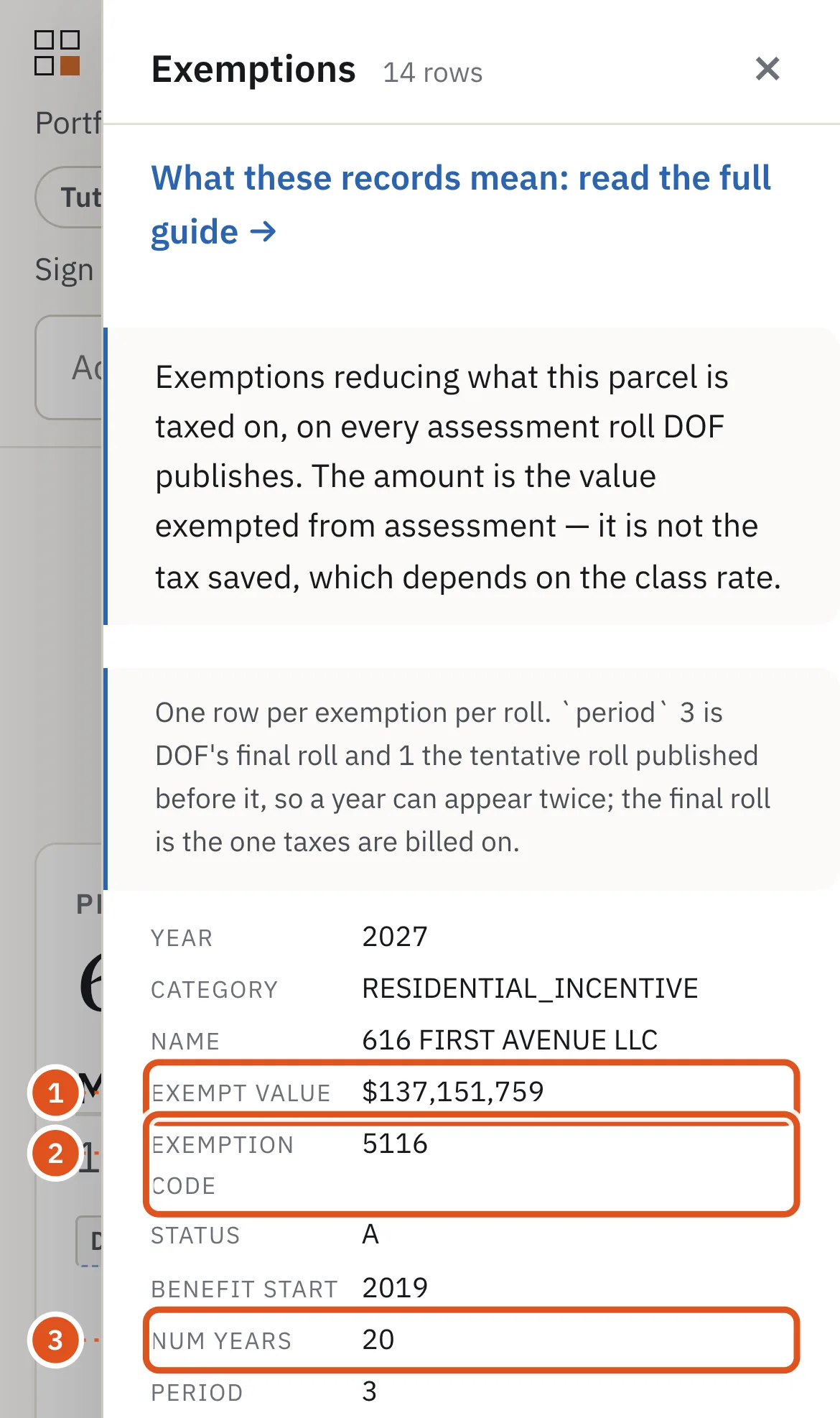
- The value taken off the assessment
- DOF's code: 5116 is a 20-year 421-a
- How long the benefit runs
Questions people ask
What is the difference between an exemption and an abatement? An exemption lowers the value you are taxed on; an abatement is a credit against the tax itself. J-51 once gave both.
I just bought a home. Can I get the STAR exemption? No — it is closed to new owners. Register for the STAR credit with the State Department of Taxation instead; it is paid as a check or direct deposit and is usually worth slightly more.
What is the income limit for the senior citizen exemption? $58,399 of combined income for 2026, for owners 65 or older who live in the home. Below $50,000 it halves the assessed value.
Why did my building's tax go up so much? Often because a 421-a or J-51 exemption is phasing out: in its last years the exemption shrinks in steps until the full tax applies.
The previous owner's exemption is on my bill. What happens? DOF removes it, because it belonged to the previous owner; you can ask for removal yourself on form EXC-0728, free if you do not qualify, and apply for any exemption you do.
Do nonprofits pay property tax in New York City? Not on property they own and use for their exempt purpose, if they apply and renew every year. Space they lease out commercially, and property they do not own, is taxed.
Related
- Assessed value and how the NYC property tax is calculated — How New York City turns a market value into a tax bill — the four tax classes, the 6% and 45% assessment ratios, the yearly caps and five-year phase-ins, exemptions and abatements, the tax rates — worked through on a real building.
- Property tax abatements: co-op and condo, J-51, solar, green roof, ICAP and CEP/CRP — NYC property tax abatements explained: co-op and condo, J-51, solar, green roof, ICAP and CEP/CRP — who qualifies and what each is worth.
- The Notice of Property Value and the assessment calendar — What New York City's Notice of Property Value shows, line by line, and the assessment calendar from January to October, with the 2026 dates.
- Overdue property charges, interest and the tax lien sale — Overdue NYC property charges: late interest for FY 2026/27, payment plans, how the tax lien sale works, and why there was no sale in 2026.
- Rent stabilization tied to tax benefits: J-51, 421-a and 485-x — Why apartments in newer NYC buildings are rent-stabilized: the rent rules that come with 421-a, 485-x and J-51 tax benefits, the lease notice, and what happens when a benefit ends.
Sources
- BlockLot Intelligence — BlockLot's own analysis of the public records below, computed October 11, 2026.
- DOF — Residential property exemptions
- DOF — STAR
- NYS Department of Taxation — STAR
- NYS Department of Taxation — STAR eligibility (2026 and 2027)
- NYS Department of Taxation — Switching from the STAR exemption to the credit
- NYS Department of Taxation — STAR credit and exemption amounts, New York City
- DOF — Senior Citizen Homeowners' Exemption (SCHE)
- DOF — Disabled Homeowners' Exemption (DHE)
- DOF — SCHE and DHE renewal questions
- DOF — Veterans' exemption
- DOF — Clergy exemption
- NYC Department of Veterans' Services — Cold War veterans' exemption (December 2025)
- HPD — J-51
- HPD — J-51 reform (the Affordable Housing Rehabilitation Program)
- NYC Council — Int. 1015-A of 2026 (J-51 renewal)
- HPD — 421-a
- HPD — 485-x
- NY Real Property Tax Law § 421-a
- NY Real Property Tax Law § 467 (senior citizens)
- NY Real Property Tax Law § 460 (clergy)
- NY Real Property Tax Law § 420-a (nonprofit organizations)
- DOF — Not-for-profit exemptions
- DOF — Request to remove an exemption (EXC-0728)
- DOF — Annual Report on Tax Expenditures, FY2026
- DOF — Annual Report on the NYC Real Property Tax, FY2026
- IRS — About Form 990