Portfolio and connected buildings
The owner's other buildings, on a table and a map, the buildings linked to them through shared offices and filings, and how to check each link.
New York owners often hold each building through its own LLC, a limited liability company that names no person, and keep a house in their own name. Two cards put those holdings back together: Owner's portfolio, the buildings BlockLot counts as this owner's, and Connected buildings, the wider set linked to them through shared offices and filings.
Both need a plan that includes the owner's portfolio; without one the cards say so with a link to the plans. Some plans list only the first part of a large portfolio. See Plans and billing.
Owner's portfolio
The card appears when BlockLot finds other buildings for this owner. Its heading says how they were found — for example through LLCs sharing a registered office, held through the LLCs of one connected owner group, or personally held — matched on same person + address.
The large figure is the number of buildings, with the number of companies, total units and total assessed value under it. On the right, Registered office is the address the owner's companies file from; click it to see everything else registered there — see Registered at this office.
Under the figure, a few plain sentences sum up the portfolio: its size and age, open violations per residential unit against the city's rate, 311 complaints, court cases, evictions, vacate orders and the highest distress score, with the worst building linked. "About the same as" the city means within 15 percent.
A line may say that HPD contacts for this building file from a management office used by many names. Buildings managed from there are not counted as this owner's.
The map and the table
When at least two buildings can be placed, a map shows one dot per building: This building, Held by the company group and Held personally. Hover a dot for its address, units and class, and click it to follow the link.
The table lists this building first, marked this property, then the others. Held by names the owner on record and links to the company's page (Company pages). Purchased gives the price and date of the latest deed, or says why there is no price: no price stated, partial interest, package deed (one deed, several lots, one price), bulk deed or amount implausible. A chip such as one deed · 3 bldgs or same deed as 2 others listed here shows buildings bought together.
When the table mixes kinds of evidence, a Match column says which applies to each row — shared office, same owner group, resolved identity, process agent or same person + address.
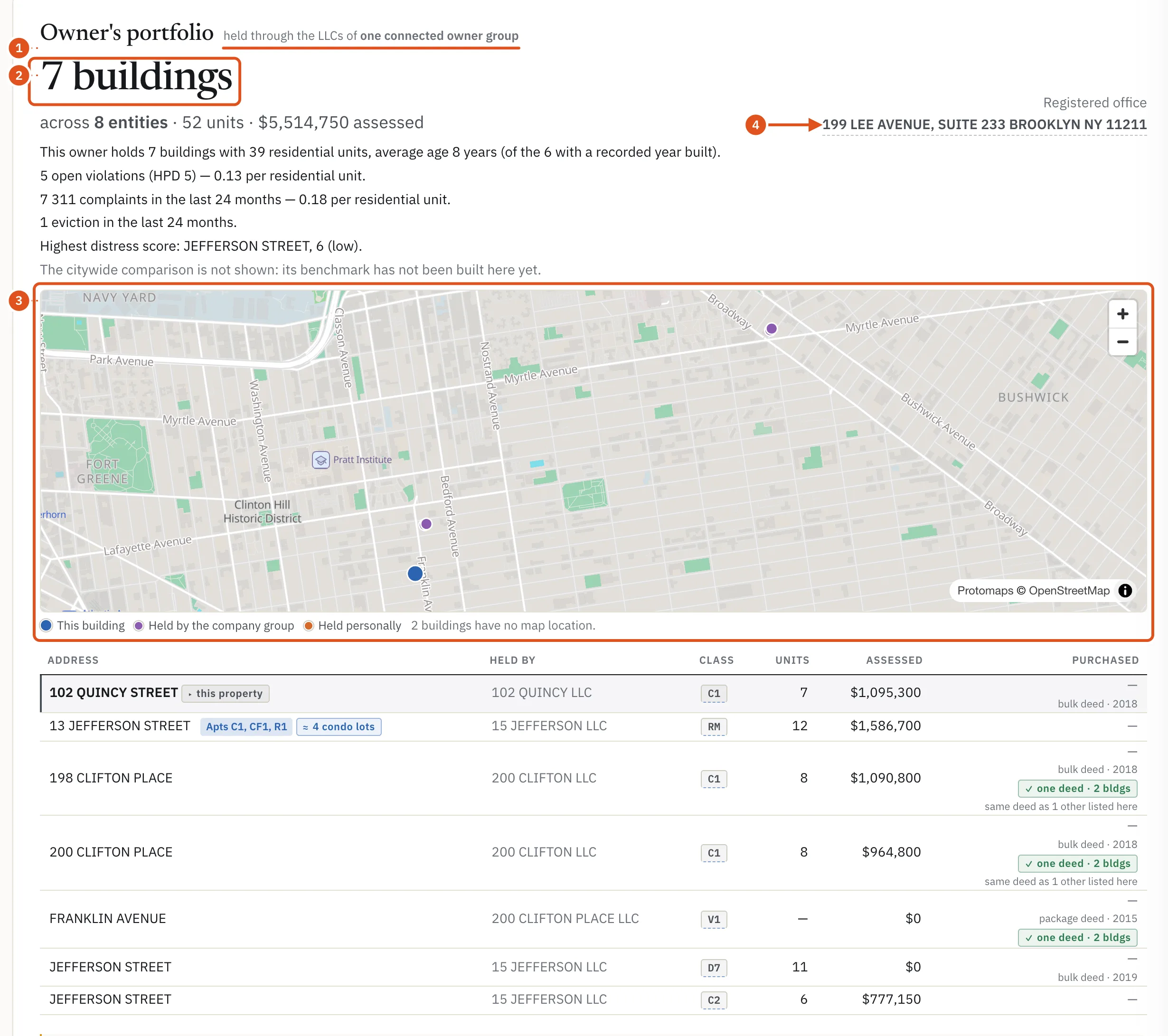
- How they were found
- Buildings held
- Each building on the map
- What else files here
Notes worth reading
- Holder per the latest recorded deed — the tax roll still names a previous owner. The card follows the deed.
- One connected owner group — the buildings are linked through confirmed evidence, listed after Grouped on:, and every building in the group shows the same list.
- … further building(s) match this owner's name but not their mailing address — deliberately not listed. A common name alone does not make a holding.
- Sold since — no longer held — buildings the roll still credits to this owner but a later deed shows were sold, with the date and buyer. They are left out of every total.
Connected buildings
Connected buildings casts a wider net: Buildings connected to this owner through a shared registered office, an HPD registration, or a shared deed mailing address. Crowded addresses, such as a filing service's door used by hundreds of companies, are excluded. Open What this cannot see for the gaps in the evidence.
The headline counts the connected buildings and says how they were reached, and flags a condominium sponsor, not a spread portfolio when most of the lots are units of one building.
The table has the portfolio's columns plus three about the link: Tier, its strength; Basis, the evidence behind it; and Source, the record it came from. Open Links traversed — the gate metrics to see every link BlockLot followed, including rejected ones: how many names and lots share the address, and kept or ✕ not counted with the reason. A link marked agent rests on a managing agent, who is hired help, not an owner.
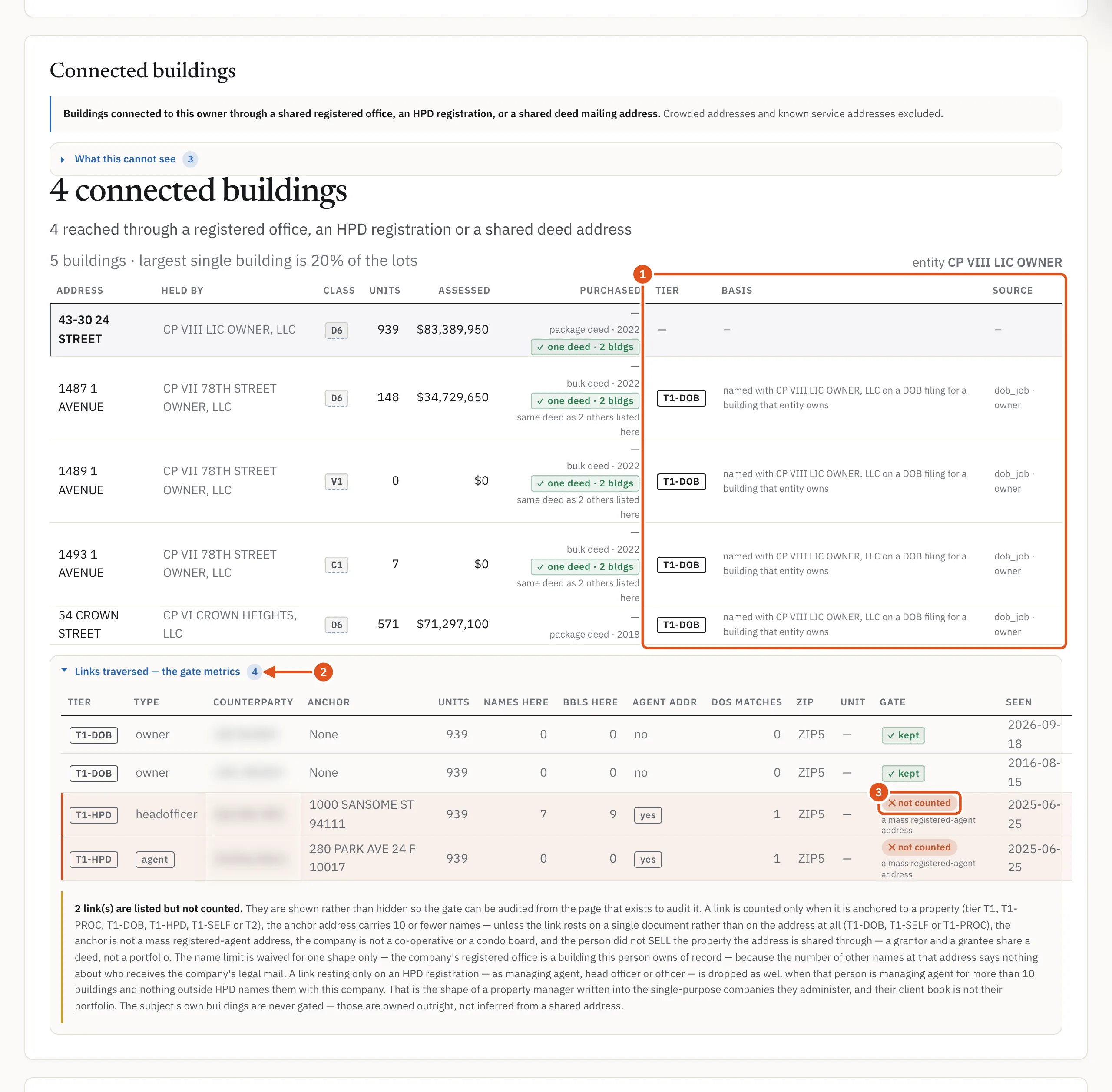
- The evidence for each link
- Open the evidence
- A rejected link
Staten Island deeds are not in ACRIS, the City Register's online records, so connections there rest on HPD registrations and the State business registry alone, and the card says so.
Companies registered with the owner
In the Owner card, collapsed lists show other companies registered at the same address in the New York State business registry: Registered at this property and Registered at the owner's address. Open one to see the companies, split into Same suite and the weaker Same building, different suite, and any people named to receive legal papers for them, under Named process agents — natural persons. For a small company that person is often the owner.
Sharing an office suggests common control, not ownership: an accountant can register unrelated clients from one storefront. An address used by a great many companies is treated as a filing service, and its companies are counted but not listed.
Checking a link
- Open the building from the table and read its Owner card and Last sold.
- Open Deed parties in its Owner card to see the names and mailing addresses on the deeds.
- Open the company from Held by to see its filings and officers on its company page.
- Search for one of the owner's companies and follow its office ↗ link to the owner office page, which lists every building held by the companies filing from that office.
- Before you act, confirm the owner on the recorded deed.