Learn NYC property · Violations and enforcement
DOB violations and ECB summonses: classes, cures and penalties
DOB violations and ECB summonses explained: Class 1, 2 and 3, cures, penalties and defaults, and why paying a fine does not close a violation.
When the City's Department of Buildings (DOB) finds something wrong with a building or a construction site, it can write one of two things. One is a summons heard at OATH, the City's administrative court — still called an ECB violation on most records. The other is a DOB violation, an order DOB enforces itself. Both are public, both stay on the building's record until they are cleared, and both matter to anyone buying, lending against or renovating a building.
This guide explains the two, the three classes of summons, how one is cleared, and what it costs. It is not about HPD violations, which concern the condition of apartments and follow a different system.
The ECB summons
An ECB summons is a notice a DOB inspector writes when work, a building or a site breaks the City's Construction Codes or the Zoning Resolution. Most records call it an ECB violation, and DOB's newer pages an "OATH summons"; ECB violations and ECB summonses are the same thing. The name comes from the Environmental Control Board, which used to hear these cases and was moved under the Office of Administrative Trials and Hearings (OATH) in 2008. OATH is not part of DOB: DOB writes the summons, and OATH's hearing officers decide it. The summons names a respondent — usually the owner, sometimes a contractor or a tenant — and gives a hearing date.
The three classes
Every summons DOB has written since July 1, 2008 carries a class. Older summonses say only hazardous or non-hazardous.
| Class | Means | Up to | Cure? |
|---|---|---|---|
| 1 | Immediately hazardous | $25,000 | Never |
| 2 | Major | $10,000 | Some |
| 3 | Lesser | $500 | Always |
The maximum is per violation, from the City's Construction Codes (§28-202.1). An uncorrected Class 1 can add up to $1,000 a day, and a Class 2 up to $250 a month, when the summons says so.
- A Class 1 violation is immediately hazardous: a threat serious enough to need correcting at once. The law also fixes some conditions as Class 1 whatever their size — working through a stop work order, occupying a building without a required Certificate of Occupancy, converting a building into several extra apartments illegally, demolishing without a permit.
- A Class 2 violation is major: it affects safety or the public but does not need correcting immediately. Failing to file a required facade, boiler, elevator or retaining-wall inspection report is Class 2 by law.
- A Class 3 violation is lesser — the paperwork and small things.
Right now 280,320 DOB summonses are open citywide, by BlockLot Intelligence's count: 85,197 of them Class 1.
Every summons DOB wrote to the Environmental Control Board (now heard at OATH) whose status on DOB's record is active: not yet resolved by a certificate of correction, a cure or a dismissal. BlockLot Intelligence, computed October 9, 2026.
From summons to resolved
- A cure. For every Class 3 summons, and for the Class 2 summonses DOB's schedule marks as curable, the respondent can fix the condition and file a certificate of correction by the cure date printed on the summons. If DOB accepts it, there is no hearing and no penalty. A cure still counts as admitting the violation. A summons with no cure date cannot be cured, and a Class 1 never can.
- A settlement before the hearing. For some summonses DOB offers a stipulation: the respondent admits the violation, pays half the hearing penalty and gets 75 days from the first hearing date to correct it.
- The hearing. OATH decides whether the violation happened. A respondent who proves at the hearing that the condition was already corrected can have the penalty halved. Hearing officers cannot change the amount itself: penalties are set by DOB's schedule.
- A default. If nobody answers the summons, OATH finds the respondent in violation by default, and for a DOB summons the default penalty is generally five times the standard one, up to the class maximum. If the condition is later certified as corrected, DOB's rules cut a default penalty to half, or to the standard penalty if that is higher.
Repeat and serious cases lose these discounts. A summons charged as aggravated — the same violation by the same respondent within three years, or one that caused an accident or injury — cannot be cured, settled or mitigated, and carries higher penalties.
How last year's summonses ended
By BlockLot Intelligence's count of DOB's records, of the Class 1, 2 and 3 summonses DOB issued between October 9, 2024 and October 9, 2025, 48.1% were found in violation, 23.8% were decided by default because nobody answered, 7.2% were cured and 10.7% were dismissed.
Class 1, 2 and 3 summonses DOB issued 12 to 24 months ago, by the hearing status on DOB's record. Admitting the charge, paying it or agreeing a settlement all count as found in violation. BlockLot Intelligence, computed October 9, 2026.
What not answering costs shows in the penalties OATH imposed on those same summonses. A Class 1 decided at a hearing cost a median $2,500; on default, $12,500. A Class 2 cost $1,250 at a hearing and $6,250 on default. Those are exactly the standard and default penalties DOB's schedule sets for the most common charges, such as work without a permit.
| Class | At a hearing | On default |
|---|---|---|
| Class 1 | $2,500 | $12,500 |
| Class 2 | $1,250 | $6,250 |
| Class 3 | $500 | $500 |
The median penalty OATH imposed on Class 1, 2 and 3 summonses DOB issued 12 to 24 months ago: found in violation at a hearing, and by default when nobody answered the summons. BlockLot Intelligence, computed October 9, 2026.
The certificate of correction
A certificate of correction is the owner's proof to DOB that the condition behind a summons has been fixed — photographs, invoices, a professional's report, filed online in DOB NOW. DOB's Administrative Enforcement Unit reviews it; once it is accepted, the summons is resolved.
Paying the penalty does not resolve a summons. The penalty settles the money; the certificate settles the violation. Until DOB accepts a certificate or OATH dismisses the case, the summons stays open on the building's public record, however long ago the fine was paid. Not filing has its own consequences: DOB can write a new summons for failing to certify, and for a Class 1 at a construction site (one- to four-family homes aside) the failure carries a separate $5,000 penalty that must be paid before DOB issues permits or accepts the certificate.
By BlockLot Intelligence's count, the most common unpaid ticket DOB has written at a property is not a hazard at all but this paperwork: 25,061 unpaid DOB tickets, 15.2% of them, are for failing to file a certificate of correction DOB had ordered.
A worked example
A small mixed-use building on West 125th Street in Harlem, owned by a company, shows how a violation outlives its fine. In October 2022 a DOB inspector wrote three Class 1 summonses there: a new door cut through a brick wall without a permit, an illegal exit door into the rear yard, and a fire-escape passage blocked with equipment and debris. OATH found all three in violation that December, and the penalties were paid.
For the blocked passage, a certificate of correction was accepted, and that summons is resolved. For the two doors, no certificate was ever recorded — so, as of October 2026, nearly four years later both still show as open on DOB's record, with nothing owed. In July 2026 DOB wrote two new Class 1 summonses for failing to certify those corrections. Nobody answered, and OATH imposed default penalties totalling $8,810. One certificate filed in time would have closed the matter for the price of the original fines.
DOB violations
A DOB violation is different: a notice entered on DOB's own records that a property breaks the law, with an order to correct it. Unlike ECB summonses, DOB violations have no hearing. Many carry a civil penalty — most often for not filing a required inspection report: a facade report, a boiler inspection, an elevator test, a gas-piping inspection, energy benchmarking. A missing facade report, for example, is charged for every month it goes unfiled.
To clear one, the owner corrects the condition, sends proof to the unit that issued it and pays any civil penalty. On DOB's older system an open DOB violation shows without an asterisk and a dismissed one with an asterisk. DOB says plainly why this matters to a buyer: violations appear in a title search, open ones can stop an owner selling or refinancing, and DOB will not issue a new Certificate of Occupancy or a Letter of Completion while they remain.
Complaints and inspections
Most inspections start with a DOB complaint made through 311; DOB complaints are public, and a building's open ones are listed on its record. DOB sorts complaints by urgency: Priority A for emergencies such as accidents, unsafe demolition or a shaking building, and Priority B for everything else, such as an illegal conversion or a missing sidewalk shed. In fiscal year 2026 (July 2025 to June 2026) DOB received 21,471 Priority A complaints and reached them in 0.3 days on average, and 78,294 Priority B complaints, reached in 21.5 days on average. An inspection can end in a summons, a DOB violation, a stop work order, a referral to another agency — or nothing, if no violation is found.
Open violations, as BlockLot counts them
Open violations on a BlockLot page add up HPD's, DOB's and ECB's together, each read in its own agency's words: an HPD violation whose status is open, a DOB violation not dismissed or resolved, an ECB summons DOB still lists as active. Most violations on record citywide are closed, so a building's raw count of violations mostly measures its history; the open count is what is still unresolved. Open does not always mean unfixed: a corrected condition stays open until the paperwork closes it, as the example above shows.
Where you see this in BlockLot
On a building's page, Violations lists DOB's violations and the ECB summonses beside HPD's, open ones first, with the agency, the status on DOB's record, the penalty, the balance due and the respondent. The Compliance & distress signals card counts open DOB complaints and unpaid OATH tickets.
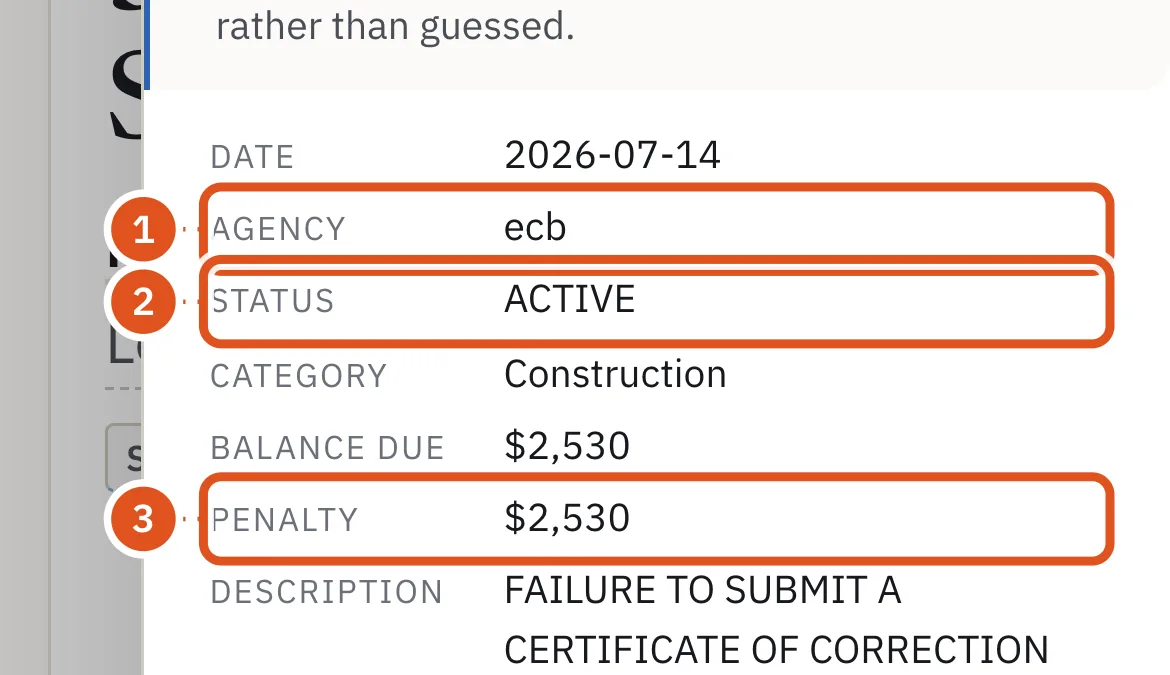
- The agency
- Still open on DOB's record
- What OATH imposed
Questions people ask
What is the difference between a DOB violation and an ECB violation? An ECB violation is a summons DOB writes that is decided at a hearing at OATH, with a penalty from DOB's schedule. A DOB violation is an order DOB enforces itself, with no hearing, often with a civil penalty for a missed filing.
I paid the fine. Why is the violation still open? Because paying settles the penalty, not the violation. An ECB summons stays open until DOB accepts a certificate of correction or OATH dismisses it.
What happens if I miss the OATH hearing? You are found in violation by default, usually at five times the standard penalty. By BlockLot Intelligence's count about 23.8% of DOB's summonses end that way. See OATH hearings and judgments for how to reopen a default.
Can I cure a Class 1 violation? No. Only Class 3 summonses and some Class 2 summonses can be cured, by the cure date printed on the summons. A Class 1 must be corrected at once and certified.
Do DOB violations stay with the building when it is sold? They stay on the building's record until they are cleared, and DOB says they appear in title searches and can block a sale, a refinancing or a new Certificate of Occupancy. A buyer usually asks the seller to clear them first.
Related
- Department of Buildings (DOB) — What New York City's Department of Buildings does, how a building permit works from filing to sign-off, what a Certificate of Occupancy is, and how DOB violations and stop work orders are issued and cleared.
- OATH hearings, unpaid tickets and docketed judgments — What OATH is, the tickets it hears, what a default costs and how to reopen one, and what a docketed judgment means for an owner and a building.
- HPD violations: Class A, B, C and I — What HPD housing violations are, what Class A, B, C and I mean, how long an owner has to fix and certify each, how a violation is closed or dismissed, and what happens when a Class C is ignored.
- Vacate orders: HPD, DOB and FDNY, and who pays for relocation — HPD, DOB and FDNY vacate orders: partial or full, how they are lifted, tenants' rights, and the relocation charges an owner can be billed.
- Construction sites: after-hours work, fences, stalled sites and city projects — The rules a New York City construction site follows next door — permitted work hours and after-hours variances, construction fences and sheds, what happens when a job stalls, and the city's school construction projects.
Sources
- BlockLot Intelligence — BlockLot's own analysis of the public records below, computed October 9, 2026.
- DOB — What is an OATH summons
- DOB — What is a DOB violation
- DOB — Resolve a summons or violation
- DOB — Certificate of Correction
- DOB — Certificate of Correction FAQ
- DOB — OATH hearings and penalties
- DOB — Penalty schedule, 1 RCNY §102-01
- DOB — Failure to certify a Class 1 violation, 1 RCNY §102-05
- DOB — Construction Codes, Title 28 Chapter 2 (Enforcement)
- DOB — Compliance violations: a step-by-step guide
- DOB — Resolve facade violations
- DOB — File a complaint
- OATH — Cure (February 2026)
- OATH — Certificate of Correction (February 2026)
- Mayor's Management Report, Fiscal 2026 — Department of Buildings
- NYC Open Data — DOB ECB Violations
- NYC Open Data — DOB Violations
- NYC Open Data — DOB Safety Violations