Learn NYC property · Violations and enforcement
OATH hearings, unpaid tickets and docketed judgments
What OATH is, the tickets it hears, what a default costs and how to reopen one, and what a docketed judgment means for an owner and a building.
The Office of Administrative Trials and Hearings, or OATH, is New York City's own independent administrative court. When a City inspector writes a ticket — Sanitation for a dirty sidewalk, the Department of Buildings for work without a permit, the Fire Department for a missed sprinkler test — OATH decides whether the ticket stands and what it costs. It is not part of the State court system, and you do not need a lawyer to appear there.
For a property owner, OATH matters in two ways. Tickets written at a building are usually written to its owner, and an unanswered ticket becomes a fine several times larger. And a fine left unpaid becomes a docketed judgment: a court judgment the City collects with interest, and in some cases a lien on the property itself.
What OATH is, and why records say "ECB"
OATH's Hearings Division decides summonses from more than 25 City enforcement agencies. Many of those cases were once heard by the Environmental Control Board (ECB), which a 2008 local law moved inside OATH. The board still exists in law, as part of OATH, and judgments for its kinds of tickets are still entered as the board's — which is why DOB's records say ECB violation, and the Department of Finance speaks of ECB judgments, years after the board stopped running its own hearings.
The tickets owners get
An OATH ticket, or OATH summons, is a ticket from a City agency that OATH decides. OATH tickets name a respondent — the person or company responsible — and a hearing date. The ones that reach property owners most often, according to the Department of Finance, are Sanitation tickets for dirty sidewalks, litter, uncleared snow and ice and illegal posters, and DOB summonses for work without a permit or for not complying with DOB's orders. The Fire Department writes them for missed inspections and tests of fire-protection systems, the Department of Environmental Protection for water, air and noise, and the Health Department for conditions that attract rodents.
Unpaid OATH tickets are the ones whose penalty is still owed, whether or not they have become judgments. They stay on OATH's records under the respondent's name until they are paid, settled or expire.
By BlockLot Intelligence's count of OATH's records, 1,490,516 unpaid tickets are located at a New York City property today, 62.1% of them from Sanitation. 71.2% of them have already become docketed judgments.
| Agency | Tickets | Median owed |
|---|---|---|
| Sanitation | 925,223 | $300 |
| Buildings | 164,469 | $3,125 |
| Health | 148,153 | $600 |
| Fire | 89,288 | $1,000 |
| Environment | 76,982 | $1,300 |
| Police | 39,411 | $25 |
| Other | 46,990 | $500 |
Every ticket heard at OATH that is located at a property and still shows a balance, and the middle ticket's balance. Paid tickets are not counted. BlockLot Intelligence, computed October 9, 2026.
The typical unpaid ticket is small — a Sanitation ticket's balance is a median $300 — but DOB's are larger, at a median $3,125, and they add up. The Department of Finance's own report put the City's collectible inventory of these judgments at $573 million on July 1, 2025, after setting aside $744.5 million it did not expect to collect; almost half of what was collectible was default penalties.
Answering a ticket
A respondent must act on or before the hearing date on the ticket. The choices:
- Admit and pay before the hearing date. That ends the case — and counts as admitting the violation.
- Fight it at a hearing by phone, by video, online, by mail or in person. A hearing can be rescheduled once.
- Take an agency's offer, where there is one. Some agencies offer a settlement or a chance to fix the condition first (DOB calls it a cure; see DOB violations and ECB summonses). The offer is the agency's, not OATH's.
OATH's hearing officers decide whether the violation happened. They cannot lower a penalty: the amounts are set by law and by each agency's schedule. A respondent who loses can appeal within 30 days of the decision (35 if it was mailed), and must generally pay the penalty first.
Defaults
If nobody answers by the hearing date, OATH issues a default decision: the respondent is found in violation without a hearing, and the penalty is higher — OATH says often two to three times the standard penalty, and for DOB's summonses it is generally five times. The City Charter treats a default as an admission and allows the maximum penalty.
A default can be reopened, but the door narrows with time:
- within 75 days of the default decision being mailed, a first request to reopen is granted;
- from 75 days to a year, the request must give a reasonable excuse;
- after a year, or for a second default, only in exceptional circumstances.
A default decision cannot be appealed; it is reopened instead, and the case is heard again. Defaults are common: in fiscal year 2026 OATH issued 453,811 default decisions out of 686,960 decisions in all.
Docketed judgments
When a penalty is not paid, OATH files it with the Civil Court of the City of New York, and it becomes a docketed judgment — docketed meaning entered in the court's records. The Department of Finance calls docketed judgments for these tickets an ECB judgment. From then on:
- interest runs on it, and the Department of Finance collects it — by notices and collection agencies, through City Marshals and the Sheriff, by holding up the respondent's City licences and permits, and by seizing property;
- the City can enforce it like a court judgment, including by placing liens on the respondent's real property;
- it lasts eight years from the docket date, under the City Charter.
DOF offers payment plans at 9% interest a year, and a settlement for some default judgments once the condition has been fixed: the respondent pays the base penalty, the interest and half of the default penalty, and the other half is waived.
By BlockLot Intelligence's count, of the unpaid tickets docketed in the last 12 months, the judgment was entered a median 111 days after the hearing date, and about 7 months after the ticket was written. 84.0% of those judgments followed a default.
Unpaid tickets at a property whose judgment was docketed in the last 365 days. The bar ends at the median; the pale band covers the middle half. BlockLot Intelligence, computed October 9, 2026.
Whose debt is it?
A ticket's penalty is owed by the respondent named on it — usually whoever owned or ran the building that day. The Department of Finance points out that each company is responsible only for the judgments filed under its own name, and someone named in error can appear at OATH and prove they did not own the property.
A docketed judgment can still reach real estate. The City may enforce it by placing a lien on property the respondent owns, which is why a buyer's title search looks for judgments against the seller. And some judgments for DOB summonses become a tax lien on the property, billed with the property tax and sold in the City's lien sale like unpaid tax: judgments against homes of up to three units, judgments for illegally converting a building into three or more extra units, and large balances on bigger buildings — $30,000 or more on a residential building of 6 to 19 units, $60,000 or more on buildings of 20 or more units or with commercial space. In fiscal year 2025 the Department of Finance converted 1,108 such violations, totalling $9.1 million, into property liens.
A worked example
A small company-owned building on Beaver Street in the Financial District shows the usual path. Between May and September 2025 Sanitation wrote it four tickets, three for putting out garbage without proper containers and one for a dirty sidewalk, each for $300. Each had a hearing date about three months later; nobody answered any of them, and each was decided by default. About three to four months after each hearing the judgment was docketed — on our records always on the last day of a month — and, as of October 2026, all four are still unpaid: $1,200 in judgments against the owning company, gaining interest, for what began as garbage set out the wrong way.
Where you see this in BlockLot
On a building's page, the Compliance & distress signals card shows Unpaid OATH tickets — how many tickets at the building still owe money, the balance OATH's records show, and how many have a docketed judgment. Only unpaid tickets are counted; the balance is OATH's own figure and can include default penalties. The building's distress score counts the unpaid balance too.
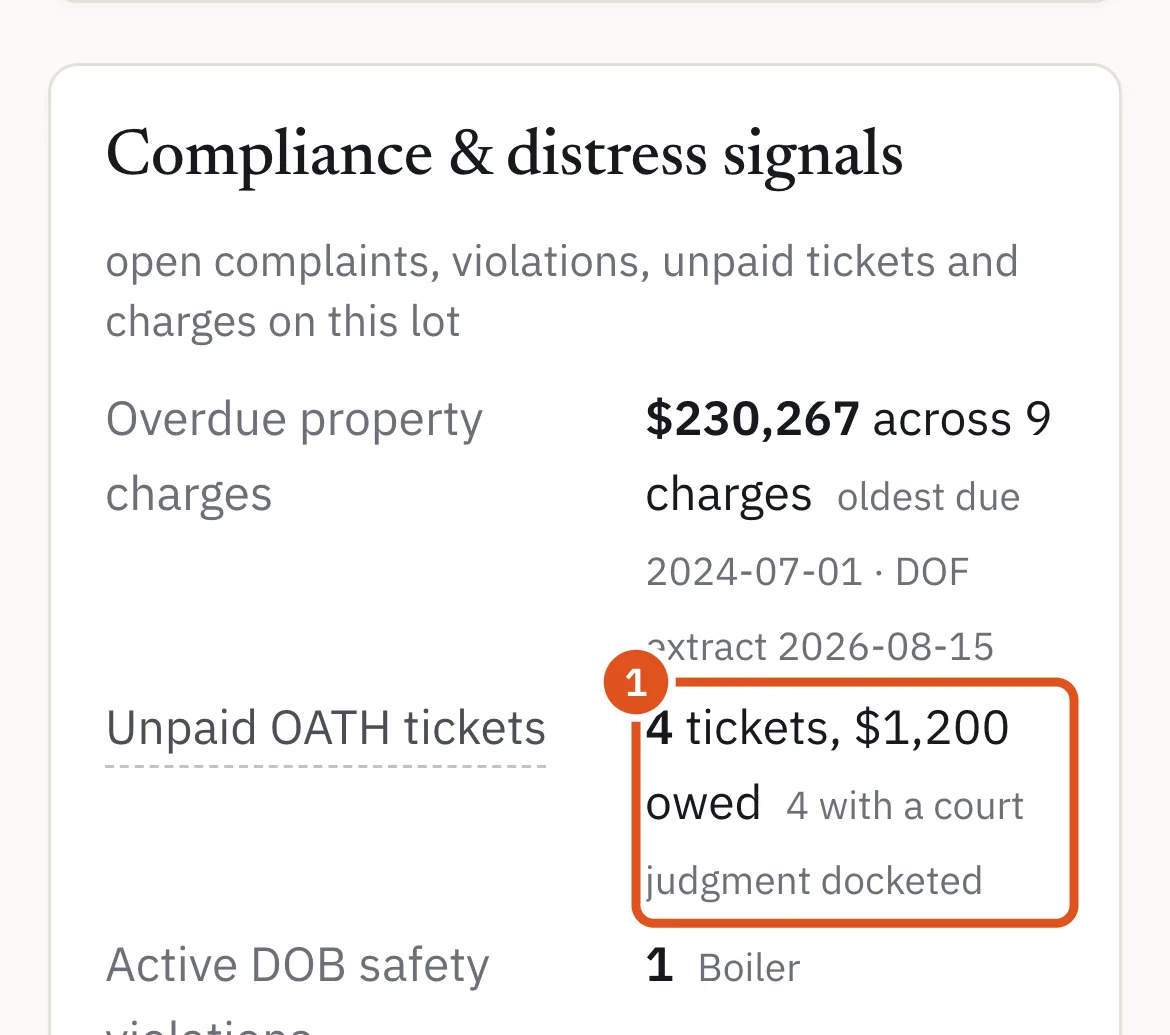
- Tickets, balance and judgments
Questions people ask
What is an OATH ticket? A summons from a City agency — Sanitation, Buildings, the Fire Department and others — that OATH, the City's administrative court, decides. It names a respondent and a hearing date.
What happens if I ignore an OATH ticket? You are found in violation by default at a higher penalty, and if it stays unpaid it becomes a docketed judgment that collects interest and that the City can enforce. By BlockLot Intelligence's count, most unpaid tickets that became judgments in the last year had been decided by default.
Can I reopen a default? Yes. A first request within 75 days of the default decision being mailed is granted; after that you need a reasonable excuse, and after a year exceptional circumstances.
Does a docketed judgment go away? It lasts eight years from the docket date under the City Charter. Paying it, or settling it under the Department of Finance's program, ends it sooner.
If I buy a building, do I inherit the seller's OATH judgments? A judgment is owed by the respondent named on it. But the City can enforce a judgment by a lien on the respondent's property, and some DOB judgments are converted into a tax lien on the building itself, so a buyer's title search looks for both.
Related
- DOB violations and ECB summonses: classes, cures and penalties — DOB violations and ECB summonses explained: Class 1, 2 and 3, cures, penalties and defaults, and why paying a fine does not close a violation.
- Department of Buildings (DOB) — What New York City's Department of Buildings does, how a building permit works from filing to sign-off, what a Certificate of Occupancy is, and how DOB violations and stop work orders are issued and cleared.
- HPD violations: Class A, B, C and I — What HPD housing violations are, what Class A, B, C and I mean, how long an owner has to fix and certify each, how a violation is closed or dismissed, and what happens when a Class C is ignored.
- BlockLot's distress score: what it measures — How BlockLot's distress score turns violations, court cases, vacate orders, liens and unpaid charges into one number from 0 to 100, and what it is not.
Sources
- BlockLot Intelligence — BlockLot's own analysis of the public records below, computed October 9, 2026.
- OATH — About OATH
- OATH — Hearings and defaults
- OATH — Hearings FAQ
- OATH — Payments and penalties
- OATH — Rules on defaults, 48 RCNY §6-20 and §6-21
- OATH — Rules on appeals, 48 RCNY §6-19
- OATH — When you have been found in violation by default (February 2026)
- OATH — Check a case's status (Summons Finder)
- NYC Charter §1049-a (OATH's published copy)
- City Council — Local Law 35 of 2008, consolidating the ECB with OATH
- DOF — Annual Report on ECB-Adjudicated Judgments (November 2025)
- DOF — Collections, and DOB judgments converted to tax liens
- DOF — Payment plans for ECB judgment debt
- DOF — ECB settlement program FAQs
- DOB — Construction Codes, Title 28 Chapter 2 (§28-204.6, judgments as tax liens)
- Mayor's Management Report, Fiscal 2026 — OATH
- NYC Open Data — OATH Hearings Division Case Status