Learn NYC property · Agencies and the basics
Department of Housing Preservation and Development (HPD)
What New York City's housing agency does — enforcing the Housing Maintenance Code, financing affordable homes, running the lotteries and Section 8 — and how every rental building must register with HPD each year, naming its owner and a managing agent.
The Department of Housing Preservation and Development, known as HPD, is New York City's housing agency. It sets out to keep the city's homes safe and affordable: it inspects apartments and enforces the rules for heat, repairs and pests, it finances the building and preservation of affordable housing, and it keeps a register of who owns and manages every rental building in the city.
For an owner, HPD is the agency that writes housing violations, that must be told every year who owns and runs the building, and that can make emergency repairs and bill the owner for them. For a tenant, it is where a 311 complaint about heat or a leak ends up. For a buyer or lender, its records — violations, registrations, litigation — are a large part of what a building's history says.
What HPD does
- Code enforcement. HPD enforces the Housing Maintenance Code, the City's rules for the condition of homes. Complaints reach it mostly through 311; an inspector can write a violation only for a condition seen in person. See HPD violations for the classes and deadlines.
- Emergency repairs. When an owner does not fix an immediately hazardous condition in time, HPD's Emergency Repair Program does the work and bills the owner through the Department of Finance. An unpaid charge becomes a tax lien on the property.
- Housing litigation. HPD's lawyers bring cases in Housing Court to force repairs, restore heat or gas, and collect penalties.
- Preservation. Loans, tax exemptions and subsidies that keep existing buildings affordable and in good repair.
- New construction. Financing for new affordable rentals, co-ops and condominiums, senior and supportive housing.
- Lotteries and rent help. NYC Housing Connect, the City's portal for affordable-housing lotteries, and HPD's Section 8 vouchers, which pay part of a family's rent to the landlord.
- Tenant protection. The Certification of No Harassment program, which can bar permits for owners found to have harassed tenants, and the lead-paint rules of Local Law 1 of 2004.
HPD in numbers
The Mayor's Management Report for fiscal year 2026 (July 2025 to June 2026) counted HPD's year:
| Measure | Fiscal 2026 |
|---|---|
| Housing problems reported | 950,750 |
| Inspections attempted | 852,777 |
| Violations issued | 874,522 |
| Of them Class C | 278,252 |
| Affordable homes started | 26,913 |
| Section 8 households helped | 36,188 |
The same report puts the median time for HPD to close an emergency problem at 3.0 days, and a non-emergency one at 12.0 days.
BlockLot counts 2,869,849 HPD violations open across the city today. In the last 12 months New Yorkers made 905,241 housing complaints to 311, and HPD inspected a median 5.2 days after the call, by BlockLot Intelligence's count.
Property registration
Every residential building of three or more homes in New York City must be registered with HPD, every year. So must a one- or two-family house when neither the owner nor a member of the owner's family lives there. Condominium and co-op boards register the building as a whole; the unit owners and shareholders do not register separately. Buildings owned by the City, its agencies and the New York City Housing Authority are exempt.
When. Registration is renewed each year by September 1. A new owner must register within five days of taking title — the registration statement goes to the City Register with the deed, and the City Register will not record a deed to an apartment building without it. A change of address, officers or managing agent is filed within five days.
The fee. $13 a year. The Department of Finance bills it on the property tax statement due July 1; it is not sent to HPD. A registration counts only when HPD has both the signed form and the payment. Owners file online, through HPD's Property Registration Online System (PROS), and then sign and mail the form.
Who is named
The registration names:
- the owner — and for a company, its officers and anyone owning more than a quarter of it. HPD's published file marks one officer as the head officer;
- a managing agent for any building of three or more homes;
- a 24-hour emergency telephone number, which HPD keeps private and uses only in emergencies.
A post office box is not an acceptable business address.
A managing agent is the person the owner puts in charge of running and maintaining the building, and of authorizing emergency repairs. The Housing Maintenance Code says the agent must be a natural person — not a company — over 21, who lives in the city or regularly works from an office there. An owner or an officer who qualifies may name themselves. HPD mails violations to the names on the registration, and the agent's name and address must also be on tenants' rent bills.
What registration looks like across the city
By BlockLot Intelligence's count of HPD's published registrations, 154,285 buildings held a registration in force on July 31, 2026, the newest date in HPD's published file. 69.7% are owned by a company, and 84.8% name a managing agent.
Registrations still in force on the date of the newest registration in HPD's published file, one per building, by the owner the registration names. BlockLot Intelligence, computed October 11, 2026.
Brooklyn has the most registered buildings, 61,232, then Queens with 42,505, Manhattan 26,229, the Bronx 19,884 and Staten Island 4,435.
If an owner does not register
- Fines. $500 to $1,500 for a building of five or fewer homes, and $1,000 to $5,000 for a larger one. False information on a registration costs $750 to $5,000, and HPD voids it. Some older HPD material still quotes $250 to $500; the current amounts date from Local Law 71 of 2023.
- No case for unpaid rent. While a building is unregistered, its owner cannot recover an apartment in Housing Court for nonpayment of rent, and must show the registration number to bring such a case at all.
- No certifying violations. HPD does not accept certifications of correction or dismissal requests from an unregistered building, and a failure to register is itself written up as a Class I order on the building's record.
A worked example. 165 East 19 Street in Brooklyn, a 107-unit apartment building owned by a limited liability company, is registered with HPD through September 1, 2027. Its registration lists the four kinds of contact HPD most often sees: a corporate owner, the company's head officer, a managing agent and a site manager.
HPD Online
HPD Online (also written HPDONLINE) is HPD's public search. Look a building up by address, by borough, block and lot, by BIN or by registration number, and it shows the registration and its dates, complaints from the last two years, open violations, repair charges, Housing Court cases, and repair and vacate orders.
The heat season
From October 1 to May 31, the heat season, owners must keep apartments at least 68°F between 6 a.m. and 10 p.m. whenever it is below 55°F outside, and at least 62°F overnight whatever the weather. Hot water must be at least 120°F. Heat complaints are HPD's single largest kind: in the last 12 months 311 sent HPD 905,241 housing complaints that named a building, and heat and hot water calls were closed a median 1.7 days after the call.
Where you see this in BlockLot
A building's page brings HPD's records together with every other agency's. Violations lists HPD's violations beside DOB's; 311 complaints lists the calls; and HPD registration contacts, under Contacts, shows the owner, officers and managing agent from the building's current registration and the dates it runs between.
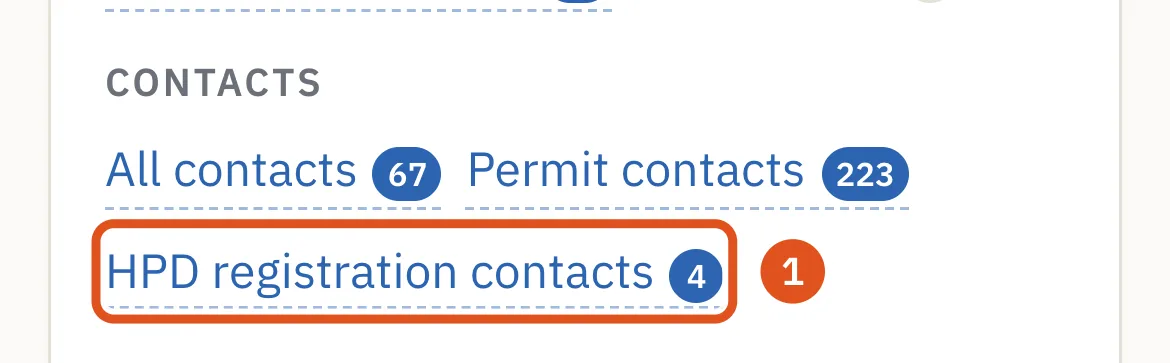
- The owner, officers and managing agent HPD has on file
Questions people ask
Does my building need to be registered with HPD? Yes, if it has three or more homes, or if it is a one- or two-family house in which neither you nor your family lives. Registration is renewed every year by September 1 and costs $13.
How do I find who manages a building? Look the building up in HPD Online. Its registration lists the owner and the managing agent, and the agent's name and address must also be on the tenants' rent bills.
Can a managing agent be a company? No. The Housing Maintenance Code requires a natural person over 21 who lives in New York City or regularly works from an office there. The agent may work for a management company.
What happens if a landlord does not register? Fines of $500 to $5,000, and the landlord cannot bring a Housing Court case to recover an apartment for unpaid rent until the building is registered.
Is HPD the same as NYCHA? No. The New York City Housing Authority owns and runs public housing. HPD regulates privately owned housing and finances affordable homes, and NYCHA's buildings do not register with it.
What is the difference between HPD and DOB? HPD deals with the condition of homes people live in — heat, leaks, pests, repairs. The Department of Buildings deals with construction, alterations and a building's legal use.
Related
- HPD violations: Class A, B, C and I — What HPD housing violations are, what Class A, B, C and I mean, how long an owner has to fix and certify each, how a violation is closed or dismissed, and what happens when a Class C is ignored.
- Certification of No Harassment (CONH) — What a Certification of No Harassment is, which buildings need one and for what work, how HPD investigates, what happens if harassment is found — and why the program became permanent in 2026.
- Department of Buildings (DOB) — What New York City's Department of Buildings does, how a building permit works from filing to sign-off, what a Certificate of Occupancy is, and how DOB violations and stop work orders are issued and cleared.
- Department of Finance (DOF) — What New York City's Department of Finance does for property — the yearly assessment roll, the property tax bill and its calendar, the City Register that records deeds and mortgages, the transfer taxes, exemptions and the charges other agencies put on a property's account.
- 311, community districts and the map units a property sits in — What 311 is and what happens to a building complaint made to it, and the map units every New York City lot is filed under — community districts and boards, City Council districts, census tracts and Neighborhood Tabulation Areas.
- HUD-assisted housing: project-based Section 8, Section 202 and 811 contracts — HUD rental assistance contracts on NYC buildings: project-based Section 8, Section 202 and 811, how tenants' rent works, what happens when a contract expires, and opt-outs.
Sources
- BlockLot Intelligence — BlockLot's own analysis of the public records below, computed October 11, 2026.
- HPD — About HPD
- HPD — Register your property
- NYC Housing Maintenance Code, §§ 27-2097 to 27-2109 (registration)
- Mayor's Management Report, Fiscal 2026 — HPD
- HPD — HPD Online
- HPD — HPD Online user guide (September 2025)
- HPD — Preservation
- HPD — New construction financing
- HPD — About Section 8
- HPD — Emergency Repair Program
- HPD — Housing litigation
- HPD — Lead-based paint
- HPD — Heat and hot water
- ACCESS NYC — NYC Housing Connect
- NYC Open Data — Multiple Dwelling Registrations
- NYC Open Data — Registration Contacts