Learn NYC property · Violations and enforcement
Housing Court, HP actions and HPD litigation
Housing Court for owners and buyers: HP actions, the cases HPD brings, harassment findings, marshal evictions and HPD's Speculation Watch List.
Housing Court is the Housing Part of the Civil Court of the City of New York: the court where landlords and tenants bring their disputes, and where the City's Department of Housing Preservation and Development (HPD) takes owners who do not keep their buildings safe. It hears landlords' cases to recover an apartment — for unpaid rent (nonpayment cases) or because a tenant has no right to stay (holdover cases) — and tenants' and HPD's cases to make an owner make repairs.
For an owner or a buyer, a building's Housing Court history is one of the clearest records of how it has been run: who sued whom, over what, and whether the court found harassment.
Cases about a building's condition
Housing-court cases about a building's condition come in two kinds, and HPD's records list both. Tenants bring their own repair cases, and HPD is automatically a party to them; HPD's lawyers in its Housing Litigation Division bring cases of their own. BlockLot counts a building's open housing-court cases from those records: the cases whose status HPD still lists as pending.
By BlockLot Intelligence's count of HPD's records, 9,292 such cases were opened in the last 12 months — 72.1% of them by tenants.
Cases in HPD's housing litigation records whose open date falls in the last 365 days: cases HPD brought and tenants' cases in which HPD is a party. BlockLot Intelligence, computed October 11, 2026.
HP actions
An HP action is a tenant's case to make the owner correct violations. HP actions are started at the Housing Court clerk's office, without a lawyer; the tenant can ask for an HPD inspection before the court date, and the court can order the owner to correct the conditions by a deadline. If the owner does not comply, the tenant can go back to court for civil penalties or a finding of contempt. HPD says this route is safer for a tenant than withholding rent, which can lead to an eviction case.
HPD's own cases
HPD litigation is brought by HPD's Housing Litigation Division to get court orders to correct conditions, civil penalties and, where orders are ignored, contempt sanctions. The main kinds:
- Heat and hot water — to restore and maintain heat and hot water, with penalties;
- Comprehensive — to correct every outstanding violation in a building, including for failing to certify corrections or to register the building;
- False certification — penalties against owners who told HPD a violation was fixed when it was not;
- Access warrants — when HPD's inspectors or repair crews have been refused entry;
- 7A — asking the court to appoint an administrator to run the building (see 7A administrators).
HPD's record of a case says whether a judgment left civil penalties owing to HPD. Its records also name the respondent, who was not necessarily the owner at the time of the case — and may not be now. Comprehensive cases can end in repairs: in fiscal year 2026, 21,573 violations were dismissed through them, and cases covering 3,546 apartments closed with the work done and the penalties paid.
Harassment
Tenants can also sue over harassment: anything an owner does, or fails to do, to drive them out or make them give up their rights, such as threats or repeated cuts to essential services. A finding of harassment comes either after a trial or, when the owner never appears, after inquest, by default. Since Local Law 165 of 2017 the court can impose civil penalties of $2,000 to $10,000 for each apartment affected — at least $4,000 where the owner was found to have harassed tenants in the previous five years — and order the owner to stop. A finding can also put a building on HPD's Certification of No Harassment list, which restricts demolition and major alterations.
Findings are rare compared with claims: by BlockLot Intelligence's count, HPD's records hold 333 findings of harassment since 2006, against 1,752 tenant cases claiming harassment in the last 12 months alone.
Evictions
A landlord who wins a nonpayment or holdover case does not evict anyone personally. Only a City Marshal — appointed by the Mayor for five years, regulated by the Department of Investigation, paid by fees rather than a City salary — can carry out a marshal eviction, and only after the court has issued a warrant of eviction and at least 14 days after serving a notice of eviction. City Marshals report every one, and most marshal evictions are recorded as possessions: the tenant is removed and their belongings stay with the landlord for safekeeping.
Most eviction cases do not end that way. In 2025 landlords filed 114,837 residential eviction cases, courts issued 61,862 warrants, and marshals carried out 17,746 residential evictions, according to the City's Office of Civil Justice. The City's own data, as BlockLot Intelligence counts it, shows evictions collapsing in 2020 and 2021 and climbing back since:
Every residential eviction a City Marshal reported as executed, by calendar year, from 2017, the first full year the City publishes. BlockLot Intelligence, computed October 11, 2026.
The whole process — the notices, the marshal's notice, stays and illegal lockouts — is on Evictions and City Marshals.
Since Right to Counsel — the City's Universal Access to Counsel program, Local Law 136 of 2017 — eligible tenants facing eviction in Housing Court are given a City-funded lawyer.
The Speculation Watch List
HPD's Speculation Watch List, created by Local Law 7 of 2018, flags rent-regulated apartment buildings bought at prices high for the income they earn — which HPD reads as a sign of greater risk of tenant harassment. A building goes on the list when most of its apartments are rent-regulated, it has at least 11 apartments (or 7 with commercial space), and it sold at a capitalization rate — net income divided by price — below the median for its borough over the previous four quarters. HPD updates the list every quarter, from sales since July 1, 2018. A listed building may be steered toward preservation programs or referred for enforcement; the list itself is not a finding of wrongdoing.
A worked example
A 53-apartment building on Manhattan Avenue in Harlem, owned by a company, has 24 housing-court cases in HPD's records since 2004 — tenants' repair cases most years, and HPD heat cases in many winters. The pressure rose recently: HPD brought a heat case in November 2024, a comprehensive case in June 2025 and another heat case that December; in February 2026 HPD placed the building in its Alternative Enforcement Program; and that spring tenants filed two more cases, one claiming harassment, both still pending as of October 2026. None of HPD's records shows a harassment finding or penalties owing to HPD.
Where you see this in BlockLot
On a building's page, Housing court (litigations) lists every case in HPD's records — the type, the date it opened, its status, whether a judgment left penalties owing to HPD, and the respondent HPD named. Evictions lists the marshals' executed evictions at the building, and Speculation watch shows a listing with its price and capitalization rate. An owner's page counts the open housing-court cases across the portfolio, and the distress score weighs them.
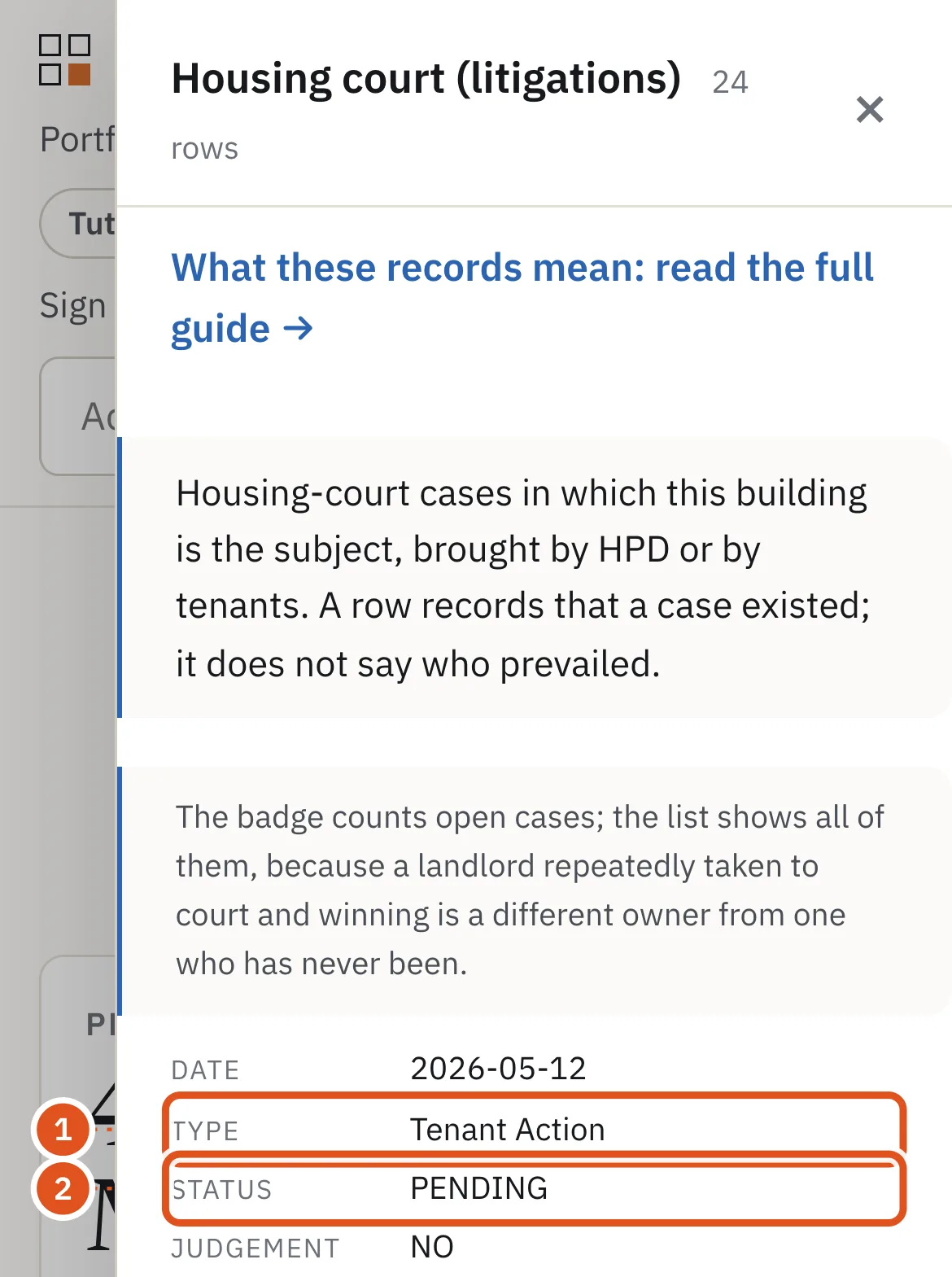
- Tenant or HPD case
- Pending or closed
Questions people ask
What is an HP action? A tenant's case in Housing Court to make the owner make repairs. HPD is automatically a party, and the court can order the work done, impose penalties and hold the owner in contempt.
Does HPD sue landlords? Yes. Its Housing Litigation Division brings cases over heat and hot water, over all of a building's violations, over false certifications and for access to make repairs, and can ask the court to appoint a 7A administrator.
What happens if an owner is found to have harassed tenants? Civil penalties of $2,000 to $10,000 per affected apartment, more after a prior finding, a court order to stop, and possibly a place on HPD's Certification of No Harassment list.
Can a landlord evict a tenant without going to court? No. Only a City Marshal, acting on a court's warrant of eviction and after at least 14 days' notice, can carry one out.
What is the Speculation Watch List? HPD's quarterly list of rent-regulated buildings bought at an unusually low capitalization rate for their borough, which HPD reads as a sign of greater risk of tenant harassment.
Related
- HPD violations: Class A, B, C and I — What HPD housing violations are, what Class A, B, C and I mean, how long an owner has to fix and certify each, how a violation is closed or dismissed, and what happens when a Class C is ignored.
- HPD emergency repairs, repair charges and 7A administrators — How HPD's Emergency Repair Program fixes hazards an owner ignores and bills the owner, how repair charges become liens, and what a 7A administrator does.
- The Alternative Enforcement Program (AEP) — How HPD picks 250 distressed buildings a year for its Alternative Enforcement Program, the four months to act, the fees and orders, and discharge.
- Certification of No Harassment (CONH) — What a Certification of No Harassment is, which buildings need one and for what work, how HPD investigates, what happens if harassment is found — and why the program became permanent in 2026.
- Evictions and City Marshals in New York City — How a New York City eviction works, from the 14-day rent demand to the City Marshal: notices, nonpayment and holdover cases, warrants, stays, illegal lockouts and the yearly numbers.
Sources
- BlockLot Intelligence — BlockLot's own analysis of the public records below, computed October 11, 2026.
- HPD — Housing Court
- HPD — Housing litigation
- HPD — Speculation Watch List
- HPD — Speculation Watch List rules, 28 RCNY Chapter 52 (2018)
- Local Law 7 of 2018 (the Speculation Watch List)
- Local Law 165 of 2017 (harassment penalties)
- DOI — New York City Marshals
- DOI — Marshals and evictions FAQ
- HRA Office of Civil Justice — Annual Report 2025
- HRA Office of Civil Justice — FY25 Annual Report Addendum
- Mayor's Management Report, Fiscal 2026 — HPD
- NYC Open Data — HPD Housing Litigations
- NYC Open Data — Evictions
- NYC Open Data — Speculation Watch List