Learn NYC property · Rent regulation and tenant protection
Evictions and City Marshals in New York City
How a New York City eviction works, from the 14-day rent demand to the City Marshal: notices, nonpayment and holdover cases, warrants, stays, illegal lockouts and the yearly numbers.
An eviction in New York City is the removal of a tenant by a public officer — a City Marshal or a deputy of the City's Sheriff — carrying out a warrant a court has issued after the landlord won a case in Housing Court. Nothing else is lawful: a landlord who changes the locks, removes a tenant's belongings or cuts off services to force someone out is committing a crime.
The process matters to both sides. A landlord who skips a notice can lose the case and start over months later; a tenant who knows the steps knows when help is still possible. For a buyer, a building's eviction history is part of the public record of how it has been run — see also Housing Court and HPD litigation.
Before any case: the notices
For unpaid rent, a landlord must first serve a written rent demand giving the tenant at least 14 days to pay or leave, served the way court papers are. Separately, once rent is five days late the landlord must send the tenant a written notice by certified mail; a landlord who does not can face that as a defense in court. Both are State law since 2019.
To end a tenancy or raise the rent by 5% or more, the landlord must give written notice of 30, 60 or 90 days, depending on how long the tenant has lived there — under a year, one to two years, or longer. Since August 2024 these notices, the rent demand and the court petition must also carry the Good Cause Eviction notice saying whether that law covers the apartment. A rent-stabilized tenant can be removed only on grounds the stabilization rules allow, usually after a notice to cure.
The case: nonpayment or holdover
Eviction cases are heard in Housing Court, the Housing Part of the City's Civil Court. There are two kinds:
- A nonpayment case asks for rent owed and possession if it is not paid. The tenant answers within 10 days of being served; if the tenant answers, a trial is set 3 to 8 days later, and if not, the landlord can win by default.
- A holdover case asks for possession because the tenant has no right to stay — a lease that ended, a breach of the lease, a nuisance, an illegal sublet, or an apartment that is not the tenant's primary home. Its papers must be served 10 to 17 days before the hearing.
Tenants facing eviction in Housing Court can get a free lawyer under the City's Right to Counsel: full representation for households at or below twice the federal poverty level and for everyone 60 or older, and advice for others. By the last quarter of the year to June 2025, 44% of tenants in eviction cases had full representation, up from 30% in fiscal year 2018, according to the City's Office of Civil Justice.
From judgment to the marshal
A landlord who wins gets a judgment of possession, and the court issues a warrant of eviction — addressed only to a City Marshal or the Sheriff. In New York City only those officers may ask the court for a warrant, and a landlord cannot simply call one in.
The marshal must then serve a notice of eviction at least 14 days before carrying it out — the City's Department of Investigation counts calendar days, weekends and holidays included, and since a 2024 law the notice is also filed electronically. The eviction itself happens on a business day between 8 a.m. and 5 p.m., never on a public holiday, with the landlord or a representative present. The Department of Investigation can suspend evictions on a given day for dangerous weather, as it did during a heat advisory on August 10, 2026, and a marshal must briefly delay where removing a sick or disabled child, or an infant, would be risky.
Until the eviction is carried out, it can still be stopped:
- in a nonpayment case, the court must cancel the warrant if the tenant pays or deposits all the rent due before the eviction, unless the landlord shows the rent was withheld in bad faith;
- the court may stay or cancel a warrant for good cause, on the tenant's request;
- a judge can stay a residential eviction for up to a year if the tenant cannot find similar housing nearby despite trying, or the move would cause extreme hardship — weighing ill health, children in local schools and the landlord's own hardship — provided the tenant deposits the rent. It does not apply where the landlord proves the tenant objectionable, or to rooms in hotels and rooming houses.
City Marshals
City Marshals are public officers appointed by the Mayor for five-year terms and supervised by the City's Department of Investigation (DOI). They are not City employees: they are paid by fees from the parties — under State law, for example, $15 for each person served with a notice of eviction and $75 to carry out the warrant — and keep 5% of money they collect on judgments, paying the City $1,500 a year plus 4.5% of their gross income. The law allows up to 83 marshals; DOI's list named 30 on October 9, 2026. A marshal eviction is one they carry out; the Sheriff's deputies, who are City employees, can carry out evictions too, at the same fees.
Marshals report every eviction they carry out, and the City publishes them. Most are recorded as legal possession: the tenant is removed and the locks changed, but the belongings stay in the landlord's care, held for the tenant. In an eviction in the narrow sense, the belongings go to a warehouse under the marshal's supervision.
By BlockLot Intelligence's count, 91.4% of the residential evictions in the last 12 months were legal possessions.
A few are ejectments — a separate court action to recover a home, which can be brought in Civil or Supreme Court.
How many evictions
Most eviction cases never reach a marshal. In the year to June 2025, landlords filed 114,390 eviction cases in Housing Court and courts issued 59,757 warrants, by the Office of Civil Justice's count; the Office notes that warrants tend to come one to two years after a case is filed. Before the pandemic, in 2019, there were 171,539 cases and 16,996 residential marshal evictions. Evictions all but stopped under the State's moratorium, which ended on January 15, 2022, and have climbed back since.
As BlockLot Intelligence counts the City's records, marshals carried out 16,375 residential evictions in the last 12 months — 33.3% of them in the Bronx:
Residential evictions City Marshals reported as carried out in the last 365 days, by the borough of the address. BlockLot Intelligence, computed October 11, 2026.
Every residential eviction a City Marshal reported as executed, by calendar year, from 2017, the first full year the City publishes. BlockLot Intelligence, computed October 11, 2026.
Commercial tenants are evicted through the same courts and marshals — 1,276 in the last 12 months — but the protections on this page for homes, including Right to Counsel, the one-year stay and the lockout law, apply only to residential tenants.
The City's records give the date an eviction was carried out but not the date the case began, so BlockLot does not time the whole process from them.
Illegal lockouts
Anyone who has lived in a home for 30 consecutive days or more, or who has a lease, can be removed only by the court process above. Under the State's unlawful eviction law, it is a crime — a class A misdemeanor — to force or threaten someone out, to remove their belongings or the door, to change or disable the lock without giving them a key, or to cut off essential services to make them leave. The civil penalty is $1,000 to $10,000 for each violation, plus up to $100 a day for not restoring the occupant. HPD says the City's own unlawful eviction law protects roommates and relatives who have lived in a home for 30 days even when they are not on the lease. A locked-out tenant can call the police or bring an illegal lockout case in Housing Court, and can sue for three times the damages.
Harassment that stops short of a lockout — repeated service cuts, threats, baseless court cases — is covered by the City's anti-harassment laws; see tenant harassment and harassment findings in Housing Court.
A worked example
At 104-20 Queens Boulevard in Queens, a rental complex of 1,327 homes owned by a company, the City's records of marshal evictions show how quickly a building's count can move.
By BlockLot Intelligence's count, marshals carried out 0 residential evictions there in 2023, 1 in 2024 and 30 in 2025 — and 17 in the last 12 months, about 1.3 for every 100 homes. The records do not say why: each is the end of a separate court case, and the case files are with the court.
Where you see this in BlockLot
A building's page lists the evictions marshals carried out there in its Evictions records — the date, whether it was residential or commercial, and whether it was an ejectment — without the apartment number. The owner page counts them across the portfolio, and area pages total Residential evictions, 24 months and Commercial evictions, 24 months.
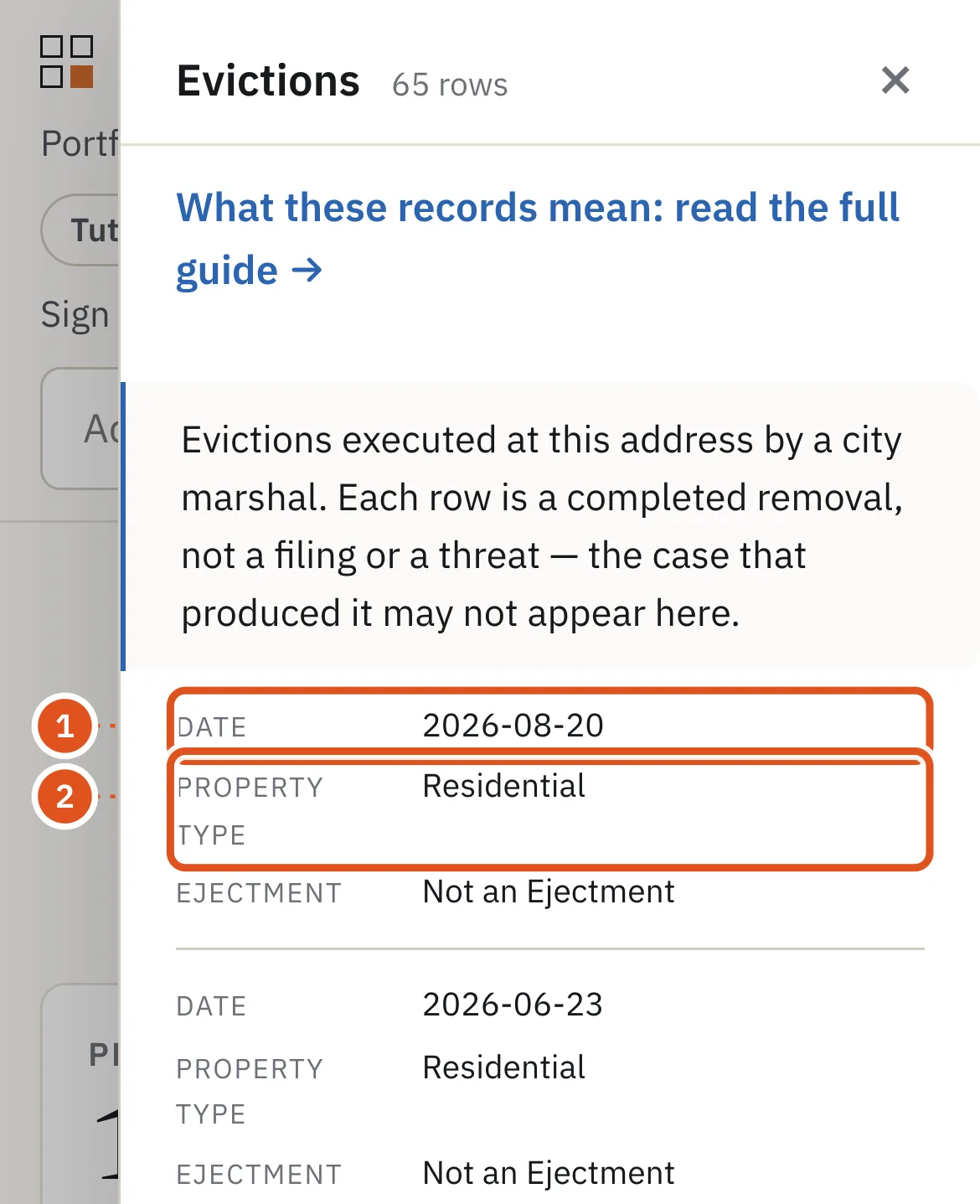
- The day it was carried out
- Residential or commercial
Questions people ask
Can my landlord just change the locks? No. Anyone who has lived in a home for 30 days or more, or has a lease, can be removed only by a marshal or the Sheriff carrying out a court's warrant. A lockout is a crime, and the tenant can call the police or go to Housing Court.
How much notice do I get before an eviction case? For unpaid rent, a written demand giving at least 14 days. To end a tenancy or raise the rent by 5% or more, 30, 60 or 90 days, depending on how long the tenant has lived there.
What happens after the landlord wins? The court issues a warrant to a City Marshal or the Sheriff, who must serve a notice of eviction at least 14 days ahead and carry it out on a business day, in daytime.
Can an eviction still be stopped? In a nonpayment case, paying all the rent owed before the eviction makes the court cancel the warrant. A judge can also stay a residential eviction for good cause, or for up to a year for hardship if the rent is deposited.
Who are City Marshals? Public officers appointed by the Mayor and supervised by the Department of Investigation, paid by fees rather than a City salary. About 30 serve today.
Do tenants get a free lawyer? Under the City's Right to Counsel, tenants at or below twice the federal poverty level, and everyone 60 or older, get full representation in Housing Court eviction cases; others get advice.
Related
- Housing Court, HP actions and HPD litigation — Housing Court for owners and buyers: HP actions, the cases HPD brings, harassment findings, marshal evictions and HPD's Speculation Watch List.
- Good Cause Eviction: what New York's 2024 law covers in NYC — New York's Good Cause Eviction Law in NYC: which apartments it covers, the exemptions, the grounds for eviction, the 8.38% rent test for 2026 and the required notice.
- Rent stabilization in New York City — NYC rent stabilization explained: which buildings, the Rent Guidelines Board's 2026 freeze, leases and renewals, the 2019 HSTPA, deregulation history, and how to check an apartment.
- Certification of No Harassment (CONH) — What a Certification of No Harassment is, which buildings need one and for what work, how HPD investigates, what happens if harassment is found — and why the program became permanent in 2026.
Sources
- BlockLot Intelligence — BlockLot's own analysis of the public records below, computed October 11, 2026.
- NY Senate — RPAPL § 711, grounds and the 14-day rent demand
- NY Senate — RPAPL § 732 and § 733, the court timetable
- NY Senate — RPAPL § 749, the warrant and the 14-day notice
- NY Senate — RPAPL § 753, a stay of up to one year
- NY Senate — RPAPL § 768, unlawful eviction
- NY Senate — RPL § 226-c, notice of non-renewal or a 5% increase
- NY Senate — RPL § 235-e, the five-day late-rent notice
- NY Senate — CPLR § 8011, marshals' and sheriffs' fees
- DOI — New York City Marshals
- DOI — Marshals and evictions FAQ
- DOI — Marshals Handbook of Regulations, with directives through 2025
- HRA Office of Civil Justice — Annual Report 2025
- HRA — Legal services for tenants (Right to Counsel)
- HPD — Tenants' rights and responsibilities (unlawful eviction)
- NY Senate — S50001 of 2021 (the eviction moratorium to January 15, 2022)
- NYC Open Data — Evictions