Learn NYC property · Agencies and the basics
ACRIS and the City Register: where deeds and mortgages are recorded
What the Office of the City Register records, what ACRIS is and how to search it, how long a deed or mortgage takes to reach the record, what is not in ACRIS — Staten Island, lis pendens, records before 1966 — and how owners can be alerted when something is recorded against their property.
ACRIS, the Automated City Register Information System, is the Department of Finance's online system for New York City's recorded property documents. Every deed, mortgage, satisfaction, assignment and lease recorded in Manhattan, the Bronx, Brooklyn or Queens is indexed there, with an image of the document, from 1966 to today. Anyone can search it, free.
A recorded document is the public evidence of who owns a property and who has a claim against it. When a buyer's lawyer orders a title search, when a lender checks for earlier mortgages, or when a neighbor wants to know who bought the building next door, the answer starts in ACRIS.
The City Register
The Office of the City Register is the part of the Department of Finance that records and keeps these documents for four boroughs.
Staten Island is different. Its deeds and mortgages are recorded by the Richmond County Clerk, in person, and are not in ACRIS. ACRIS lists Staten Island lots only because the City's transfer-tax returns for Staten Island are filed through it.
The City Register records, among other things:
- deeds, which transfer ownership;
- mortgages, and the papers that follow them — satisfactions when a loan is paid off, assignments when a lender sells the loan, agreements that change or combine loans;
- powers of attorney, leases and memoranda of leases, easements, condominium declarations, and zoning lot descriptions;
- UCC financing statements on co-op apartments and fixtures — loans against personal property tied to a building. All other UCC filings go to the New York Department of State.
ACRIS sorts its 126 document types into four classes — deeds and other conveyances; mortgages and instruments; UCC and federal liens; other documents — and names each with a short code: DEED, MTGE for a mortgage, SAT for a satisfaction, ASST for an assignment.
What the City Register records in a year
Every document indexed in ACRIS in the twelve months to the newest recording published, each counted once. Staten Island's deeds and mortgages are recorded by the Richmond County Clerk and are not here; its transfer-tax returns are. BlockLot Intelligence, computed October 9, 2026.
In the twelve months to September 30, 2026, ACRIS indexed 303,635 documents, by BlockLot Intelligence's count, among them 57,985 deeds, 46,203 mortgages and 41,277 satisfactions of paid-off mortgages. The 26,979 transfer-tax returns filed without a deed include co-op sales — a co-op apartment is bought as shares in the building's corporation, not by deed, but the City's transfer tax still applies and is filed in ACRIS — and the returns for Staten Island, whose deeds are recorded elsewhere. Timeshare deeds, 11,107 of them, are their own document type.
How a document is recorded
The filer prepares the cover pages and tax forms in ACRIS, uploads or delivers the document, and pays the fees and taxes. A deed must come with the City's Real Property Transfer Tax return, due within 30 days of the transfer, and the State's real property transfer report (form RP-5217NYC). A mortgage pays the Mortgage Recording Tax. The basic recording fee is $32 plus $5 a page, with a $42 minimum for two pages.
Every document recorded since January 2, 2003 gets a City Register File Number (CRFN) — the year followed by nine digits — and a document ID. Older documents are found by the reel and page they were recorded under.
How long recording takes
Each index entry carries two dates: the document date, the date written on the document, and the recorded date, the legal date it was recorded.
By BlockLot Intelligence's count of the documents recorded in the twelve months to September 30, 2026, a deed reached the record a median 14 days after the date written on it, a mortgage 15 days, and a satisfaction of a paid-off mortgage 6 days.
Days from the date written on a document to the day the City Register recorded it, for documents recorded in the same twelve months. The bar ends at the median; the pale band covers the middle half. BlockLot Intelligence, computed October 9, 2026.
Most of that time passes before the document reaches the City Register, because once it arrives recording is quick: the Mayor's Management Report for fiscal 2026 put the average time to record and index a document at 1.4 days. The practical lesson is the gap: for about two weeks after a typical sale, the public record can still show the seller as the owner.
Searching ACRIS
ACRIS's document search looks documents up by:
- party name — a person or a company, as seller or buyer, borrower or lender (ACRIS calls them party 1 and party 2, and what each means depends on the document);
- parcel — borough, block and lot; see BBL, block and lot;
- document type, over a range of dates;
- document ID or CRFN, or reel and page for documents before 2003.
Each result shows the document's type, dates, amount, parties and lots, and opens an image of the recorded document. The Department of Finance also publishes the whole index as data on NYC Open Data, updated monthly.
What is not in ACRIS
- Staten Island's deeds and mortgages — at the Richmond County Clerk.
- Documents from before 1966 — on microfilm and in ledgers at the City Register's Land Records Research Library in Jamaica, Queens.
- Lis pendens and mechanic's liens — filed with the County Clerk in each borough, not recorded at the City Register.
- Most UCC filings — at the New York Department of State, unless they concern a co-op apartment or fixtures.
DOF itself says that reviewing the records is not the same as a title search.
Deed fraud and alerts
The City Register must generally record any deed or mortgage that is proper on its face, so a forged deed can reach the record. DOF's free Notice of Recorded Document program sends an email or letter — usually the day after recording — when a document is recorded against a registered property, Staten Island included. DOF advises owners to sign up, check their deed at least once a year, and report suspected fraud to the Sheriff and the borough's District Attorney.
A worked example. The Empire State Building's lot, Manhattan block 835, lot 41, has 130 documents indexed against it in ACRIS besides its deeds — 11 of them mortgages and 4 satisfactions — every one searchable by that block and lot.
Where you see this in BlockLot
A building's page reads ACRIS for you. Deeds & sales lists every recorded deed with its price and date; Mortgages & liens lists the mortgages, satisfactions, assignments and other documents, each linked to its image in ACRIS; Deed parties names the buyers and sellers. On Staten Island the page says the records sit with the Richmond County Clerk instead of showing an empty list.
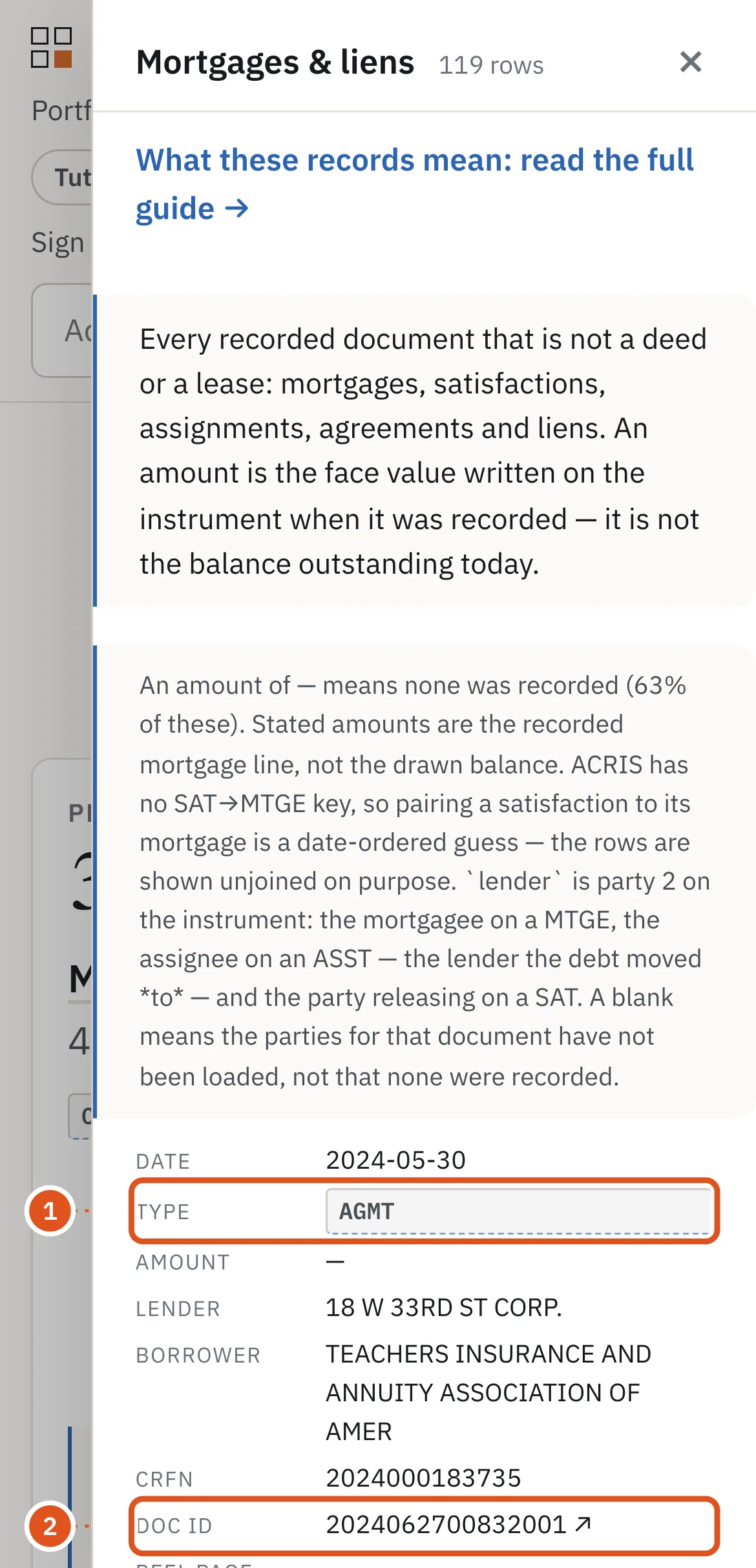
- ACRIS's document type
- Opens the document in ACRIS
Questions people ask
How do I find the deed to a property in New York City? Search ACRIS by borough, block and lot, or by the owner's name, and filter for deeds. On Staten Island, search the Richmond County Clerk's records instead.
Is ACRIS free? Yes. Searching and viewing documents online is free; certified copies cost $4 a page.
How long after closing is a deed recorded? By BlockLot Intelligence's count, a median 14 days after the date on the deed. The City Register itself takes a day or two once the document is submitted.
Why can't I find a co-op apartment's sale in ACRIS? A co-op apartment is not real property but shares in the building's corporation, so there is no deed. The sale's transfer-tax return, and any UCC filing for the loan, are in ACRIS under the building's lot.
What is a CRFN? The City Register File Number: the official number of a document recorded since 2003, made of the year and nine digits.
Can someone record a fake deed on my property? The City Register records documents that are proper on their face, so it can happen. Signing up for the free Notice of Recorded Document alerts tells you within a day when anything is recorded against your property.
Related
- Department of Finance (DOF) — What New York City's Department of Finance does for property — the yearly assessment roll, the property tax bill and its calendar, the City Register that records deeds and mortgages, the transfer taxes, exemptions and the charges other agencies put on a property's account.
- BBL, block and lot: how New York numbers its land and buildings — What a BBL is, how borough, block and lot make up its ten digits, why condominiums have billing lots and unit lots, how lots are merged and split, and how the BIN that identifies a building differs.
- Department of Housing Preservation and Development (HPD) — What New York City's housing agency does — enforcing the Housing Maintenance Code, financing affordable homes, running the lotteries and Section 8 — and how every rental building must register with HPD each year, naming its owner and a managing agent.
- PLUTO, NYC Open Data and the public registries behind a property — What NYC Open Data is, what City Planning's PLUTO lot file holds and where its fields come from, how city-owned land is marked, what the New York Department of State's business registry says about the companies that own buildings — and how BlockLot uses each.
- Ground leases, net leases and recorded memoranda of lease — What a ground lease is and who owns what under one, how a net lease shifts a building's costs to its tenant, why long leases are recorded in ACRIS as memoranda of lease, how transfer and property taxes treat leases, and what Battery Park City shows about all of it.
Sources
- BlockLot Intelligence — BlockLot's own analysis of the public records below, computed October 11, 2026.
- DOF — ACRIS
- DOF — Recording property documents
- DOF — Recording property-related documents
- DOF — ACRIS frequently asked questions
- DOF — ACRIS processing errors and older records
- ACRIS — Document search
- DOF — Real Property Transfer Tax
- DOF — Mortgage Recording Tax
- DOF — UCC financing statements and recording fees
- DOF — Deed fraud
- DOF — Notice of Recorded Document program FAQ
- New York UCC § 9-501 (where financing statements are filed)
- New York CPLR § 6511 (notice of pendency)
- New York Lien Law § 10 (mechanic's liens)
- NYS Department of Taxation and Finance — Real property transfer reports
- NYC Open Data — ACRIS Real Property Master
- NYC Open Data — ACRIS Document Control Codes