Value and tax
The City's market and assessed values, the tax class, an estimate of the annual property tax with past years, exemptions, and Finance's own sales record.
The Value & tax card shows how the City values the building for tax purposes and roughly what that means in tax. It is the middle card of the row that also holds Owner and Contacts. Use it to size a building's tax burden, to see how its valuation has moved, and to check Finance's own record of what the lot sold for.
Without a plan you see the assessed value; the rest of the card needs a plan. See Plans and billing.
Reading the card
Every label with an underline opens a short definition. The rows:
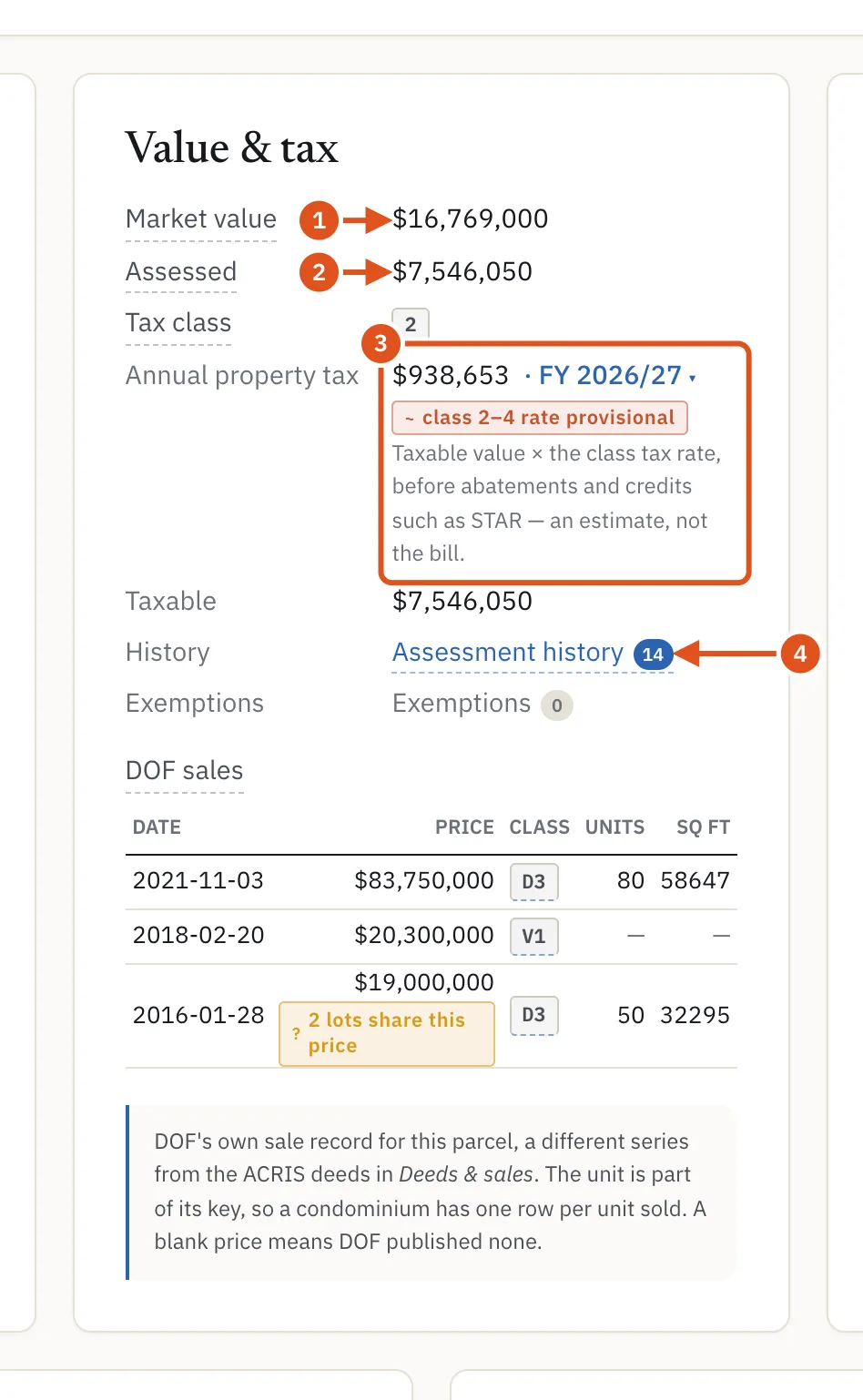
- Market value — the Department of Finance's valuation of the property for tax purposes. It is not an estimate of what the building would sell for.
- Assessed — the part of the market value the City taxes: a fixed fraction of it that depends on the tax class, and limited in how fast it can rise each year. On a property held for a long time it can sit far below the market figure. Neither number is a sale price.
- Tax class — which of the City's four property tax classes the lot is in. Class 1 is one- to three-family homes; class 2 is other residential property — co-ops, condominiums and rentals of four or more units; class 3 is utility property; class 4 is commercial and industrial property. Click the code for its full meaning. The class sets the assessment fraction and the tax rate, so it matters more to the tax than the assessed value does.
- Annual property tax — the taxable value multiplied by the class tax rate, with the fiscal year beside it (for example FY 2026/27). This is the tax before abatements and credits such as STAR, so it is an estimate, not the bill the owner pays. When that year's tax rates are not final yet, it carries the chip provisional rate.
- Taxable — the value the tax rate is applied to: the assessed value less any exemptions.
- History — a count; click it to open the assessment history, one row per roll year.
- Exemptions — a count; click it for the exemptions on each roll. The amount is the value exempted from assessment, not the tax saved.
- Finance's valuation
- The taxed fraction
- Estimated yearly tax
- Every roll year
Past years of tax
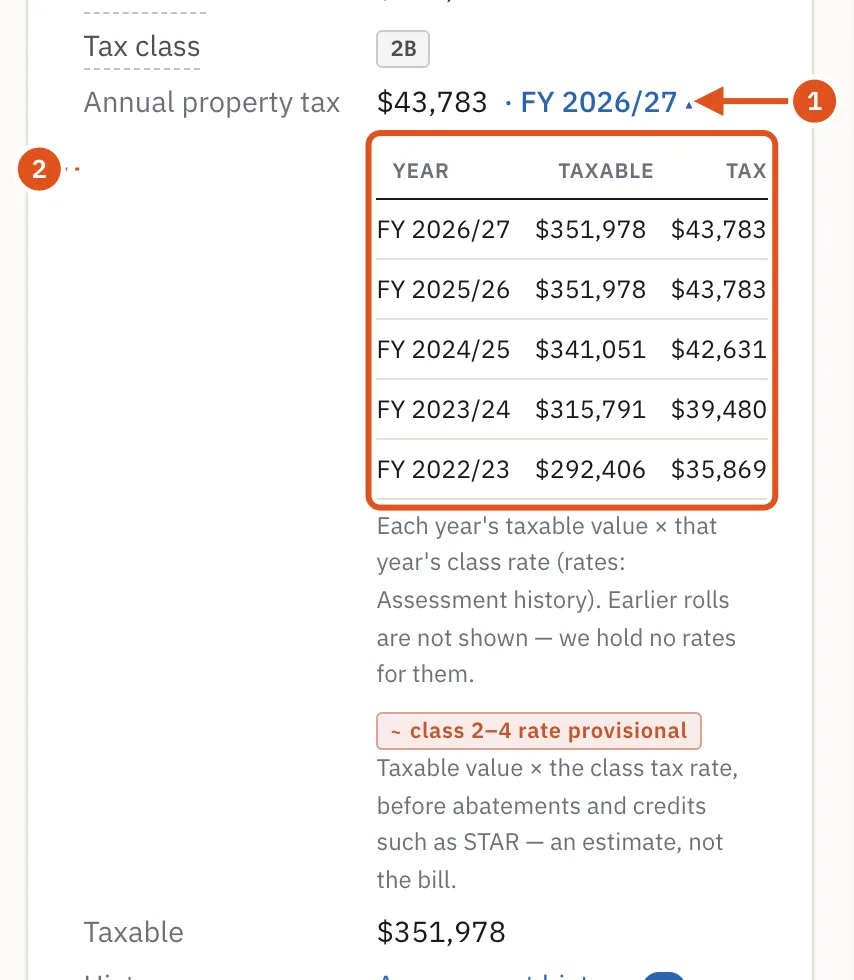
Click the fiscal year beside Annual property tax to open a small table of earlier years: Year, Taxable and Tax, each year's taxable value times that year's class rate. Years before the earliest rate BlockLot holds are not shown. The same arithmetic is used in the assessment history drawer, so the two agree.
The newest roll is often the tentative one the City publishes for the coming fiscal year, which is why the year is always named.
- Click to open
- Earlier years
DOF sales
Under the card's figures, DOF sales lists the Department of Finance's own record of sales of this lot, newest first: Date, Price, Unit, Class, Units and Sq ft. It is a different record from the ACRIS deeds — the City Register's recorded documents — that Sales history and Last sold use. Because a condominium apartment is part of its key, a condominium has one row per apartment sold. A blank price means Finance published none.
When the same price appears on several lots on the same day, the row carries a chip such as 3 lots share this price. Finance repeats a package deal's full price on every lot the deal conveyed, and publishes no document number that could confirm it, so treat that price as the whole package's, not this lot's.
Tips
- Use the tax estimate in your numbers, with care. Property tax is one of a building's largest costs, and the figure here is the levy before any abatement the owner may hold.
- A big gap between market and assessed value is normal for property held a long time, because assessed value can only rise so fast. It is not a sign the building is undervalued.
- Exemptions and abatements are not the same thing. Exemptions reduce the taxable value and appear in the drawer; abatements and credits reduce the bill itself and are not on the roll.