Learn NYC property · Value and property tax
Overdue property charges, interest and the tax lien sale
Overdue NYC property charges: late interest for FY 2026/27, payment plans, how the tax lien sale works, and why there was no sale in 2026.
When a New York City property owner does not pay the property tax — or a water bill, or a charge for repairs the City made — the debt does not go away when the building changes hands. It becomes a tax lien: a legal claim against the property itself. Interest runs on it every day, and for decades the City has collected the oldest of these debts by selling them, in the tax lien sale, to a trust that collects them and can foreclose.
This page follows a debt from the missed due date to the sale, says what the rates and thresholds are for fiscal year 2026/27, and explains why there was no sale in 2026.
What the City bills on a property
The Department of Finance (DOF) sends one statement for a property, and it carries more than the tax. Property charges include the property tax and charges DOF collects for other agencies: the Department of Buildings' boiler, elevator and sign fees, sidewalk repairs, fire inspections, Business Improvement District charges, the rent-stabilization fee, and the Department of Housing Preservation and Development's charges for emergency repairs and demolitions (see HPD violations). A dispute about one of them goes to the agency that charged it, not to DOF.
Water and sewer are billed separately, by the Department of Environmental Protection, but unpaid they become a lien in the same way — see Water and sewer charges.
Due dates and interest
The tax year runs July 1 to June 30. A property with an assessed value of $250,000 or less is billed quarterly, due July 1, October 1, January 1 and April 1, with an interest-free grace period to the 15th; anything larger is billed twice a year, July 1 and January 1, with no grace period.
A late payment carries interest compounded daily, counted from the original due date. For FY 2026/27 the City Council set the rates on June 30, 2026, keeping those of the two years before:
| Assessed value | Interest a year |
|---|---|
| $250,000 or less | 6% |
| Over $250,000 to $450,000 | 9% |
| Over $450,000 | 16% |
For apartment buildings of more than ten units and for class 4 property, the band is decided by the actual assessed value, before phase-ins and exemptions. Unpaid sidewalk-repair charges carry their own rate — 18% for larger properties and vacant land.
Overdue across the city
A charge is overdue — in arrears — once its due date, and any grace period, has passed without payment. DOF's statement for the property then shows it as a balance past due, interest runs on it from the original due date, and once it is large and old enough it can be sold in a lien sale.
189,483 tax lots had a balance past its due date in DOF's statement of property charges of August 15, 2026, owing $3.7 billion between them, by BlockLot Intelligence's count of that statement. Most debts are small and recent — the median lot owed $1,213, and its oldest unpaid charge had been due for about 4 months — but 71,291 lots, 37.6%, had owed for more than a year, and they hold 79.1% of the money.
Every tax lot with a balance past its due date in the Department of Finance's latest quarterly statement of property charges, by the due date of its oldest unpaid charge. BlockLot Intelligence, computed October 11, 2026.
Payment plans
- Standard plan. Anyone can spread an overdue balance over up to ten years, paid monthly or quarterly, with interest. No down payment is required, though DOF recommends one. Missing both the installments and the new bills for six months is a default, and a defaulted owner cannot start a new plan on that property for five years. DOF's own example: $10,000 paid over five years at 9% costs more than $12,000.
- Reduced interest. An owner-occupant of a one- to three-family home or a condominium assessed at $250,000 or less, with household income of $200,000 or less, can pay 2.5% a year on a plan instead.
- PT AID — Property Tax and Interest Deferral — lets eligible owner-occupants with income up to $110,750 (2026) defer part of their tax or pay a share of their income, with the deferred balance growing at 2.5%.
DOF executed 4,746 plans in 2025, more than eight times as many as in 2024 — it credits the June 2025 lien sale for the jump.
The tax lien sale
In a lien sale the City sells the debt, not the property. The buyer is a trust the City sets up for each sale, financed by bonds and served by private companies that collect. Once a lien is sold, the trust adds a 5% surcharge on the whole lien, charges interest compounded daily at the same 6%, 9% or 16% the City charges, and adds about $300 of notice costs. If the debt is neither paid nor on a payment agreement a year after the sale — sooner if the owner falls behind on the trust's interest or on new taxes — the trust can go to court to foreclose. Any money left from a foreclosure auction after the debt is paid goes back to the former owner. New taxes are still paid to the City.
Three kinds of debt can be sold: property tax, water and sewer charges, and HPD's emergency repair and Alternative Enforcement Program charges — with the interest on all of them.
Who can be in a sale
Under DOF's rules for the 2025 sale, a property tax debt could be sold when it reached:
| Property | Owed | For |
|---|---|---|
| Home of 1–3 families, condo or co-op unit | $5,000 | 3 years |
| Vacant land that can be built on, class 1 | $1,000 | 3 years |
| Rental owned by an HDFC | $5,000 | 2 years |
| Any other property | $1,000 | 1 year |
Water debt and HPD charges have thresholds of their own, and an owner-occupied one-family home that owes only water cannot be in a sale at all. Apartment buildings in bad physical and financial distress are left out and sent instead to HPD's Third Party Transfer program (below).
The notices
DOF mails warnings 90, 60, 30 and 10 days before the sale, to the property and to the owner, and publishes each list. Each list is the whole list at that date, so a property that pays or makes an agreement simply drops off the next one.
The 2025 sale shows how it works out. By BlockLot Intelligence's count of DOF's published lists, the 90-day notice of February 2025 named 29,972 properties — 50.5% of them in tax class 1, the class of small homes — and 4,545 were on the final sale list in June 2025: 15.2% of those first warned. The other 84.8% paid, signed an agreement, qualified for an exemption or were otherwise taken off. The City's Mayor's Management Report gives the same 4,545 properties for the 2025 sale.
Tax lots on each list the Department of Finance published for the 2025 sale. A lot leaves the list when the debt is paid, an agreement is made or it is excluded, so each bar holds what was still owed. BlockLot Intelligence, computed October 11, 2026.
Ways off the list
Before the sale an owner can pay, sign a payment plan, or get an exemption approved — senior, disabled homeowner, veteran or nonprofit; an exemption approved within 90 days after the sale even cancels the sale of that lien. Easy Exit takes an owner-occupied home of one to three families, or a condominium, out of the sale for a year when the owner's income is under DOF's limit and they own no other City property. An owner-occupied small home that owes only HPD emergency repair charges can be removed for a year by certifying the repairs, and owners on active military duty are protected.
The 2026 pause, and what comes next
There was no lien sale in 2026. On March 11, 2026 the Mayor paused it for a six-month review — DOF's acting commissioner told the City Council so that day, and HPD's and the Mayor's Management Report's 2026 reports say the same. As of October 9, 2026 the City had published no result of the review and no date for another sale. DOF's own lien-sale page still describes the 2025 sale.
The law changed too. In January 2026 the City Council overrode mayoral vetoes and enacted a package of laws:
- Local Law 62 of 2026 lets DOF sell liens by any method only until December 31, 2028; after that, only to a New York City land bank. It also bars a lien buyer from foreclosing on an owner-occupied class 1 home until at least a year after the sale and until the debt reaches the lesser of 15% of the market value or $70,000.
- Local Law 56 of 2026 creates the land bank. It takes effect only once the State's Urban Development Corporation approves it, and as of October 2026 no approval had been published.
Third Party Transfer and in rem
For distressed apartment buildings — where the lien is 15% or more of the value and the building also has many hazardous violations or emergency repair charges — the City's route is not a sale of the debt but an in rem foreclosure: a court judgment that gives the City the property, which HPD's Third Party Transfer program then conveys to a new, qualified owner. The City's Independent Budget Office reports the program has hardly been used since 2019.
Where you see this in BlockLot
On a building's page, the Compliance & distress signals card shows Overdue property charges — the balance past due in DOF's latest quarterly statement, across how many charges, and the due date of the oldest. Tax liens under the records opens every appearance on DOF's lien-sale lists, notice by notice, and the distress score's breakdown says whether the building is on the latest list. The deal search and the distress list can look for buildings with DOF charges in arrears or on a lien-sale list. A listing means the debt qualified for a sale, not that a lien was sold or is still owed.
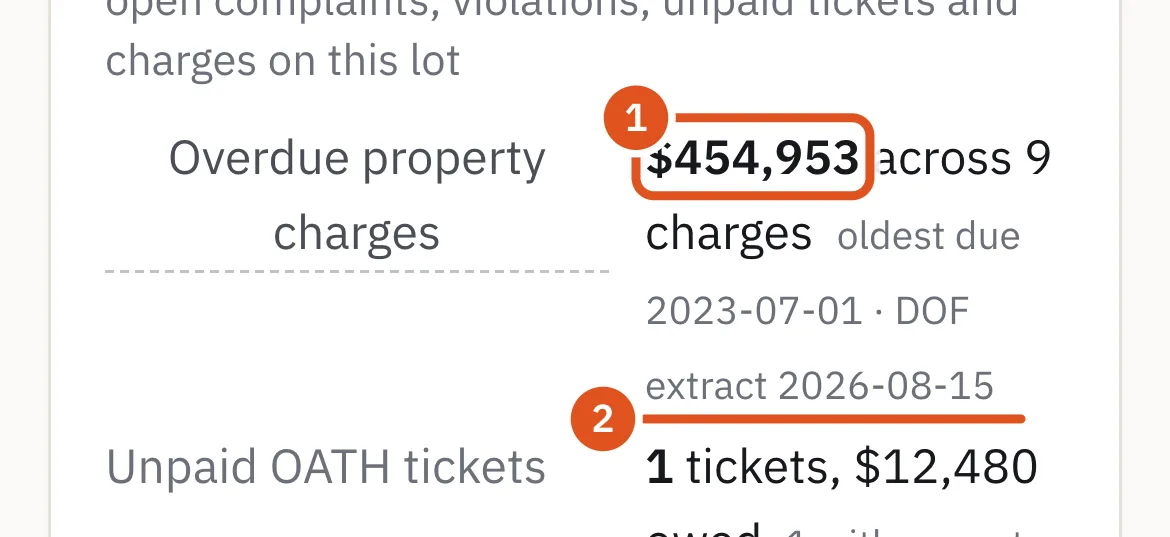
- The balance past due
- Unpaid since
Questions people ask
What happens if I pay my New York City property tax late? Interest, compounded daily from the original due date: for FY 2026/27, 6% a year for a property assessed at $250,000 or less, 9% up to $450,000 and 16% above. Quarterly payers can pay by the 15th of the due month without interest.
Is there a tax lien sale in 2026? No. The Mayor paused it on March 11, 2026 for a six-month review, and as of October 9, 2026 no new sale had been announced. A 2026 law allows sales to private trusts only through 2028, then only to a City land bank.
Does a lien sale mean I lose my home? Not directly. The City sells the debt; the trust then collects it with a 5% surcharge, interest and fees, and can go to court to foreclose if it stays unpaid — usually not before a year has passed.
How do I get off the lien sale list? Pay, or sign a payment plan before the sale; or qualify for an exemption, Easy Exit or another program. In the 2025 sale about five of every six properties on the first notice were off the list by the sale.
Who buys the liens? A trust the City creates for each sale, financed by selling bonds to investors; companies it hires collect the debts. A lien is not sold to the public, and the property itself is not sold at the lien sale.
Can I pay overdue property tax in installments? Yes. DOF's standard plan spreads it over up to ten years with interest, and low-income owner-occupants can use reduced-interest plans or PT AID.
Related
- Water and sewer charges (DEP) as a property charge and a lien — How NYC water and sewer charges are billed to the owner, the FY 2026/27 rates, late charges, and how an unpaid water bill becomes a lien.
- Assessed value and how the NYC property tax is calculated — How New York City turns a market value into a tax bill — the four tax classes, the 6% and 45% assessment ratios, the yearly caps and five-year phase-ins, exemptions and abatements, the tax rates — worked through on a real building.
- Property tax exemptions: STAR, senior, disabled, veterans, clergy, J-51, 421-a and 485-x — NYC property tax exemptions explained: STAR, senior and disabled homeowners, veterans, clergy, 421-a, 485-x, J-51 and nonprofit property.
- HPD violations: Class A, B, C and I — What HPD housing violations are, what Class A, B, C and I mean, how long an owner has to fix and certify each, how a violation is closed or dismissed, and what happens when a Class C is ignored.
Sources
- BlockLot Intelligence — BlockLot's own analysis of the public records below, computed October 11, 2026.
- DOF — NYC property tax lien sale
- DOF — Lien sale archive (lists, trust documents, status reports)
- DOF — Interest rates for late payments
- DOF — Property tax due dates
- DOF — Payment plans
- DOF — Property Tax and Interest Deferral (PT AID)
- DOF — Lien sale Easy Exit program
- DOF — Charges billed for other agencies
- DOF — Payment plan programs, annual report for 2025
- DOF — Testimony on the FY2027 preliminary budget (March 11, 2026)
- NYC Council — Res. 530 of 2026 (FY2027 interest rate)
- NYC Council — Res. 533 of 2026 (FY2027 installment-agreement rate)
- NYC Council — Int. 1407-A, enacted as Local Law 62 of 2026
- NYC Council — Int. 570-B, enacted as Local Law 56 of 2026 (land bank)
- HPD — Tax delinquency
- HPD — Tax lien sale outreach, FY2026 report
- Mayor's Management Report, FY2026
- NYC Independent Budget Office — The tax lien sale: history, outcomes and alternatives (April 2026)