Learn NYC property · Ownership
Co-ops and condominiums: what you own, boards, flip taxes, sponsors and taxes
The difference between a New York City co-op and a condominium — shares and a proprietary lease against a unit you own outright — how boards, offering plans, sponsors and flip taxes work, how each is taxed, and how each shows up in the public record.
New York City has two main ways to own an apartment, and they are different kinds of property. A co-op buyer buys shares in a corporation that owns the whole building; a condominium buyer buys the apartment itself. Almost everything else — who approves a sale, how the tax is billed, what the public record shows — follows from that difference.
What a co-op owner owns
In a co-op (a housing cooperative), a corporation owns the building and the land. A buyer buys shares of that corporation allocated to one apartment, and the shares carry a long-term proprietary lease for it. The owner is at once a shareholder in the corporation and its tenant. Each month the owner pays maintenance charges to the corporation in proportion to the apartment's shares, and the corporation runs the building and receives its bills — the property tax bill among them.
Because the corporation owns the building, the corporation is the owner of record: it is the name on the deed, the tax bill and, for a rental-sized building, HPD's registration. A co-op apartment changes hands without a deed.
What a condominium owner owns
A condominium (a condo) divides a building into units, each owned outright as real property, together with an undivided percentage interest in the common elements — the land, the structure, the lobby, the roof and the shared systems. A unit can be an apartment, an office, a store or a parking space. The percentage, the unit's common interest, is fixed in the declaration and cannot be separated from the unit.
Each unit owner pays common charges, its share of the cost of running the common elements. Unpaid common charges become a lien on the unit, which the board can record and foreclose like a mortgage; Liens covers it.
A building becomes a condominium only when its owner records a condominium declaration (a condo declaration) under New York's Condominium Act, with floor plans certified by an architect or engineer. Recording it is what lets the Department of Finance redraw its tax map, giving each unit its own lot.
By BlockLot Intelligence's count of ACRIS, the City Register recorded about 365 new condominium declarations a year from 2016 to 2025.
A condop combines the two: a condominium one or more of whose units is owned by a co-operative corporation, whose shareholders hold the apartments in it. The Department of Finance classes such a unit R9, a co-op within a condominium, and counts condops apart in its reports.
Boards
A co-op is governed by a co-op board, its board of directors, elected by the shareholders under the corporation's by-laws and the proprietary lease. The board's consent is part of a sale: a co-op may withhold its consent from a buyer, and no City law requires it to say why. A bill to require a written statement of reasons within five days, Int 0774-2026, was introduced in the City Council on March 10, 2026 and is in committee; earlier versions died at the end of their sessions. The City's Human Rights Law covers co-op and condominium board members who deal with applicants, and since January 1, 2025 the Fair Chance Housing Law has limited how a board may consider a buyer's criminal history.
A condominium is run by a board of managers elected by the unit owners under its by-laws, at least a third of whose terms end each year. The by-laws may govern the sale, leasing and occupancy of units, and may let the board buy, hold or lease a unit on the owners' behalf. The Attorney General's guidance is that both kinds of board must act with prudent business judgment.
Flip taxes
A flip tax is a fee a co-op charges, payable to the corporation, when shares change hands. The name is informal — it is not a tax and the City does not collect it. New York's Business Corporation Law allows a co-op to charge different transfer fees on shares of the same class, so long as the fees are written into the proprietary leases, the occupancy agreements or the offering plan, or into an amendment properly approved. The amount — a share of the price, a sum per share or a flat fee — is whatever those documents say.
Sponsors, offering plans and conversions
The sponsor is the developer or owner who creates a co-op or condominium and sells its apartments. Under the State's Martin Act, no co-op shares or condominium units may be offered to the public until an offering plan has been filed with the Attorney General, whose Real Estate Finance Bureau reviews it. A resale by an individual owner needs no plan. The Attorney General generally requires a sponsor to give up control of the board once it has sold more than half the shares or units, or five years after the first closing, whichever comes first.
Apartments the sponsor has not sold are sponsor units; a buyer of a block of them takes over as holder of unsold shares, and files its own amendments to the plan. In the record, the unsold units of a condominium stay in the sponsor's name lot by lot.
A rental building turned into a co-op or condominium is a co-op conversion. In New York City a plan for an occupied building is now a non-eviction plan: it can take effect only once purchase agreements cover at least 51% of the apartments, signed by tenants living there when the plan was accepted (15% in a building of five or fewer homes, in limited cases), and tenants who do not buy cannot be evicted for not buying. The older eviction plans, under which non-buying tenants could be removed after a period, are limited to plans submitted before the 2019 rent law, and no plan may be changed into one.
How each is taxed
- Property tax. A co-op gets one property tax bill for the whole building, sent to the corporation. A condominium unit is its own tax lot with its own bill; the building and its common elements are not taxed separately. State law requires the Department of Finance to value both as if they were rental buildings, not from their apartments' sale prices — market value explains what that does to their values.
- The co-op and condo abatement. An owner whose co-op or condominium apartment is a primary residence can get a partial abatement, applied for by the board.
- Transfer taxes. The City's and State's transfer taxes apply to a sale of co-op shares just as to a sale of a condominium unit, and the mansion tax applies to either at $1 million or more.
Co-ops and condominiums in the record
The Department of Finance classes each lot by what stands on it: C6 for a walk-up co-op and D4 for an elevator co-op, R4 for a condominium apartment in an elevator building and R0 for a condominium's billing lot. A condominium's units are numbered from lot 1001, and the building as a whole has a billing lot numbered from 7501; BBL, block and lot explains them.
By BlockLot Intelligence's count of the Department of Finance's 2026/27 roll, the city's taxable co-ops are 6,856 buildings holding 371,234 apartments, and its taxable condominium homes are 250,723 units in 8,842 condominiums. Counted the same way, the 2025/26 roll matches the Department's own annual report to within 0.2%. Fully exempt co-ops, such as Co-op City below, are outside both counts.
A condominium sale is a deed, recorded in ACRIS like any other. A co-op sale is not: the shares are personal property, so the City Register records instead a UCC financing statement when a buyer borrows against them, and the transfer-tax return is filed through ACRIS. The Department of Finance's sales file lists both:
| Year | Co-op | Condominium |
|---|---|---|
| 2025 | 13,081 | 12,716 |
| 2024 | 12,373 | 11,733 |
| 2023 | 12,335 | 11,716 |
| 2022 | 16,266 | 16,215 |
| 2021 | 16,580 | 18,254 |
| 2020 | 10,175 | 9,262 |
| 2019 | 13,113 | 11,834 |
| 2018 | 13,444 | 11,809 |
| 2017 | 14,414 | 13,847 |
| 2016 | 14,515 | 12,355 |
Sales of $10,000 or more in the Department of Finance's sales file, by calendar year: co-op apartments (the building classes DOF gives co-ops) and condominium homes (its residential unit classes). BlockLot Intelligence, computed October 10, 2026.
A worked example. Co-op City, in the northeast Bronx, is a housing co-operative. Its main lot, built in 1969, holds 10,914 apartments on PLUTO, and its owner of record is the co-operative, RIVERBAY CORPORATION. ACRIS holds no deed for the lot, because its apartments change hands as shares — yet in the twelve months to September 30, 2026 the City Register recorded 26 new co-op financing statements against it, each a loan secured on one apartment's shares.
Where you see this in BlockLot
A building's page shows its Department of Finance building class with what it means — an elevator co-operative, a condominium unit — and, for a condominium, whether the lot is the billing lot or a unit and which condominium it belongs to. Co-op financing statements on a building appear among its liens and filings, and a condominium's unit sales in its sales history.
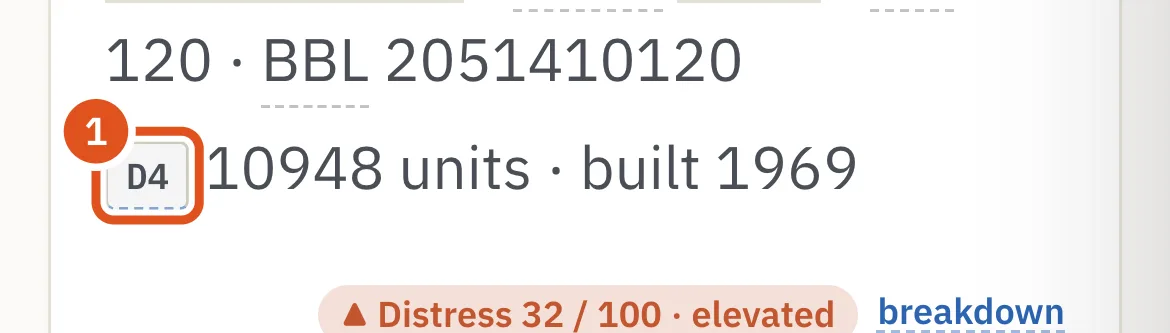
- D4, an elevator co-operative
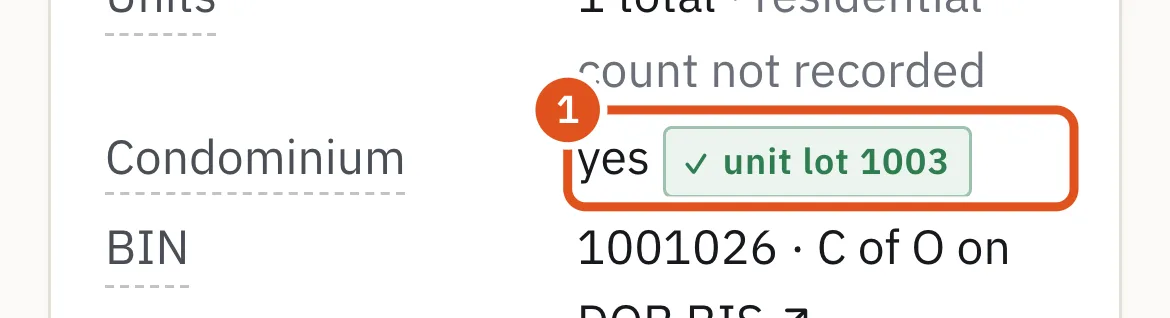
- A unit lot of the condominium
Questions people ask
What is the difference between a co-op and a condo? A co-op buyer buys shares in the corporation that owns the building, with a proprietary lease for the apartment; a condominium buyer owns the apartment outright as real property, with a share of the common elements. A co-op sale needs the board's consent.
Do co-op owners pay property tax? Not directly. The City sends one bill for the whole building to the corporation, and the owners pay the corporation maintenance charges in proportion to their shares. Owners who live in their apartments may share in the co-op and condo abatement.
What is a flip tax? A fee a co-op charges, payable to the corporation, when shares are sold, as its proprietary leases or offering plan set out. It is not a government tax.
Can a co-op board reject a buyer without a reason? Yes: no City law requires a co-op to give reasons for withholding consent, though it may not discriminate in violation of the Human Rights Law. A bill to require written reasons is before the City Council.
Why is there no deed for a co-op apartment? Because the buyer acquires shares, which are personal property, not real property. ACRIS records the transfer-tax return and, if the buyer borrows, a UCC financing statement against the shares.
What is a sponsor unit? An apartment the developer or converting owner has not yet sold under the offering plan. Its owner, the sponsor or a holder of unsold shares, files amendments to the plan with the Attorney General.
Related
- Market value (NYC property tax) — What the Department of Finance's "market value" is, why it is not what a property would sell for, how DOF estimates it for each tax class — with the income formula — and how and when an owner can challenge it.
- Property tax abatements: co-op and condo, J-51, solar, green roof, ICAP and CEP/CRP — NYC property tax abatements explained: co-op and condo, J-51, solar, green roof, ICAP and CEP/CRP — who qualifies and what each is worth.
- UCC filings, federal tax liens, mechanic's liens and other liens on property — The claims besides mortgages that can sit on a New York City property — UCC financing statements on co-op loans and fixtures, IRS federal tax liens, mechanic's liens, condominium common-charge liens and judgments — where each is filed, how long it lasts and how it ends.
- Transfer taxes: the NYC RPTT, the State transfer tax and the mansion tax — The taxes due when New York City property changes hands — the City's Real Property Transfer Tax, the State's real estate transfer tax and its higher New York City rate, and the mansion tax — with their rates, who pays each, and worked numbers for homes and buildings.
- BBL, block and lot: how New York numbers its land and buildings — What a BBL is, how borough, block and lot make up its ten digits, why condominiums have billing lots and unit lots, how lots are merged and split, and how the BIN that identifies a building differs.
- Who owns a building: LLCs, the owner of record and the beneficial owner — How to find who owns a New York City building — the deed, HPD's registration, the Department of State's registry — why so many owners are LLCs, the difference between the owner of record and the beneficial owner, and how BlockLot groups an owner's buildings.
- Ground leases, net leases and recorded memoranda of lease — What a ground lease is and who owns what under one, how a net lease shifts a building's costs to its tenant, why long leases are recorded in ACRIS as memoranda of lease, how transfer and property taxes treat leases, and what Battery Park City shows about all of it.
- When an owner dies: estates, probate and what the property record shows — What happens to a New York City property when its owner dies — joint ownership, transfer-on-death deeds and life estates, probate and administration in the Surrogate's Court, the executor's deed, the estate tax lien — and what each step leaves in ACRIS and on the tax bill.
Sources
- BlockLot Intelligence — BlockLot's own analysis of the public records below, computed October 10, 2026.
- NY Attorney General — Cooperatives
- NY Attorney General — Condominiums
- NY Attorney General — Before you buy a co-op or condo
- New York Real Property Law § 339-e (Condominium Act definitions)
- New York Real Property Law § 339-f (a condominium is made by recording a declaration)
- New York Real Property Law § 339-g (a unit is real property)
- New York Real Property Law § 339-v (by-laws and the board of managers)
- New York Real Property Law § 339-y (each unit a separate tax parcel)
- New York Real Property Law § 339-z (the lien for common charges)
- New York Business Corporation Law § 501 (fees on a transfer of co-op shares)
- New York General Business Law § 352-e (offering plans)
- New York General Business Law § 352-eeee (conversions in New York City)
- NY Attorney General — Form RS-2/CD-2 (sponsors and holders of unsold shares)
- NYC Council — Int 0774-2026, sales of cooperative apartments
- NYC Commission on Human Rights — Who is covered (fair housing)
- New York Real Property Tax Law § 581 (co-ops and condominiums valued as rentals)
- NYC 311 — Co-op and condo property tax bills
- NYC Department of Finance — Real Property Transfer Tax
- NYS Department of Taxation and Finance — Real estate transfer tax
- NYC Department of Finance — UCC financing statements
- NYC Department of Finance — New condominium tax map information
- NYC Department of Finance — Annual Report of the NYC Property Tax, FY2026