Learn NYC property · Ownership
Absentee owners, owner-occupied homes and owners' mailing addresses
What "absentee owner" means in New York City property records, where an owner's mailing address comes from, which rules turn on whether an owner lives in the home — HPD registration, STAR, the senior exemption, the co-op and condo abatement, Good Cause Eviction — and how far a deed's address can be trusted.
An absentee owner is an owner who does not live in, or work from, the property it owns — in practice, an owner whose mailing address is somewhere else. New York law never defines the phrase, and absentee owners — absentee landlords, when they rent the property out — are a reading of the records, not a legal category. The rules that matter speak instead of whether a home is the owner's primary residence, and the records speak only of addresses. This guide covers both, and why the two do not always agree.
Most New York City homes are rented, not owned: the City's 2023 Housing and Vacancy Survey counted 1,109,000 owner-occupied homes among 3,432,000 occupied ones, about a third. Owners live in most one-family houses — 78% of them in 2023 — in fewer than half the homes in two-family houses, and in about one percent of homes in larger buildings.
Where an owner's address comes from
An owner's mailing address appears in three public places, and each is written at a different moment:
- The deed. Every party on a document in ACRIS has an address, and the City publishes them as Open Data. The grantee's is the address the buyer gave on the day of the purchase, and nothing updates it afterwards.
- The tax bill. The Department of Finance prints the mailing address it holds for the property's notices in the bill's upper right; it can differ from the property. An owner changes it online or with the Department's property information update form, so it can be current — but the City does not publish it as Open Data.
- HPD's registration. A registered building's owner gives a residence and business address each year, and a post office box alone does not count as a business address.
A building is owner-occupied when its owner, or for some rules the owner's family, lives there; the rules call this owner occupancy. No public record states it directly; it shows up as what the owner claims, such as a homeowner's exemption, or what the owner does not file, such as an HPD registration a non-resident owner would owe.
The rules that turn on where the owner lives
A primary residence is the home a person lives in for most of the year. Several property rules depend on it:
- Tax benefits. STAR, the Senior Citizen Homeowners' Exemption (SCHE), the Disabled Homeowners' Exemption (DHE) and the Alternative Veterans' Exemption all require the home to be the owner's primary residence, and so does the co-op and condominium abatement, which also caps an owner at three units in one development. The State checks STAR against income tax returns; a false claim can cost six years of STAR, a penalty and repayment.
- The pied-à-terre surcharge. From the 2026/27 tax year, homes worth more than set amounts that are nobody's primary residence owe a surcharge.
- HPD registration. Every building of three or more homes registers with HPD whoever lives there. A one- or two-family house registers only when neither the owner nor a family member — a spouse, partner, parent, child, sibling, grandparent or grandchild, or their in-laws — lives in it. A non-resident owner of such a house must name a city resident over 21 to receive notices and summonses, and a building of three or more homes needs a managing agent who lives or keeps an office in the city.
- Tenants. New York's Good Cause Eviction law, in effect since April 20, 2024, exempts an owner-occupied building of ten or fewer apartments, and a small landlord owning ten or fewer units in the State. Under rent stabilization, one owner may take back one apartment for its own primary residence, with limits that protect older, long-standing and disabled tenants.
How BlockLot reads it, and how far to trust it
BlockLot compares the grantee's mailing address on a building's latest deed with the building's own address, after evening out the spelling ("Ave" and "Avenue", unit numbers set aside). If they differ, the Owner card says Absentee; if they match, Owner-occupied; with no deed to read — a co-op, a lot not conveyed since 1966, or Staten Island, whose deeds are not in ACRIS — it says nothing.
An out-of-state owner is one whose deed address is outside New York State. Area pages and the deal search count both.
That is a reading of an address, not a finding about a person, and our own check shows how far it goes:
Share of one- and two-family homes whose latest deed gives the buyer a mailing address other than the house. The second bar is homes with the senior or disabled homeowners' exemption, which require the owner to live there: the gap between the deed and where an owner lives. BlockLot Intelligence, computed October 10, 2026.
By BlockLot Intelligence's count, the latest deed of 56.9% of one- and two-family homes gives the buyer a mailing address other than the house. But so does the deed of 45.4% of the homes whose owners receive the senior or disabled homeowners' exemption — owners who must live there. The mismatch grows with the deed's age: a deed keeps the address given on the day it was signed, and later moves never reach it. Out-of-state addresses are rarer, 2.3% of homes, and less noisy, but even 1.7% of those resident owners' deeds carry one.
Read Absentee as "the deed mails elsewhere", a lead to check, never as proof the owner lives away. The tax bill's address and HPD's registration are more current, and an exemption that requires the owner to live there is a stronger sign than any address.
A worked example. The Empire State Building's latest deed gives its owner's address in care of its parent company, in Midtown ZIP code 10165, so by the reading above its owner mails elsewhere. For a commercial or large rental building, an owner mailing from an office says nothing about how the building is run.
Where you see this in BlockLot
A building's Owner card shows the mailing address from the latest deed and the Occupancy it implies, marked "address-normalised"; the Deed parties drawer lists every party and its address. Area pages count lots whose owner mails from elsewhere or from out of state, and the deal search filters on both.
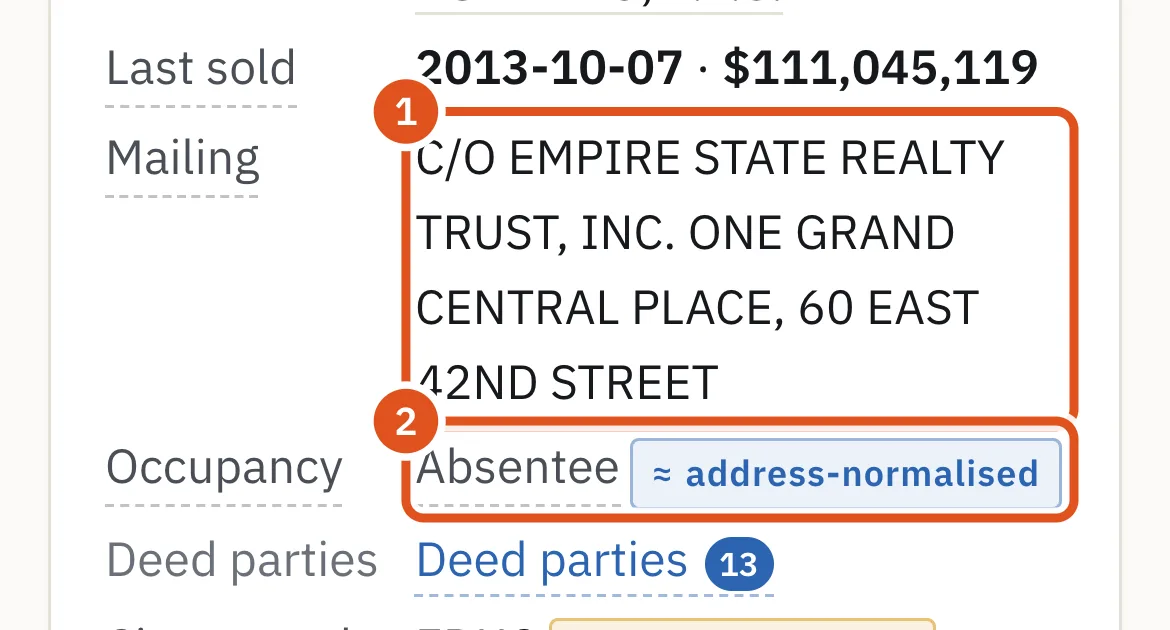
- The grantee's address on the latest deed
- Absentee: the deed mails elsewhere
Questions people ask
What is an absentee owner? An owner who does not live in or use the property — in the records, one whose mailing address is somewhere else. It is not a legal status; the rules that matter ask whether the home is the owner's primary residence.
How can I tell if the owner lives in a building? No record says so directly. A homeowner's exemption such as STAR or SCHE requires the owner to live there; a one- or two-family house registered with HPD is one its owner says it does not live in; and the tax bill and HPD registration give more current addresses than the deed.
Why does BlockLot call an owner absentee when I know they live there? Because the address on the latest deed differs from the building's — often the address the owner gave on the day of the purchase. Nothing updates a deed's address after it is recorded.
Does a landlord who lives elsewhere have to register with HPD? Yes, for a one- or two-family house where neither the owner nor a family member lives, and for every building of three or more homes. The owner must also name a New York City resident, or a managing agent in the city, to receive notices.
Do owner-occupied buildings follow different rent rules? Some do. Good Cause Eviction exempts owner-occupied buildings of ten or fewer apartments, and the rent stabilization rules let an owner recover one apartment for its own primary residence, with protections for some tenants.
How do I change the mailing address on my tax bill? Through the Department of Finance, online or with its property information update form. Keeping it current is also one of the City's own defences against deed fraud.
Related
- Who owns a building: LLCs, the owner of record and the beneficial owner — How to find who owns a New York City building — the deed, HPD's registration, the Department of State's registry — why so many owners are LLCs, the difference between the owner of record and the beneficial owner, and how BlockLot groups an owner's buildings.
- Deeds in New York City: the kinds of deed, and grantor and grantee — What a deed is, the kinds New York law describes — bargain and sale, quitclaim, executor's, referee's — transfer-on-death and life estate deeds, who the grantor and grantee are, and what party 1 and party 2 mean on any document in ACRIS.
- Property tax exemptions: STAR, senior, disabled, veterans, clergy, J-51, 421-a and 485-x — NYC property tax exemptions explained: STAR, senior and disabled homeowners, veterans, clergy, 421-a, 485-x, J-51 and nonprofit property.
- The pied-à-terre surcharge (non-primary residence surcharge) — NYC's 2026 pied-à-terre surcharge on high-value homes that are no one's primary residence: who owes it, the rates, and its legal status.
- Department of Housing Preservation and Development (HPD) — What New York City's housing agency does — enforcing the Housing Maintenance Code, financing affordable homes, running the lotteries and Section 8 — and how every rental building must register with HPD each year, naming its owner and a managing agent.
- BlockLot's distress score: what it measures — How BlockLot's distress score turns violations, court cases, vacate orders, liens and unpaid charges into one number from 0 to 100, and what it is not.
- Co-ops and condominiums: what you own, boards, flip taxes, sponsors and taxes — The difference between a New York City co-op and a condominium — shares and a proprietary lease against a unit you own outright — how boards, offering plans, sponsors and flip taxes work, how each is taxed, and how each shows up in the public record.
- When an owner dies: estates, probate and what the property record shows — What happens to a New York City property when its owner dies — joint ownership, transfer-on-death deeds and life estates, probate and administration in the Surrogate's Court, the executor's deed, the estate tax lien — and what each step leaves in ACRIS and on the tax bill.
Sources
- BlockLot Intelligence — BlockLot's own analysis of the public records below, computed October 10, 2026.
- HPD — Register your property
- NYC Housing Maintenance Code, §§ 27-2097 and 27-2098 (registration)
- NYC Department of Finance — Update property and billing information
- NYC Department of Finance — Property tax bill FAQ
- NYC Department of Finance — Senior Citizen Homeowners' Exemption
- NYC Department of Finance — Disabled Homeowners' Exemption
- NYC Department of Finance — Cooperative and Condominium Tax Abatement
- NYC Department of Finance — Non-Primary Residence Surcharge
- NYS Department of Taxation and Finance — STAR eligibility
- NYS Department of Taxation and Finance — STAR penalties
- New York Real Property Law § 214 (Good Cause Eviction: exemptions)
- HPD — Good Cause Eviction
- NYS Homes and Community Renewal — Fact Sheet 10, owner occupancy
- HPD — 2023 New York City Housing and Vacancy Survey, selected initial findings
- NYC Department of Finance — Protect your property from deed fraud
- NYC Open Data — ACRIS Real Property Parties