Learn NYC property · Deeds, mortgages and sales
Sale prices in the public record: ACRIS, DOF's sales files, $0 deeds and package deals
Where New York City sale prices are published — the price written on the deed in ACRIS and the Department of Finance's rolling and annualized sales files — why so many sales show $0, and how partial interests, package deals and non-arm's-length sales distort a price.
A sale price in New York City is written down twice, by two different records, and they do not always agree. One is the price written on the deed and indexed in ACRIS. The other is the Department of Finance's own list of sales, published as its rolling and annualized sales files. Anyone reading a price — a buyer checking a neighbor's sale, an appraiser picking comparable sales — should know which one they are looking at and what it leaves out.
The price on the deed
The price written on a deed is its consideration: the total paid for the transfer. ACRIS publishes it as the document's amount — the consideration on a deed, the principal on a mortgage — with a percent transferred where the parties reported one. It is one amount for the whole document, however many lots the deed conveys.
A deed records only real property. A co-op apartment is sold as shares, so it has no deed; its sale appears in ACRIS only as a transfer-tax return. And Staten Island's deeds are recorded by the Richmond County Clerk, not in ACRIS.
DOF's sales files
The Department of Finance publishes every recorded sale in DOF rolling sales files — the last twelve months, borough by borough, updated monthly — and in annualized sales files, one per year since 2003. Each row is one sale of one lot or apartment: condo and co-op apartments appear one row per unit, with the apartment number, and Staten Island is included. Each carries the building class at the time of sale, the units and the floor area. NYC Open Data publishes both, citywide.
DOF's own yearly summary of one- to three-family homes counts only sales of $200,000 or more. For 2025 it put the median one-family house at $785,000, the median two-family at $992,794 and the median three-family at $1,280,000, across 19,388 sales.
Why so many sales show $0
DOF's glossary says it plainly: a $0 sale is a transfer of ownership without a cash consideration — a parent giving a house to a child, for example. The same is true of a deed whose price reads $0, which the property pages call no price stated. Owners move buildings into their own companies or trusts, heirs receive property, spouses add or remove each other, and a correction deed re-records an earlier one. None of those is a sale at a market price.
Every deed indexed in ACRIS in the twelve months to the newest recording published, each counted once, by the consideration written on it. Staten Island's deeds are recorded by the Richmond County Clerk and are not here. BlockLot Intelligence, computed October 10, 2026.
They are common. By BlockLot Intelligence's count, 41.9% of the 57,985 deeds recorded in the twelve months to September 30, 2026 stated no price, and 1,583 more a nominal one under $10,000. In DOF's sales file for 2025, 34.8% of the rows record $0.
A nominal consideration is a token amount — $10, $100 — written on a deed that is really a gift or a reshuffle. The State's assessors exclude every sale of $10 or less from their studies as unrepresentative, and leave out sales under $10,001 when they compare assessments with prices. BlockLot marks a deed under $10,000 as nominal.
Partial interests
A deed can convey only part of a property — one co-owner's half, a sibling's third. ACRIS records the reported share as the percent transferred. The price on such a deed buys the share, not the building, so dividing it by the building's size understates what the building is worth. An empty or zero percentage means none was reported, not that nothing changed hands.
In the twelve months to September 30, 2026, 742 deeds stated a partial interest, by BlockLot Intelligence's count.
Package deals
A package deal sells several lots for one price — a row of buildings, a portfolio across the city, a developer's assemblage of neighboring lots. ACRIS records it as one document with one amount and a list of every lot it covers; nothing says how the price splits among them. BlockLot's area pages call a package kept to one block an assemblage sale, and one across several blocks a portfolio sale.
In the twelve months to September 30, 2026, 2,629 deeds conveyed more than one lot, by BlockLot Intelligence's count.
DOF's sales files carry no deed number, so a package cannot be told apart from separate sales there. In BlockLot's reading of the file, a package shows as the same price on several lots of one block on the same day — the whole price repeated on each. Taking any one of those rows as that lot's price overstates it, sometimes many times over.
Arm's-length sales
An arm's-length sale is one freely negotiated in the open market between a willing buyer and a willing seller, neither under pressure, and unrelated to each other. Only such a sale tells you what a property is worth, and only arm's-length sales are used by assessors to check their values.
The State's real property transfer report, filed with every deed, asks the parties to flag the conditions that make a sale something else: a sale between relatives or related companies; a buyer who is also a seller; a government agency or a lender as buyer or seller, as in a foreclosure; a deed that is not a warranty or bargain and sale deed; a sale of less than the whole interest; a business sold with the property; or other unusual factors — a divorce or bankruptcy settlement, an auction, an estate sale.
Where you see this in BlockLot
A building's Sales history lists every deed with its price, marking a deed with no price stated, a nominal price, a deed that also conveyed lots elsewhere, and a DOF row whose price is shared by several lots. Where DOF records the same date and price, the row says DOF agrees; where only DOF has the sale — a co-op, Staten Island — it is listed as a DOF record.
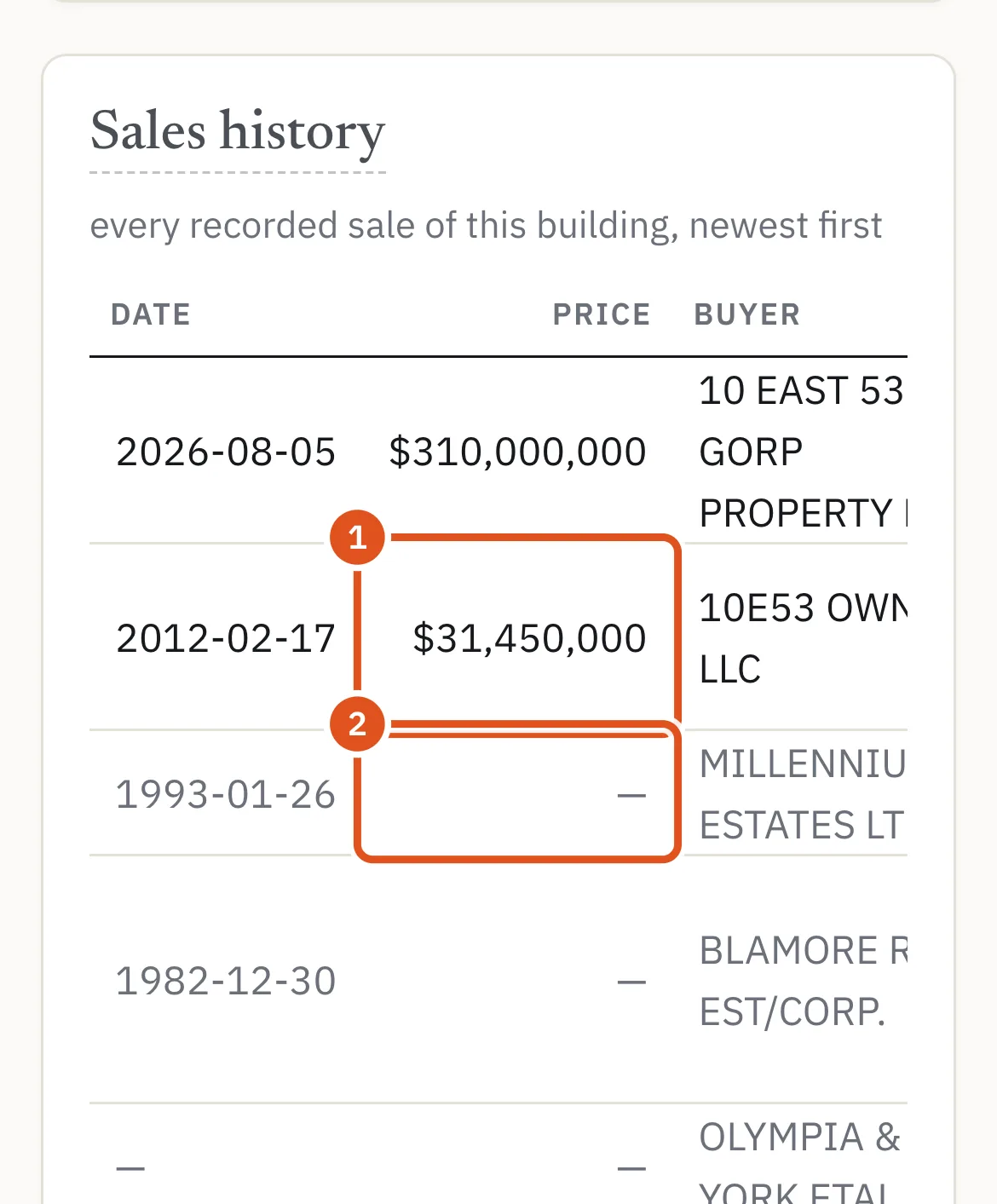
- The consideration on the deed
- No price stated
Questions people ask
Where can I find what a house sold for in New York City? In the Department of Finance's rolling sales files, searchable by borough and neighborhood, or on the deed in ACRIS. On Staten Island, DOF's files have the sale while ACRIS does not.
Why does a property show a $0 sale? Because ownership changed without a cash price — a gift to a family member, a transfer into the owner's own company or trust, an inheritance or a correction. A $0 deed is not a sale at a market price.
Why do ACRIS and DOF show different prices for the same sale? Often because one deed sold several lots: ACRIS shows the package's price once, while DOF's file repeats it on every lot. A partial interest or a correction deed can also explain a difference.
Are co-op sales public in New York City? Yes, in DOF's sales files, one row per apartment with its number. ACRIS has no deed for them, because co-op apartments are sold as shares.
What is an arm's-length sale? A sale in the open market between unrelated parties, both willing and neither under pressure. A sale between relatives, at a foreclosure auction or out of an estate usually is not.
Related
- Comparable sales: how professionals use them, and how BlockLot picks them — What comparable sales are, how appraisers and assessors choose and adjust them, the units they compare on — price per square foot, per unit — and, as our own reading of the public record, how BlockLot picks a building's comparable sales and when it declines to estimate a value.
- Deeds in New York City: the kinds of deed, and grantor and grantee — What a deed is, the kinds New York law describes — bargain and sale, quitclaim, executor's, referee's — transfer-on-death and life estate deeds, who the grantor and grantee are, and what party 1 and party 2 mean on any document in ACRIS.
- Transfer taxes: the NYC RPTT, the State transfer tax and the mansion tax — The taxes due when New York City property changes hands — the City's Real Property Transfer Tax, the State's real estate transfer tax and its higher New York City rate, and the mansion tax — with their rates, who pays each, and worked numbers for homes and buildings.
- ACRIS and the City Register: where deeds and mortgages are recorded — What the Office of the City Register records, what ACRIS is and how to search it, how long a deed or mortgage takes to reach the record, what is not in ACRIS — Staten Island, lis pendens, records before 1966 — and how owners can be alerted when something is recorded against their property.
- Market value (NYC property tax) — What the Department of Finance's "market value" is, why it is not what a property would sell for, how DOF estimates it for each tax class — with the income formula — and how and when an owner can challenge it.
Sources
- BlockLot Intelligence — BlockLot's own analysis of the public records below, computed October 11, 2026.
- DOF — Rolling sales data
- DOF — Annualized sales
- DOF — Glossary of terms for property sales files
- DOF — Citywide one-, two- and three-family home sales, 2025
- NYC Open Data — NYC Citywide Rolling Calendar Sales
- NYC Open Data — NYC Citywide Annualized Calendar Sales Update
- NYC Open Data — ACRIS Real Property Master
- NYC Open Data — ACRIS Real Property Legals
- NYS Department of Taxation and Finance — RP-5217 instructions
- NYS Office of Real Property Tax Services — Sales usability criteria
- NYS Office of Real Property Tax Services — Valuation standards