Tutorials · Owners and companies
Company pages
One company that owns NYC property — its State registration, the addresses it uses, the buildings it holds now and the companies registered beside it.
A company page answers "who is this LLC?" in one place. It joins the company's registration with the New York Department of State (DOS) to what the City's records say it owns, so you can see its registered agent, where it asks its deeds to be sent, which buildings it holds today and which other companies share its office. Each company page has its own address, so you can send it to a colleague.
An LLC is a limited liability company, the most common way to hold a New York building.
Getting there
A company's name is a link almost everywhere it appears in BlockLot:
- in search, under Owners & entities, when you search a company name;
- on a property page, in the owner and portfolio cards and in the record drawers;
- on the office page, the block page's ownership lists and the deal search results.
Click the name to open its page.
Reading the page
The header
The eyebrow reads Entity and the kind of company, followed by its name. Next to it are a few chips:
- DOS-matched: the name was found in the State's business registry.
- no NY DOS match: it was not. That is common and not suspicious. The registry covers LLCs and corporations, so an estate, a trust, a partnership or an out-of-state filer is legitimately absent. The page still shows its buildings.
- companies share this name: several registered companies have the same name once punctuation is set aside, and BlockLot had to pick one. A warning box says so, because the agent and address below may then belong to a different company. Treat that page as a lead.
- registered-agent address: the company files from a law firm, filing service or virtual office.
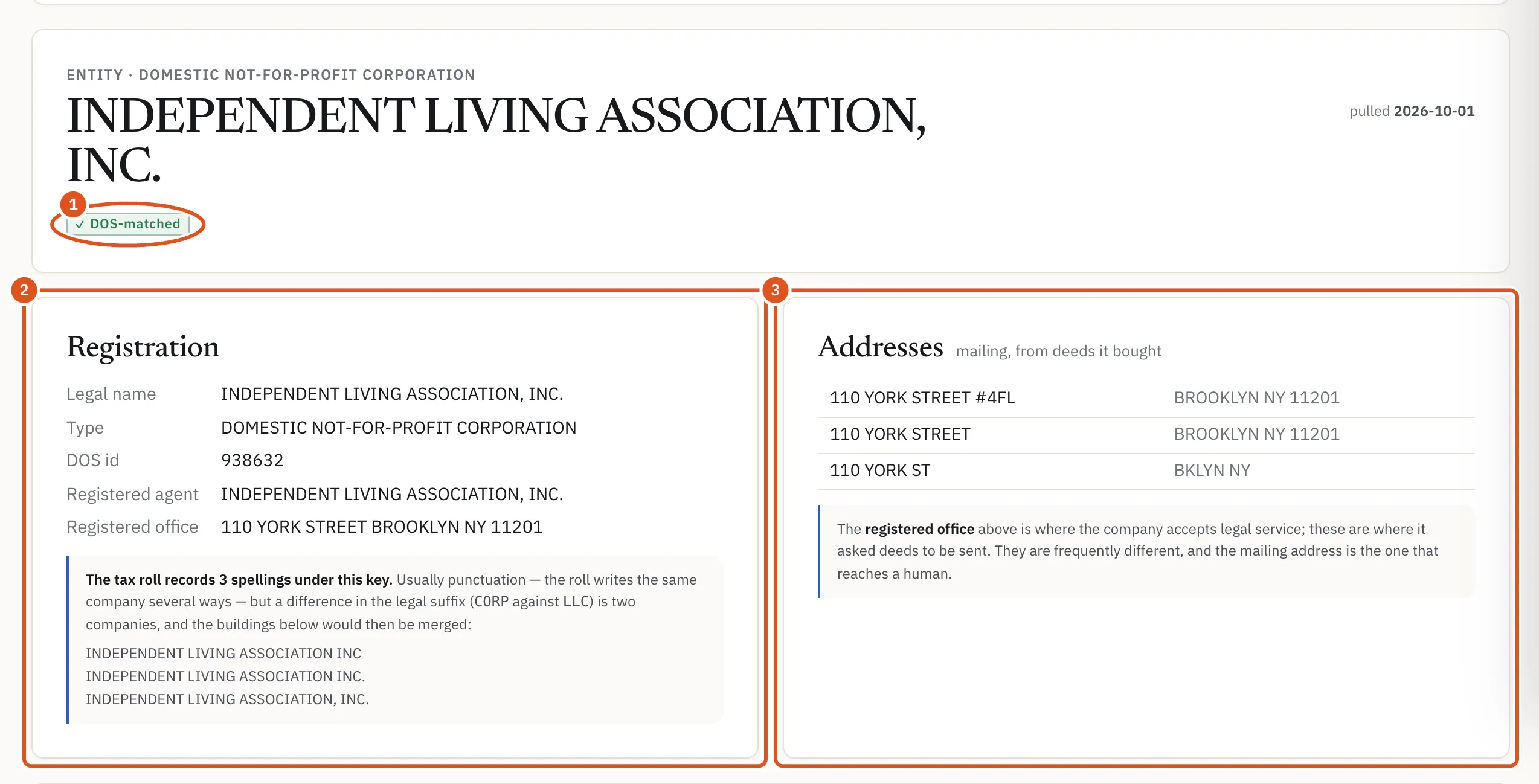
- Found in the State registry
- The State's record
- Where deeds were sent
Registration
What the State registry records: Legal name, Type, DOS id, Legal papers to (the name the State forwards legal papers to, often the person behind a small LLC) and Registered office (the address they go to). That name is not a registered agent: naming one is optional, and most LLCs don't.
If the City's tax roll spells the owner several ways, the card lists every spelling. Usually it is punctuation, but a different legal ending, such as CORP against LLC, means two companies whose buildings have been merged on this page.
Addresses
mailing, from deeds it bought: the addresses the company gave on the deeds of the buildings it bought, most recent first. The registered office is where the company accepts legal service; the deed mailing address is where it wants its mail, and it is more often the one that reaches a person.
Buildings held
currently held, condominium lots collapsed: the large number is how many buildings the company holds now, with total units and market value. The table lists each one with its Address, Class (click the code for its meaning), Units, Assessed value and Distress (the building's distress score out of 100, then open violations over all violations on record), worst first.
"Holds now" follows the latest recorded deed. The City's tax roll can name an owner a year or more after a sale, so a building the company has sold drops off here even when the roll still shows its name.
Below the table, a note may say how many tax lots have been recorded to this name at some point. That count includes every condominium unit separately and every property since sold, so it is usually larger. Both numbers are true; they answer different questions.
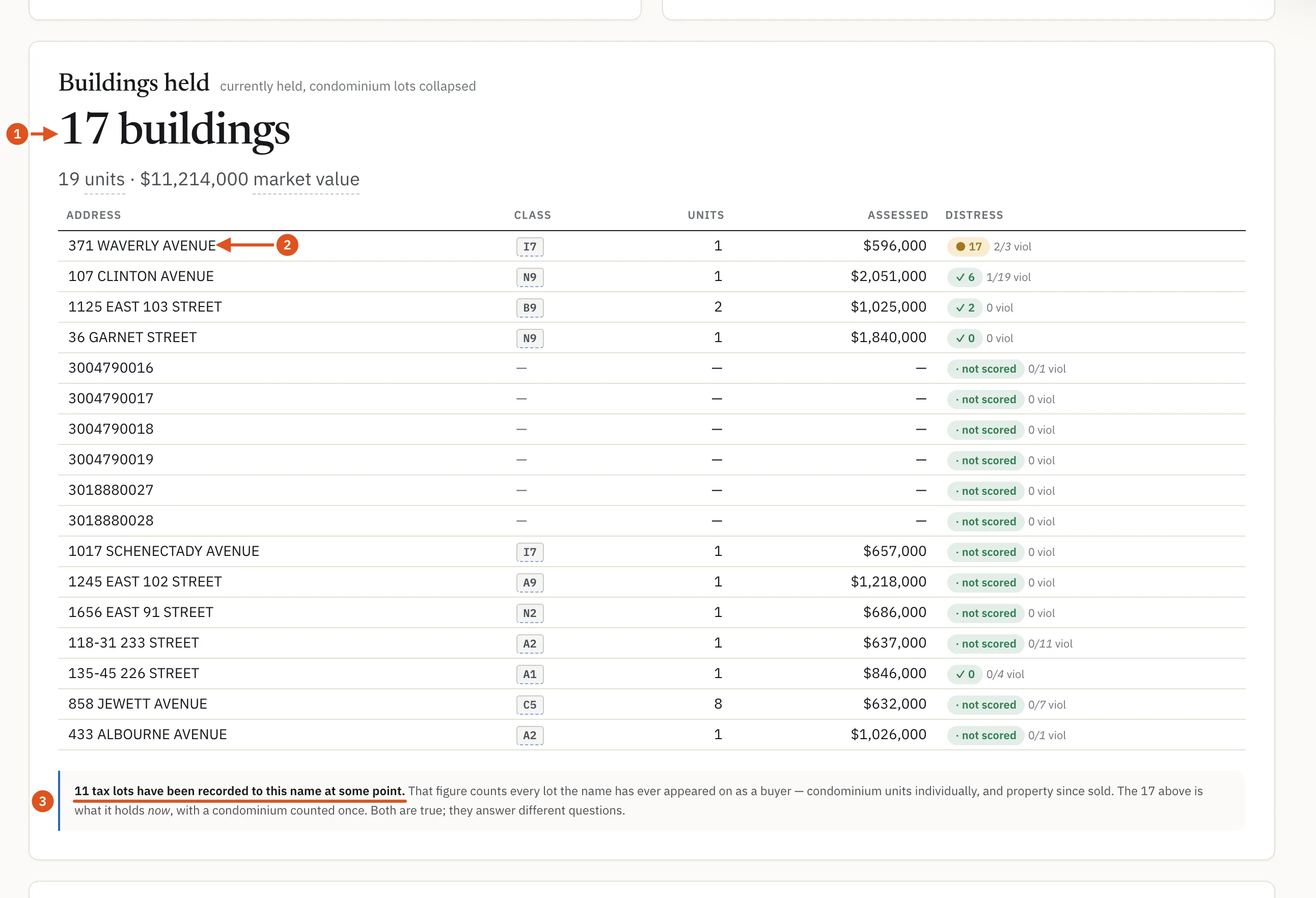
- Held now
- Opens the property page
- Ever recorded, not held
Co-registered entities
same registered office: other companies that file from the same registered office, each with the number of tax lots ever recorded to it. Click one to open its page. This is often how the rest of an operator's LLCs turn up.
When the office is a mass registered-agent address, the list is withheld, because a filing service's clients have nothing to do with each other.
Who can see it
Company pages need an account. Opening one counts as one report against your monthly allowance; opening the same company again in the same month does not count again. A free account sees the page with its details hidden, and company names need a plan that includes the owner's portfolio. See Plans and billing.
Tips
- To see every building held from the company's office, search the company and use its office ↗ link. See Owner office pages.
- The property page's Owner's portfolio card goes further than one company: it gathers the owner's other companies and the people behind them. See The owner's portfolio.
- For a step-by-step walk through an LLC, see Who owns this building?.