Learn NYC property · Ownership
When an owner dies: estates, probate and what the property record shows
What happens to a New York City property when its owner dies — joint ownership, transfer-on-death deeds and life estates, probate and administration in the Surrogate's Court, the executor's deed, the estate tax lien — and what each step leaves in ACRIS and on the tax bill.
When a New York City owner dies, the property does not wait for paperwork to change hands: the law decides at the moment of death who it belongs to. What the public record shows lags behind, sometimes by years. This guide follows the ways a property passes at death and what each one leaves in ACRIS and on the tax bill. It explains the record, not anyone's rights in a particular case.
Property that passes outside the estate
A person's estate is everything they owned at death, to be gathered, used to pay debts and taxes, and handed on. Some property never enters it, because the way it was owned already says who takes it:
- Joint ownership. A deed to a married couple creates a tenancy by the entirety unless it says otherwise, and a deed may create a joint tenancy between two or more people. Both carry a right of survivorship: when one owner dies, the survivor holds the whole. A deed to several people that says nothing more creates a tenancy in common, and each one's share passes through that person's own estate. Since 1996 the same rule covers co-op shares and the proprietary lease held by spouses.
- A transfer-on-death deed. Since July 2024 a New York owner can record a transfer-on-death deed naming who takes the property at death, without probate. It must be recorded while the owner is alive. Nothing in the law requires anything more to be recorded after the death.
- A life estate. An owner who signed a life estate deed kept the right to the property for life and gave the rest — the remainder — to someone else, who takes it when the life tenant dies.
How quickly the new deed took hold shows in the record. By BlockLot Intelligence's count of ACRIS, the City Register recorded 1,492 transfer-on-death deeds between the law taking effect and September 30, 2026, 862 of them in the last twelve months, against 16 revocations — and 1,540 life estate deeds in the same twelve months.
Transfer-on-death deeds recorded in ACRIS in each whole calendar quarter since New York's law took effect on July 19, 2024. Staten Island's are recorded by the Richmond County Clerk and are not here. BlockLot Intelligence, computed October 11, 2026.
Probate and administration
Everything else goes through the Surrogate's Court, the State court that handles the affairs of people who have died. There is one in each county, so five in New York City, and a case is filed in the county where the person lived.
Probate is the court proceeding that proves a will is valid. The will names an executor; once the court admits the will, it issues letters testamentary, the document that lets the executor act for the estate.
With no will the case is an administration proceeding, and the court appoints an administrator — usually a close relative, in the order the law sets — by letters of administration.
A person who dies without a will dies intestate, and New York's law of intestacy decides who inherits. A spouse and children share it — the spouse takes $50,000 and half the rest, the children the remainder; a spouse alone, or children alone, take everything; and failing them, parents, then brothers and sisters and their children, then more distant relatives. The people who inherit are the heirs.
Real property is not part of a small estate: the simplified procedure for estates of up to $50,000 covers personal property only, so a house or apartment building needs a full probate or administration case to be sold or deeded by the estate. The courts' law librarians note that title vests in the heirs, or in the people the will names, at death; the executor or administrator's role is to deal with the property for the estate, and a will need not grant the power to sell or mortgage it — the law gives it unless the will says otherwise, except for property the will leaves to someone by name.
What the record shows
When the estate sells, or deeds the property to the heirs, it records an ordinary deed: ACRIS has no separate type for it. The grantor signs as executor or administrator, or is named as the estate of the owner, and that is how such a deed is told apart — the deeds guide covers the executor's deed. A sale by an estate is a common sight in the record.
By BlockLot Intelligence's reading of grantors' names, 2,973 of the deeds recorded in 2025 were signed for an estate:
| Year | Deeds | From an estate | Share |
|---|---|---|---|
| 2025 | 57,373 | 2,973 | 5.2% |
| 2024 | 52,145 | 2,974 | 5.7% |
| 2023 | 50,602 | 2,802 | 5.5% |
| 2022 | 66,140 | 3,049 | 4.6% |
| 2021 | 64,992 | 2,463 | 3.8% |
| 2020 | 45,409 | 2,031 | 4.5% |
| 2019 | 56,111 | 2,790 | 5.0% |
| 2018 | 58,552 | 2,928 | 5.0% |
| 2017 | 61,087 | 2,963 | 4.9% |
| 2016 | 60,228 | 2,836 | 4.7% |
Deeds recorded in ACRIS each calendar year, at any price, and those whose grantor signed as an executor or administrator or is named as an estate — our reading of the names. Staten Island is not here. BlockLot Intelligence, computed October 10, 2026.
A deed from an executor to the people the will names, with nothing paid, is exempt from the City's transfer tax but must still be reported on its return; a deed from an executor selling the property is taxed like any sale.
New York's estate tax puts a lien on a dead owner's real property for fifteen years. To sell or mortgage it, the estate obtains a release from the State Tax Department — unless the owner and a surviving spouse were its only joint tenants — and the release is recorded: ACRIS calls it a release of estate tax lien, with the person who died as its party.
The City Register recorded 119 in the last twelve months. Only larger estates owe the tax: the State's basic exclusion is $7,350,000 for deaths in 2026, and an estate more than 5% over it loses the exclusion altogether.
The tax bill. The Department of Finance's records keep the owner's name until someone asks for a change. An executor or administrator can add their own mailing address, attaching the death certificate and the letters; an heir removes a dead owner's name the same way. Exemptions granted to the owner personally end: when a child inherits a parent's home, the Department removes the senior homeowners' exemption granted to the parent, and a surviving spouse must answer the Department's renewal to keep it.
There is no timeframe in this guide. Our records hold the dates documents were signed and recorded, but not the date of death or of the court's letters, which are filed with the Surrogate's Court: how long estates take is not ours to give.
When nothing is recorded
When heirs never record a deed, the record keeps naming the owner who died, sometimes for decades. Such property is what deed thieves look for: the Attorney General and the Department of Finance both warn that thieves target homes whose owner died years ago and whose heirs never transferred title, and both advise heirs to update the deed. The City Register mails a notice when a document is recorded against a property, and executors and administrators can sign up for those alerts too.
Where you see this in BlockLot
A building's Sales history and Deed parties list every deed with its grantor, so a deed signed by an executor or an estate shows as such. The distress search flags a sale by an estate or executor in the last two years, and counts transfer-on-death deeds among its notes.
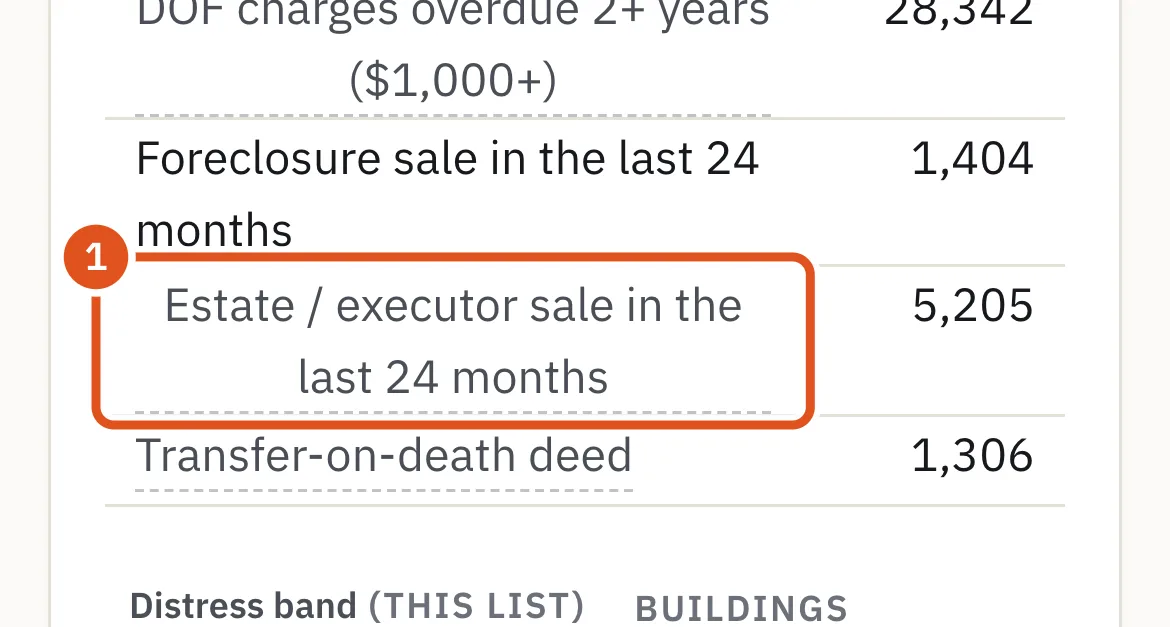
- Deeds signed by an executor, an administrator or an estate
Questions people ask
Who owns a house after the owner dies? The law decides at the moment of death: a surviving joint tenant or spouse holding by the entirety, the beneficiary of a recorded transfer-on-death deed, or otherwise the heirs or the people the will names, subject to the executor's or administrator's powers. The record changes only when a deed is recorded.
Does a house have to go through probate in New York? Not if it passes outside the estate — by joint ownership, a transfer-on-death deed or a life estate. Otherwise, yes: real property is excluded from New York's small estate procedure.
How long does the deed stay in a dead owner's name? Until someone records a new deed. Nothing forces heirs to, and properties left in a dead owner's name are a favourite target of deed thieves.
Do you pay transfer tax when you inherit a house? Inheriting is not a sale. An executor's deed to the will's beneficiaries for nothing is exempt from the City's transfer tax, though it is reported; a sale by the executor is taxed like any other.
What happens to the senior exemption when the owner dies? It ends unless a qualifying surviving spouse, or a sibling of 65 or more, still owns and lives in the home and answers the Department of Finance. A child who inherits loses it.
What is a release of estate tax lien? The State Tax Department's release of the lien its estate tax places on a dead owner's real property, recorded so the estate can sell or mortgage it.
Related
- Deeds in New York City: the kinds of deed, and grantor and grantee — What a deed is, the kinds New York law describes — bargain and sale, quitclaim, executor's, referee's — transfer-on-death and life estate deeds, who the grantor and grantee are, and what party 1 and party 2 mean on any document in ACRIS.
- Who owns a building: LLCs, the owner of record and the beneficial owner — How to find who owns a New York City building — the deed, HPD's registration, the Department of State's registry — why so many owners are LLCs, the difference between the owner of record and the beneficial owner, and how BlockLot groups an owner's buildings.
- Absentee owners, owner-occupied homes and owners' mailing addresses — What "absentee owner" means in New York City property records, where an owner's mailing address comes from, which rules turn on whether an owner lives in the home — HPD registration, STAR, the senior exemption, the co-op and condo abatement, Good Cause Eviction — and how far a deed's address can be trusted.
- Transfer taxes: the NYC RPTT, the State transfer tax and the mansion tax — The taxes due when New York City property changes hands — the City's Real Property Transfer Tax, the State's real estate transfer tax and its higher New York City rate, and the mansion tax — with their rates, who pays each, and worked numbers for homes and buildings.
- Property tax exemptions: STAR, senior, disabled, veterans, clergy, J-51, 421-a and 485-x — NYC property tax exemptions explained: STAR, senior and disabled homeowners, veterans, clergy, 421-a, 485-x, J-51 and nonprofit property.
- ACRIS and the City Register: where deeds and mortgages are recorded — What the Office of the City Register records, what ACRIS is and how to search it, how long a deed or mortgage takes to reach the record, what is not in ACRIS — Staten Island, lis pendens, records before 1966 — and how owners can be alerted when something is recorded against their property.
- Co-ops and condominiums: what you own, boards, flip taxes, sponsors and taxes — The difference between a New York City co-op and a condominium — shares and a proprietary lease against a unit you own outright — how boards, offering plans, sponsors and flip taxes work, how each is taxed, and how each shows up in the public record.
Sources
- BlockLot Intelligence — BlockLot's own analysis of the public records below, computed October 11, 2026.
- New York Constitution, Article VI § 12 (the Surrogate's Court)
- NY Courts — Ask a Law Librarian: executors and administrators
- NY Courts — Ask a Law Librarian: when there is no will
- NY Courts — Ask a Law Librarian: who owns a decedent's real property
- New York Surrogate's Court Procedure Act § 1301 (small estates)
- New York Surrogate's Court Procedure Act § 1302 (real property excluded)
- New York Estates, Powers and Trusts Law § 4-1.1 (who inherits without a will)
- New York Estates, Powers and Trusts Law § 6-2.2 (joint ownership)
- New York Estates, Powers and Trusts Law § 11-1.1 (an executor's powers)
- New York Real Property Law § 424 (transfer-on-death deeds)
- NYS Department of Taxation and Finance — Estate tax
- NYS Department of Taxation and Finance — Releasing the estate tax lien
- New York Tax Law § 982 (the estate tax lien)
- NYS Department of Taxation and Finance — STAR eligibility (life estates)
- NYC 311 — Remove a deceased owner from a property tax bill
- NYC Department of Finance — Property information update form
- NYC Department of Finance — SCHE and DHE frequently asked questions
- NYC Department of Finance — Real Property Transfer Tax
- NYC Department of Finance — Deed theft prevention
- NY Attorney General — Deed theft
- NYS Office of Real Property Tax Services — Opinion of Counsel, vol. 12 no. 35 (joint tenancy and survivorship)
- NYC Department of Finance — Notice of Recorded Document FAQ
- NYC Open Data — ACRIS Document Control Codes