Learn NYC property · Agencies and the basics
Building class codes and land use: what A1, C6, D4, O4 and R4 mean
How the Department of Finance's two-character building class describes every property in New York City, the 25 letter families from A to Z, the codes beginners meet most, how a building class relates to the tax class, and City Planning's eleven land-use categories built from it.
A building class — its building classification, or building class code — is the two-character code the Department of Finance gives every property in New York City to say what it is used for and, often, how it is built. The letter is the family — A is a one-family house, D an elevator apartment building, O an office building, R a condominium unit — and the second character narrows it down: A5 is an attached or semi-detached one-family house, O4 an office tower of 20 stories or more. DOF calls this the property's "constructive use", and the Department of Buildings' "building code" means the same thing.
The building class appears on the assessment roll, on every Notice of Property Value and in DOF's sales data, which uses it to group similar properties. It is how BlockLot, and anyone comparing sales, finds properties like the one in question: a two-family brick house is compared with other two-family houses, not with a corner store.
The letter families
DOF's list has 25 families, A to Z with no X:
| Code | Family |
|---|---|
| A | One-family dwellings |
| B | Two-family dwellings |
| C | Walk-up apartments |
| D | Elevator apartments |
| E | Warehouses |
| F | Factories and industrial buildings |
| G | Garages |
| H | Hotels |
| I | Hospitals and health facilities |
| J | Theatres |
| K | Store buildings |
| L | Lofts |
| M | Religious facilities |
| N | Asylums and homes |
| O | Office buildings |
| P | Indoor public assembly and cultural facilities |
| Q | Outdoor recreational facilities |
| R | Condominiums |
| S | Primarily residential, mixed use |
| T | Transportation facilities |
| U | Utility bureau properties |
| V | Vacant land |
| W | Educational facilities |
| Y | Government and City departments |
| Z | Miscellaneous |
Homes dominate. By BlockLot Intelligence's count of City Planning's lot file, 66.0% of the city's lots are one- or two-family houses (classes A and B):
Every lot in PLUTO by the first letter of the Department of Finance's building class. A condominium counts once, under R. BlockLot Intelligence, computed October 9, 2026.
The L family is still on DOF's list, but no lot carries a loft code on any of DOF's published rolls from fiscal 2023 to 2027, nor in City Planning's current file.
Codes you will meet
- A1 to A9 — one-family houses: A1 a detached house of two stories, A5 attached or semi-detached, A0 a Cape Cod, A7 a mansion or town house.
- B1, B2, B3 — two-family houses: brick, frame, and converted from one family.
- C0 — a three-family house. Three-family houses sit in the C family, walk-up apartments, though they are taxed with one- and two-family homes.
- C6 and D4 — co-op buildings: C6 a walk-up co-operative, D4 an elevator co-operative. A co-op building is one lot, so its class describes the whole building.
- R codes — condominium units: R4 a residential unit in an elevator building, R2 one in a walk-up, RR a condominium rental, RG and RP indoor and outdoor parking, RK retail, RB office space. R0 is a special condominium billing lot.
- S1, S2, S9 — homes with a store or office: one family with one store, two families with one store, and larger mixed buildings.
- K1, K4 — store buildings: a one-story retail building, and one mainly retail with other uses.
- O4 — an office building of 20 stories or more.
- V0, V1 — vacant land: zoned residential outside Manhattan, or zoned commercial or residential in Manhattan.
- Z7, Z8 — an easement, and a cemetery.
DOF adds codes as the city changes. Codes for walk-up and elevator buildings of fewer than 11 units, rentals and co-ops alike (CB, CC, DB, DC), first appear on the fiscal 2025 and 2026 rolls, and community gardens (VG, VC) on the fiscal 2027 roll.
Building class and tax class
The building class and the tax class are different things. The tax class — 1, 2, 3 or 4 — decides how a property is assessed and taxed; the building class describes what it is. DOF says there is a direct correlation between them, and for most families the class settles it: on the fiscal 2027 final roll every A and B lot is in tax class 1, every D lot in class 2 or one of its sub-classes, and every lot in families E, F, H, I, J, K, M, N, O, P, Q, T, W and Y in class 4.
But for C, R, S, V, G, U and Z the building class alone does not decide. A C0 three-family house is class 1, while a walk-up apartment building of four or more homes is class 2; condominium units, the R codes, are spread across classes 1, 2 and 4; a G0 garage on a home's lot is class 1, while a commercial garage is class 4.
Land use
City Planning sorts every lot into one of eleven land use categories. A lot's land use category is coarser than its building class and meant for mapping and planning. It assigns each building class to the category that fits it best, so the land use code in PLUTO is derived from DOF's building class:
Every lot in PLUTO by the land-use category the Department of City Planning gives it — a condominium counts once, as one lot. A few thousand lots have no category. BlockLot Intelligence, computed October 9, 2026.
| Code | Land use category |
|---|---|
| 01 | One and two family buildings |
| 02 | Multi-family walk-up buildings |
| 03 | Multi-family elevator buildings |
| 04 | Mixed residential and commercial buildings |
| 05 | Commercial and office buildings |
| 06 | Industrial and manufacturing |
| 07 | Transportation and utility |
| 08 | Public facilities and institutions |
| 09 | Open space and outdoor recreation |
| 10 | Parking facilities |
| 11 | Vacant land |
A few rules follow from the mapping. Co-ops are split by their building, not their ownership: a C6 walk-up co-op is land use 02 and a D4 elevator co-op 03. A three-family C0 house is 02, not 01. Homes with a store, the S codes, are 04 — mixed residential and commercial. A condominium billing lot, R0, and easements, Z7, get no land use at all.
Counting lots and counting land tell different stories. One- and two-family houses fill 66.0% of the lots but only 26.2% of the lot area, while open space and outdoor recreation — parks above all — is 0.6% of the lots and 23.4% of the area, by BlockLot Intelligence's count of PLUTO. Lot area can include streets that were mapped but never built, so it is not quite the city's land area.
Land use is not zoning
Land use describes what stands on a lot today. Zoning is the law that says what may be built there — the uses allowed, how large and how dense. The two can disagree: a building put up legally before the zoning changed may stay, and City Planning calls it non-conforming or non-complying. A lot's land use tells you what is there; its zoning tells you what could be.
A worked example. The Empire State Building is building class O4 — "office only with or without comm - 20 stories or more" in DOF's words — and its land use is "Commercial and office buildings". A unit in a commercial condominium such as 120 Broadway is class RB, office space, while the condominium's billing lot is R0.
Where you see this in BlockLot
A building's page shows its building class as a code beside the address — click it for the definition and the other codes in its family — and its land use in the Zoning & use card, next to the zoning district.
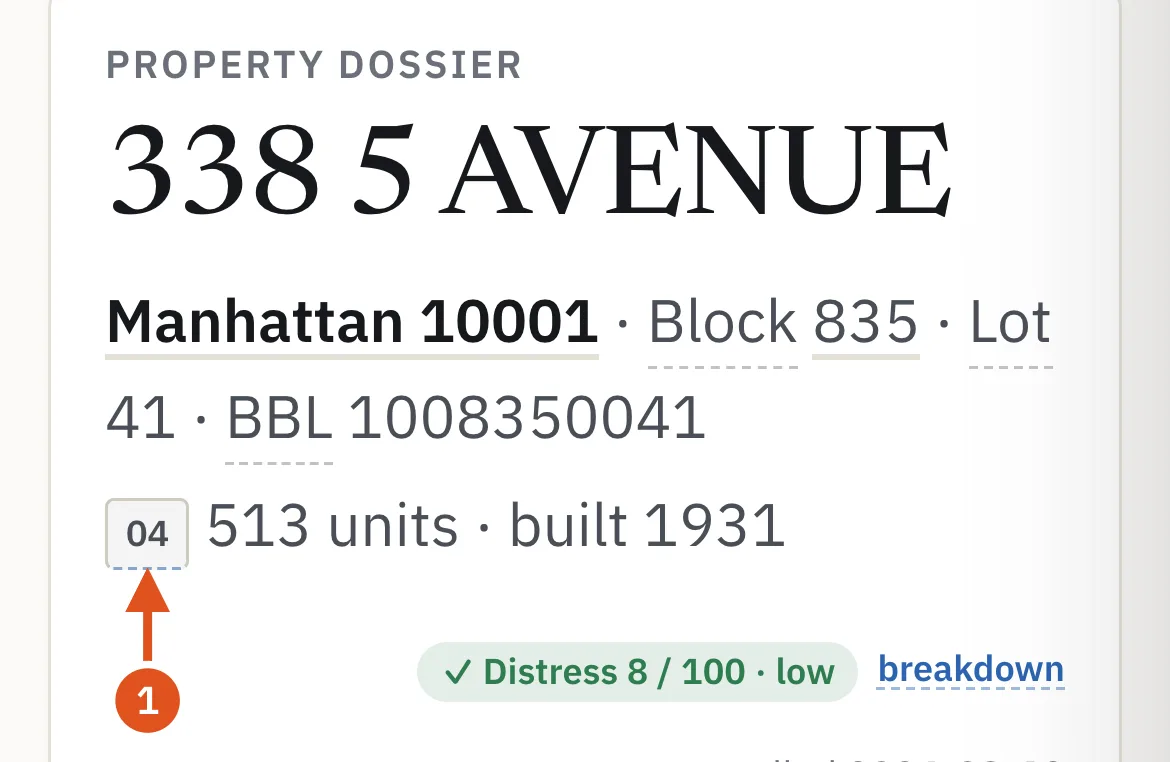
- DOF's building class
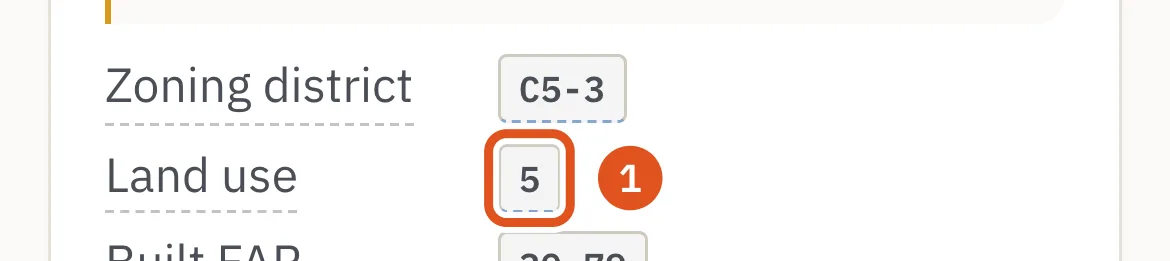
- City Planning's land use category
Questions people ask
What does building class A1 mean? A one-family detached house of two stories, small or mid-sized. The A family is one-family houses; the digit says which kind.
What building class is a co-op? C6 for a walk-up co-op building and D4 for an elevator co-op. A condominium unit is in the R family instead — R4 for an apartment in an elevator building.
Is the building class the same as the tax class? No. The building class describes the property; the tax class (1 to 4) sets how it is taxed. Most building classes fall in one tax class, but some, such as C, R and S, can be in several.
Where do I find a property's building class? On the Department of Finance's assessment roll and in City Planning's PLUTO file; BlockLot shows it beside the address on every building's page.
What is the difference between land use and zoning? Land use is what is on the lot now; zoning is what the law allows there. A lot zoned for apartments can still hold a one-family house.
Can a building class change? Yes. It follows the property: a vacant lot that is built on, or a rental building converted into condominiums, ends up with a different class.
Related
- BBL, block and lot: how New York numbers its land and buildings — What a BBL is, how borough, block and lot make up its ten digits, why condominiums have billing lots and unit lots, how lots are merged and split, and how the BIN that identifies a building differs.
- PLUTO, NYC Open Data and the public registries behind a property — What NYC Open Data is, what City Planning's PLUTO lot file holds and where its fields come from, how city-owned land is marked, what the New York Department of State's business registry says about the companies that own buildings — and how BlockLot uses each.
- Assessed value and how the NYC property tax is calculated — How New York City turns a market value into a tax bill — the four tax classes, the 6% and 45% assessment ratios, the yearly caps and five-year phase-ins, exemptions and abatements, the tax rates — worked through on a real building.
- Department of Finance (DOF) — What New York City's Department of Finance does for property — the yearly assessment roll, the property tax bill and its calendar, the City Register that records deeds and mortgages, the transfer taxes, exemptions and the charges other agencies put on a property's account.
Sources
- BlockLot Intelligence — BlockLot's own analysis of the public records below, computed October 11, 2026.
- DOF — Building classification codes
- DOF — Glossary of terms for property sales files
- DOF — Assessment roll explanation
- DOF — Definitions of property assessment terms (tax classes)
- DOF — Property assessments (roll data)
- NYC Open Data — Property Valuation and Assessment Data
- DCP — PLUTO Data Dictionary, August 2026 (26v2), land use and appendices C and D
- DCP — PLUTO README, August 2026 (26v2)
- NYC Open Data — PLUTO
- DCP — Zoning FAQ