Learn NYC property · Deeds, mortgages and sales
Transfer taxes: the NYC RPTT, the State transfer tax and the mansion tax
The taxes due when New York City property changes hands — the City's Real Property Transfer Tax, the State's real estate transfer tax and its higher New York City rate, and the mansion tax — with their rates, who pays each, and worked numbers for homes and buildings.
A transfer tax is a tax on the transfer of real property itself, charged as a share of the price. When a New York City property changes hands, two governments tax it: the City, with its Real Property Transfer Tax, and the State, with its real estate transfer tax and, on homes of $1 million or more, the mansion tax. They are separate from the yearly property tax and from the mortgage recording tax on a loan.
Together they are one of the largest costs of a sale, and on a large building they come to millions of dollars. They are paid when the deed is recorded, and their returns are filed through ACRIS with it.
The City's Real Property Transfer Tax
The RPTT is the City's tax on a sale of New York City real property for more than $25,000. Its rate depends on what the property is and on the price:
| Property | ≤ $500k | > $500k |
|---|---|---|
| Home | 1% | 1.425% |
| Other | 1.425% | 2.625% |
A "home" here is a one- to three-family house, a condominium unit or a co-op apartment; every other property — apartment buildings, offices, stores, land — pays the commercial rates. The property's type is fixed on the day of the transfer.
- Who pays: the seller (the grantor). If the seller does not pay, or is exempt, the buyer must.
- When: the return (form NYC-RPT) is filed and the tax paid within 30 days of the transfer — before the deed is recorded — even when no tax is due.
- On what: the whole price, including any mortgage or lien the property is sold subject to, except that on a house, condo unit or co-op apartment an existing loan that stays on the property is not counted.
- Late: interest, and penalties of up to 25% of the tax.
The RPTT also reaches transfers that are not deeds: a sale of co-op shares, the grant or assignment of a lease, and the sale of a controlling interest — 50% or more — in a company that owns or leases New York City property. Selling the company instead of the building does not avoid the tax.
Some transfers are exempt — to or from the federal, State or City governments, to or from a nonprofit organized for religious, charitable or educational purposes, a deed given only as security for a loan, or a change in the form of ownership where the owners stay the same. Most of those still file a return.
In calendar year 2025 the RPTT came to $1.79 billion, 22% more than in 2024, on 54,802 taxable transfers, the Department of Finance reports — $788 million of it on homes and $1.0 billion on commercial property.
The State's real estate transfer tax
New York State's real estate transfer tax is 0.4% of the price — $2 for every $500 — on every conveyance over $500, paid by the seller with form TP-584-NYC within 15 days of the deed's delivery. In New York City it rises to 0.65% on a home sold for $3 million or more and on any other property sold for $2 million or more. That higher rate, and the mansion tax's higher brackets, have applied since July 1, 2019.
The mansion tax
The mansion tax is the State's tax on the buyer of a home for $1 million or more: 1% of the price, paid by the buyer. Since July 1, 2019, New York City homes of $2 million or more pay more — the State's supplemental tax, in brackets:
| Price of the home | Mansion tax |
|---|---|
| $1 million to under $2 million | 1% |
| $2 million to under $3 million | 1.25% |
| $3 million to under $5 million | 1.5% |
| $5 million to under $10 million | 2.25% |
| $10 million to under $15 million | 3.25% |
| $15 million to under $20 million | 3.5% |
| $20 million to under $25 million | 3.75% |
| $25 million or more | 3.9% |
The rates above are the 1% and the supplemental tax together. On a building that mixes homes and other uses, the threshold is tested on the whole price, but the tax falls only on the part paid for the homes.
Every rate applies to the whole price
None of these taxes is charged only on the amount above a threshold. Cross one, and the higher rate applies to the entire price. A home sold for $999,999 owes no mansion tax; at $1,000,000 the buyer owes $10,000. The same cliff sits at $500,000 for the RPTT and at $2 or $3 million for the State's higher rate.
Worked numbers
At the rates in force since July 1, 2019:
| Price | Seller pays | Buyer pays | Total |
|---|---|---|---|
| $400,000 home | $5,600 | — | $5,600 |
| $800,000 home | $14,600 | — | $14,600 |
| $1,500,000 home | $27,375 | $15,000 | $42,375 |
| $2,500,000 home | $45,625 | $31,250 | $76,875 |
| $6,000,000 home | $124,500 | $135,000 | $259,500 |
| $10 million building | $327,500 | — | $327,500 |
The seller's column is the City's RPTT plus the State's tax: on the $1.5 million home, 1.425% ($21,375) and 0.4% ($6,000). The buyer's is the mansion tax. The building is commercial: 2.625% ($262,500) and 0.65% ($65,000). A buyer who borrows also pays the mortgage recording tax on the loan, which is not in the table.
A real sale. 10 East 53rd Street, a 38-storey office tower, sold for $310,000,000 on August 5, 2026. As commercial property above $2 million it owed the City's RPTT at 2.625% — $8,137,500 — and the State's tax at 0.650%, $2,015,000: $10,152,500 in all, at the published rates, on the price written on the deed.
How many sales cross each line
One- to three-family houses and condo and co-op apartments sold in the calendar year, at $10,000 or more, from DOF's annualized sales file. A sale whose date and price repeat on another lot of the same block is left out, as probably part of a package. BlockLot Intelligence, computed October 11, 2026.
By BlockLot Intelligence's count of the Department of Finance's sales file, of the 44,763 home sales of $10,000 or more in 2025, 35.8% were for $1 million or more and owed the mansion tax, and 12.3% for $2 million or more, the City's higher brackets. 22.2% were under $500,000, the City's lower rate.
Where you see this in BlockLot
A building's page shows each sale's price in Sales history and the most recent one in the Owner card's Last sold line — the price these taxes are worked on. BlockLot does not show the tax paid: the transfer-tax returns themselves are not published.
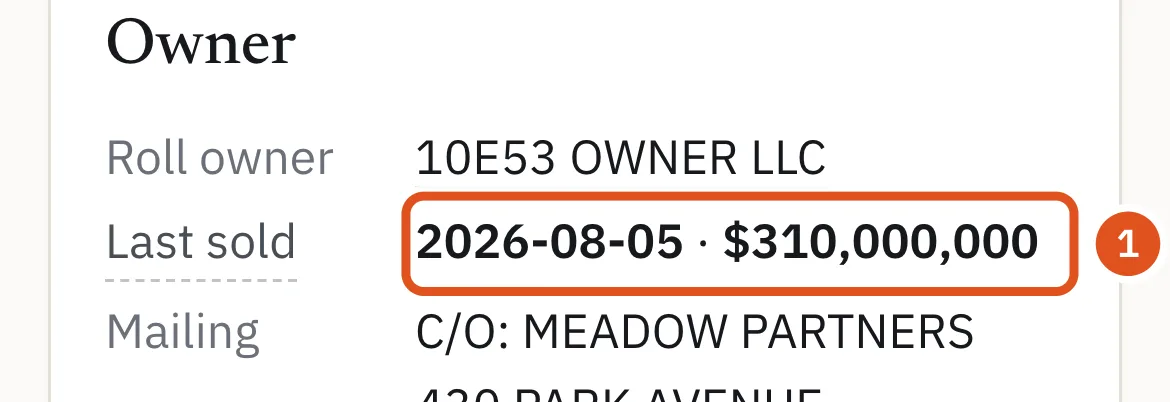
- The price the taxes are worked on
Questions people ask
Who pays the transfer tax in New York City, the buyer or the seller? The seller pays the City's RPTT and the State's transfer tax; the buyer pays the mansion tax on a home of $1 million or more. If the seller does not pay, the buyer becomes liable.
How much is the NYC transfer tax on a $1 million home? The City's RPTT is 1.425% ($14,250), the State's tax 0.4% ($4,000) — both the seller's — and the buyer owes a 1% mansion tax ($10,000): $28,250 in all.
Does the mansion tax apply to co-ops? Yes. A co-op apartment counts as a home for the mansion tax and for the City's lower RPTT rates, although it is bought as shares rather than by deed.
Is the mansion tax only on the amount over $1 million? No. Once the price reaches $1 million, the tax is on the whole price.
Can you avoid the transfer tax by selling the company that owns the building? No. Transferring 50% or more of a company that owns New York City property is itself taxed by the City's RPTT.
When is the transfer tax due? The City's within 30 days of the transfer and before the deed is recorded; the State's within 15 days of the deed's delivery.
Related
- Deeds in New York City: the kinds of deed, and grantor and grantee — What a deed is, the kinds New York law describes — bargain and sale, quitclaim, executor's, referee's — transfer-on-death and life estate deeds, who the grantor and grantee are, and what party 1 and party 2 mean on any document in ACRIS.
- Sale prices in the public record: ACRIS, DOF's sales files, $0 deeds and package deals — Where New York City sale prices are published — the price written on the deed in ACRIS and the Department of Finance's rolling and annualized sales files — why so many sales show $0, and how partial interests, package deals and non-arm's-length sales distort a price.
- Mortgages, satisfactions, assignments and CEMAs — What a mortgage is and who the mortgagor and mortgagee are, the mortgage recording tax, and the documents that follow a loan in ACRIS — assignments when it is sold, CEMAs when it is refinanced, satisfactions when it is paid off — plus reverse mortgages, HMDA and loan-to-value.
- The pied-à-terre surcharge (non-primary residence surcharge) — NYC's 2026 pied-à-terre surcharge on high-value homes that are no one's primary residence: who owes it, the rates, and its legal status.
- ACRIS and the City Register: where deeds and mortgages are recorded — What the Office of the City Register records, what ACRIS is and how to search it, how long a deed or mortgage takes to reach the record, what is not in ACRIS — Staten Island, lis pendens, records before 1966 — and how owners can be alerted when something is recorded against their property.
Sources
- BlockLot Intelligence — BlockLot's own analysis of the public records below, computed October 11, 2026.
- DOF — Real Property Transfer Tax (RPTT)
- DOF — Real Property Transfer Tax statistical profile, calendar year 2025
- DOF — RPTT reports and statistical profiles
- DOF — Statement of audit procedure RPTT-2019-1
- New York Tax Law § 1402 (the real estate transfer tax)
- New York Tax Law § 1402-a (the mansion tax)
- New York Tax Law § 1402-b (the supplemental tax in New York City)
- NYS Department of Taxation and Finance — Real estate transfer tax
- NYS Department of Taxation and Finance — Instructions for Form TP-584-NYC
- NYS Department of Taxation and Finance — Real estate transfer tax expenditure report