Learn NYC property · Value and property tax
Challenging an assessment: RPIE, the Tax Commission and SCAR
How to challenge a NYC property assessment: DOF's Request for Review, the Tax Commission, the RPIE filing, SCAR and Article 7 — with success rates.
A New York City owner who thinks a property is assessed too high has three places to say so: the Department of Finance (DOF), which made the assessment; the Tax Commission, an independent City agency that hears appeals; and, after the Tax Commission, the State courts. The steps run on fixed deadlines — most of them in March — and for income-producing property one filing, the RPIE, must be made the year before or the door to an appeal can close.
Owners of large buildings appeal routinely, through lawyers who file every year; owners of homes rarely do. This page explains each step, who can use it, and how often it works.
A Request for Review at DOF
A Request for Review asks DOF to look again at its own market value or tax class. It opens when the notices come out in January; in 2026 it closed on March 16 for class 1, March 2 for class 2 and April 1 for class 4. DOF can raise the value as well as lower it, and its answer cannot be appealed within DOF. Above all, a Request for Review does not replace an application to the Tax Commission and does not move its deadline: only the Tax Commission application keeps the right to go to court.
A Request to Update is different: it corrects facts about the property — square footage, units, year built — and has no deadline (see the Notice of Property Value).
The Tax Commission
The NYC Tax Commission is the City's independent body for reviewing assessments — a president and six commissioners appointed by the Mayor with the Council's consent, part of the Office of Administrative Tax Appeals. It hears four kinds of claim: that the property is misclassified, that the assessment is excessive (including a missed exemption), that it is unequal to similar property, or that it is unlawful. It can lower the assessed value, change the class or allow an exemption, but it can never raise a value or take an exemption away. For class 1 homes and class 2 buildings of fewer than eleven units it reviews the assessed value, not DOF's market value.
Deadlines
Applications must be received — not postmarked — by March 1 for classes 2, 3 and 4 and March 15 for class 1, set by the City Charter and never extended. In 2026 both fell on Sundays and moved to March 2 and March 16. An owner sent a revised notice raising the value after February 1 gets 20 days from that notice instead.
The forms
| Form | For |
|---|---|
| TC108 | Class 1 homes |
| TC101 | Class 2 and 4 buildings, not condominium units |
| TC109 | Condominium units |
| TC106 | Class, and building exemptions such as 421-a or J-51 |
A building that earned rent in the year before must attach an income and expense schedule (TC201 for rentals, TC203 for co-ops and condominiums, others for hotels and stores), and the largest need an accountant's review. Applications are filed on paper with an original signature — in person or by mail, never by e-mail — and there is a $175 fee where the assessed value is $2 million or more, added to the tax bill rather than paid with the application. Since 2026 the Commission also hears appeals of the pied-à-terre surcharge on form TC107.
Hearings and offers
The Commission grants a hearing on request when it can, and otherwise decides on the papers; most 2025 hearings were held by video. DOF's assessment is presumed correct, and the owner must show otherwise with substantial evidence — which is why, in 2025, more than 98% of applicants had a lawyer or other representative. When the Commission agrees, it makes an offer of a lower assessment. Accepting it means giving up any court case for that year and earlier ones. An offer accepted before the final roll shows on the July bill; anything later comes back as a refund or credit from DOF.
How often it works
The Commission's 2025 annual report, for the FY 2025/26 roll, counted 57,198 applications covering 263,290 tax lots. 8,567 received an offer — about one in seven — and 7,038 accepted, reducing assessed values by $3.95 billion, nearly all of it in classes 2 and 4: class 1 homes accounted for 58 accepted offers worth $4.2 million.
DOF's roll records which lots are under an application, and by which form. By BlockLot Intelligence's count of the FY 2026/27 roll, 270,313 tax lots were under one: 47,171 on the form for classes 2 and 4, 3,154 homes in class 1, and 219,755 condominium units — one application covers every unit of a building, and each unit is a lot of its own. Counted the same way on the year before's roll, the lots come within about 1% of the 263,290 in the Commission's own report.
Tax lots the Department of Finance's roll marks with a Tax Commission application, by the form filed. One condominium application covers every unit in the building, and each unit is its own tax lot, so the condominium bar counts apartments, not applications. BlockLot Intelligence, computed October 9, 2026.
It is the large buildings that appeal. On that roll the lots under an application held 47.8% of class 4's market value and 66.6% of class 2's, but 0.5% of class 1's homes.
RPIE — the income filing that comes first
The Real Property Income and Expense statement, the RPIE, is a yearly report of what an income-producing property earned and spent, which DOF uses to value buildings on their income (see Market value). Owners of income-producing property with an actual assessed value over $40,000 on the tentative roll must file one — or a claim of exclusion, if an exception applies. The RPIE for 2025 was due June 1, 2026, filed online.
- No filing at all is needed for residential property of ten or fewer apartments, class 1 and class 2 property of six or fewer units with at most one store, and property assessed at $40,000 or less.
- A claim of exclusion is filed instead by, among others, residential co-ops with up to 2,500 square feet of commercial space, wholly owner-occupied property, property rented only to related parties, and vacant buildings and land. Owners of individual residential condominium units do not file.
- Larger property adds a rent roll at an assessed value of $750,000 or more.
Not filing costs money — DOF's penalty schedule runs from $300 to $100,000 by assessed value, and up to 5% of the assessed value after three years in a row — and, worse, an appeal: the Tax Commission can refuse to review a property whose RPIE was not filed. In 2025 it turned away 592 applications for that reason. DOF publishes the lists of non-filers.
In court: SCAR and Article 7
After a timely application to the Tax Commission, an owner who got no offer, or turned one down, can go to the State Supreme Court — even if the Commission has not decided yet. For FY 2026/27 the cases had to be filed before October 25, 2026 — by Friday, October 23, this year.
- Small Claims Assessment Review (SCAR) is a simple, low-cost route for an owner-occupied one-, two- or three-family home used only as a residence. The owner must first have filed with the Tax Commission and not accepted an offer, then files a petition with the County Clerk with a $30 fee. A hearing officer — no lawyer needed — decides, and a reduction is refunded automatically. Co-op apartments, class 2 condominiums, homes with a store or office, and homes owned by a company are not eligible. Few New Yorkers use it: the State counted 462 SCAR petitions in New York City in 2023, against more than 63,000 across the State.
- Article 7 — a tax certiorari case under Article 7 of the State's Real Property Tax Law — is the route for every other property. It needs a lawyer for a company, a $210 filing fee, and a Tax Commission application filed in time. Filing it does not stop the tax from being collected.
Where you see this in BlockLot
On a building's page, History in the Value & tax card opens every year's roll for the lot: a year in which the assessed value fell while the market held steady is often a year in which an appeal succeeded. BlockLot does not show who filed or what was claimed.
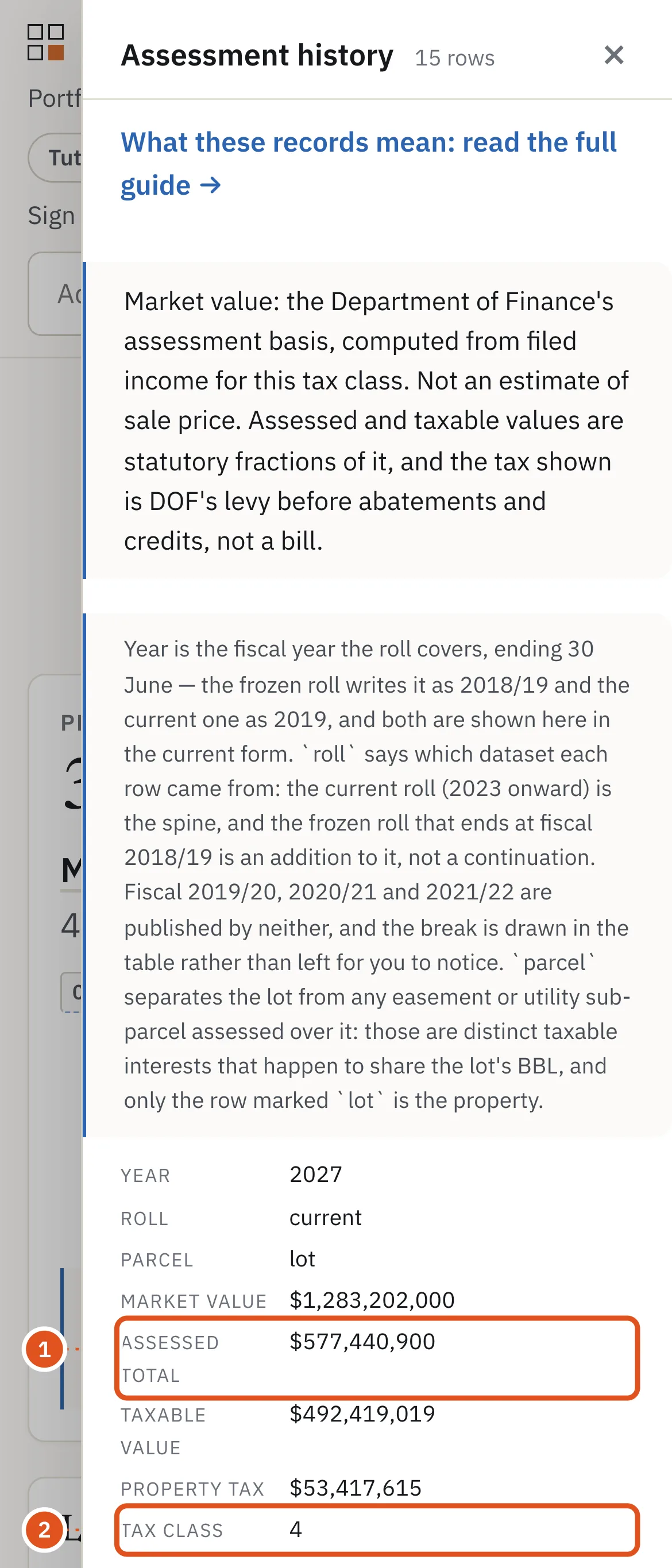
- The assessed value — what the Tax Commission can lower
- The tax class — which it can also change
Questions people ask
How do I appeal my New York City property tax assessment? File an application with the NYC Tax Commission by March 1 (classes 2–4) or March 15 (class 1), on form TC108 for a home, TC101 for a building or TC109 for a condominium unit. You can also ask DOF for a Request for Review, but it does not replace the Tax Commission.
What is the difference between a Request for Review and a Tax Commission appeal? A Request for Review asks DOF to recheck its own value, which it can raise or lower. The Tax Commission is independent, can only lower an assessment or grant relief, and filing with it is what keeps the right to go to court.
Do I have to file an RPIE? Yes, if you own income-producing property with an actual assessed value over $40,000 — unless it is residential with ten or fewer apartments or another exception applies, in which case you may have to file a claim of exclusion instead. The 2025 RPIE was due June 1, 2026.
How likely is a Tax Commission reduction? In 2025, about one application in seven received an offer, and accepted offers cut assessed values by $3.95 billion — almost all of it for apartment and commercial buildings.
Can I take my case to small claims court? Only if you own and live in a one- to three-family home used only as a residence, and only after filing with the Tax Commission. SCAR costs $30; the 2026 deadline was October 23.
Do I need a lawyer? Not for a home, at the Tax Commission or in SCAR. Most owners of large buildings use one, and a company needs one in court.
Related
- Market value (NYC property tax) — What the Department of Finance's "market value" is, why it is not what a property would sell for, how DOF estimates it for each tax class — with the income formula — and how and when an owner can challenge it.
- The Notice of Property Value and the assessment calendar — What New York City's Notice of Property Value shows, line by line, and the assessment calendar from January to October, with the 2026 dates.
- Assessed value and how the NYC property tax is calculated — How New York City turns a market value into a tax bill — the four tax classes, the 6% and 45% assessment ratios, the yearly caps and five-year phase-ins, exemptions and abatements, the tax rates — worked through on a real building.
- The pied-à-terre surcharge (non-primary residence surcharge) — NYC's 2026 pied-à-terre surcharge on high-value homes that are no one's primary residence: who owes it, the rates, and its legal status.
Sources
- BlockLot Intelligence — BlockLot's own analysis of the public records below, computed October 9, 2026.
- DOF — Real Property Income and Expense (RPIE)
- DOF — RPIE filing information (January 2026)
- DOF — RPIE frequently asked questions (March 2026)
- DOF — RPIE penalties
- DOF — RPIE non-compliance lists
- DOF — Assessment and valuation forms (Request for Review, Request to Update)
- DOF — Challenge your assessment
- DOF — Request for Review, class 1 (2026)
- NYC Tax Commission
- NYC Tax Commission — Forms (2026/27)
- NYC Tax Commission — Challenging your Notice of Property Value
- NYC Tax Commission — How to appeal a tentative assessment (TC600, 2026)
- NYC Tax Commission — Judicial review (TC707, 2026/27)
- NYC Tax Commission — Small Claims Assessment Review (TC708, 2026/27)
- NYC Tax Commission — Annual report, 2025
- NYS Department of Taxation — Grievance procedures
- NYS Department of Taxation — SCAR and certiorari activity
- NYC Open Data — Property Valuation and Assessment Data