Learn NYC property · Value and property tax
The Notice of Property Value and the assessment calendar
What New York City's Notice of Property Value shows, line by line, and the assessment calendar from January to October, with the 2026 dates.
Every January the New York City Department of Finance (DOF) sends the owner of every property a Notice of Property Value — the NOPV. It says what DOF thinks the property is worth, what it will be taxed on, and in which tax class, for the tax year that starts the following July 1. It is the one document every owner gets that explains the tax before the bill arrives, and the start of every deadline for disagreeing with it.
The Notice of Property Value (NOPV) is not a bill — DOF prints "This is not a bill" on it, and nothing has to be paid. It is a notice of the values DOF has put on the tentative assessment roll for the coming tax year, with an estimate of the tax for budgeting and the ways to challenge them.
What the notice shows
DOF's own annotated sample for a home (in its class 1 guide) has three pages:
- The values. The owner, the address and the borough, block and lot; the tax class and the building class; the number of units; the market value, the assessed value and any exemptions on file; and an estimated tax, worked out with the current tax rate, for budgeting only.
- How the tax is worked out. Market value, then the assessed value at the class's ratio and limits, then — for class 1 and small class 2 buildings — the effective market value, then the exemptions and the taxable value. This page also lists the two ways to disagree.
- The property's details. What DOF has on file: zoning, lot size, year built, stories, finished square feet, residential and commercial units, garage, basement, construction type — with a table of what changed since last year.
A notice for a larger building (class 2 or 4) also shows the actual and transitional assessed values, and a condominium unit's notice its condominium number and the unit's share of the building. The steps from market value to tax are explained on Assessed value.
The effective market value is the assessed value divided by the class's assessment ratio — 6% for class 1, 45% for class 2 buildings of up to ten units. Because yearly caps hold the assessed value down, it is usually lower than the market value printed above it, and it is the number that matters in an appeal: the Tax Commission will lower the assessment only if the property is worth less than the effective market value.
Worked example: the Empire State Building's notice
The Empire State Building is owned by a company and is in tax class 4, building class O4 (an office tower). Its notice for FY 2026/27, from DOF's roll:
- Market value last year: $1,186,766,000.
- Market value on the notice (the tentative roll): $1,283,202,000 — 8.1% more.
- Actual assessed value, at 45%: $577,440,900; transitional assessed value, which phases increases in over five years: $492,419,019.
On the final roll in May the market value was $1,283,202,000 — the same as the notice.
The roll also records that the owner challenged it, with a Tax Commission application on form TC101, the form for class 2 and 4 property — routine for a building this size, as Challenging an assessment explains.
The calendar
The New York City assessment year runs on fixed dates set by the City Charter and DOF. For the FY 2026/27 roll they fell like this; a deadline on a weekend or holiday moves to the next business day.
- January 5 — the taxable status date. The City Charter fixes each property's taxable status on this day: the notice values the property as it stood then. The FY 2026/27 values reflect what happened between January 6, 2025 and January 5, 2026.
- January 15, 2026 — the tentative roll and the notices. The tentative assessment roll is DOF's first, provisional list of every property's value for the coming tax year; the notices go out the same day.
- March 2 and March 16, 2026 — the challenge deadlines. The Tax Commission had to receive appeals by March 2 for classes 2, 3 and 4 and March 16 for class 1 (the usual March 1 and 15 fell on Sundays). DOF's own Request for Review closed on March 16 for class 1, March 2 for class 2 and April 1 for class 4. Applications for the homeowner exemptions — senior, disabled, veterans, clergy — were also due March 16, and the co-op and condominium abatement on February 23.
- Late May 2026 — the final roll. The final assessment roll is the roll taxes are billed on, after DOF's reviews and the Tax Commission's early decisions. DOF's summary of the FY 2026/27 final roll is dated May 26.
- June 1, 2026 — RPIE filings. Owners of income-producing property file their income and expenses for the year before (RPIE).
- July 1, 2026 — the tax year begins. The first bill of FY 2026/27 is due.
- October 23, 2026 — the court deadline. A case in court over the year's assessment must be filed before October 25 — this year by Friday, October 23.
The next notices, for FY 2027/28, will value property as of January 5, 2027.
Revisions and corrections
- A revised notice. When DOF changes a value after the tentative roll, the owner gets a revised Notice of Property Value. If it raises the value and is dated after February 1, the owner has 20 days from its date to go to the Tax Commission, even after the March deadline.
- A Request to Update. If the property's details are wrong — square footage, units, year built — the owner asks DOF to correct them with a Request to Update. There is no deadline: one filed between late August and mid-April changes the final roll, and a later one the next January's tentative roll.
- Disagreeing with the value. A Request for Review asks DOF to look again; an application to the Tax Commission is the formal appeal and keeps the right to go to court. Both are explained on Challenging an assessment.
The roll across the city
DOF's tentative roll for FY 2026/27 put the city's market value at $1.659 trillion, up 5.4%; the final roll, as of May 26, 2026, at $1.657 trillion, up 5.27% on the year before. By class, the final roll's market value rose 5.16% for class 1, 6.65% for class 2 and 3.79% for class 4.
Those are totals. Lot by lot, most values rose — but not all. By BlockLot Intelligence's count of the FY 2026/27 roll, 73.4% of the city's 1,115,610 taxable lots in classes 1, 2 and 4 got a higher market value than the year before, and 25.2% a lower one:
| Class | Rose | Fell |
|---|---|---|
| Class 1 | 70.3% | 29.2% |
| Class 2 | 80.4% | 18.1% |
| Class 4 | 72.6% | 19.7% |
Share of tax lots whose final market value rose or fell from the year before, over every lot in classes 1, 2 and 4 that is not fully exempt. The rest did not change. BlockLot Intelligence, computed October 9, 2026.
The bills
The bill that follows — the property tax bill, also called the Statement of Account — is issued about a month before each due date. A property with an assessed value of $250,000 or less pays quarterly (July 1, October 1, January 1 and April 1, each with a grace period to the 15th); a larger one pays twice a year (July 1 and January 1). The June bill shows the exemptions and abatements for the year starting July 1, which the January notice may not yet include. Co-op apartment owners get neither a notice nor a bill: the co-op does, for the whole building. See Overdue property charges for what happens after a due date.
Getting a copy
Notices, bills and statements are online in DOF's Property Tax Public Access portal, reached from DOF's Notice of Property Value page. By phone, 311 (212-639-9675 from outside the city) will send one by e-mail or post within five business days.
Where you see this in BlockLot
On a building's page, History in the Value & tax card opens Assessment history: every roll DOF has published for the lot, year by year — market value, assessed value, taxable value and the tax class — so the numbers on each year's notice can be followed over time.
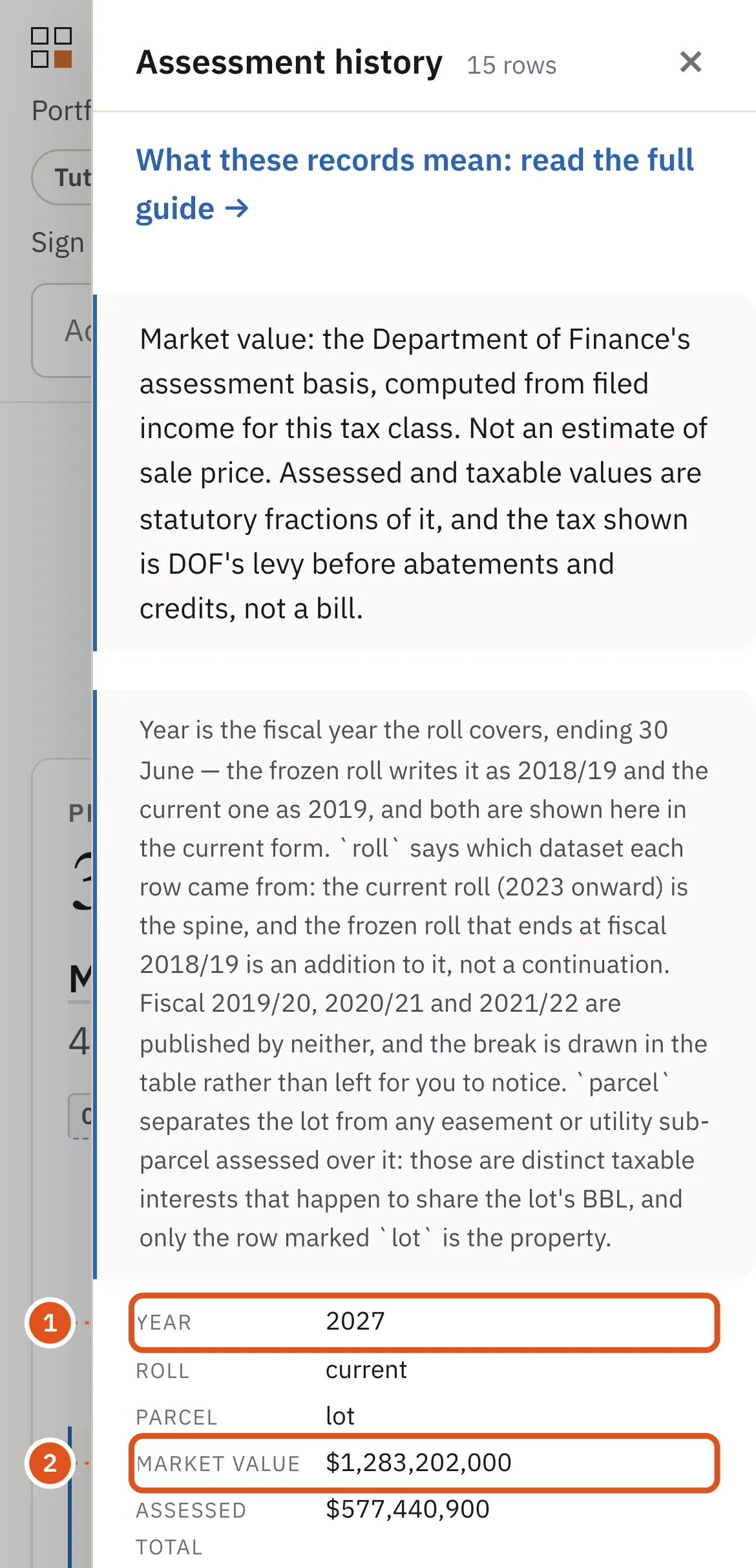
- The tax year the roll is for
- The market value on that year's notice
Questions people ask
Is the Notice of Property Value a bill? No. It tells you DOF's values for the coming tax year and estimates the tax, and nothing is due. The bill comes in June for the year starting July 1.
When does the Notice of Property Value come out? Every January, on the day DOF publishes the tentative roll — January 15 in 2026. It values the property as of January 5.
Why is my market value on the notice so different from what my home would sell for? DOF estimates it from statistical models, income or, for co-ops and condominiums, as if the building were a rental, as State law requires. See Market value.
What is "effective market value"? The assessed value divided by 6% (class 1) or 45% (small class 2 buildings). Caps keep it below the market value, and an appeal succeeds only if the property is worth less than it.
The notice has my square footage wrong. What do I do? File a Request to Update with DOF; it has no deadline. If you also think the value is too high, file with the Tax Commission by its March deadline as well.
How do I get a copy of my notice? From DOF's Property Tax Public Access portal online, or by calling 311.
Related
- Market value (NYC property tax) — What the Department of Finance's "market value" is, why it is not what a property would sell for, how DOF estimates it for each tax class — with the income formula — and how and when an owner can challenge it.
- Assessed value and how the NYC property tax is calculated — How New York City turns a market value into a tax bill — the four tax classes, the 6% and 45% assessment ratios, the yearly caps and five-year phase-ins, exemptions and abatements, the tax rates — worked through on a real building.
- Challenging an assessment: RPIE, the Tax Commission and SCAR — How to challenge a NYC property assessment: DOF's Request for Review, the Tax Commission, the RPIE filing, SCAR and Article 7 — with success rates.
- Property tax exemptions: STAR, senior, disabled, veterans, clergy, J-51, 421-a and 485-x — NYC property tax exemptions explained: STAR, senior and disabled homeowners, veterans, clergy, 421-a, 485-x, J-51 and nonprofit property.
- Water and sewer charges (DEP) as a property charge and a lien — How NYC water and sewer charges are billed to the owner, the FY 2026/27 rates, late charges, and how an unpaid water bill becomes a lien.
Sources
- BlockLot Intelligence — BlockLot's own analysis of the public records below, computed October 11, 2026.
- DOF — Notice of Property Value
- DOF — FY2027 tentative assessment roll (press release, January 15, 2026)
- DOF — Property assessments (the rolls and their summaries)
- DOF — FY2027 final roll summary (May 2026)
- DOF — 2026 Department of Finance calendar
- DOF — Definitions of property assessment terms
- DOF — Class 1 property guide (2026), with an annotated notice
- DOF — Class 2 property guide (2026)
- DOF — Assessment and valuation forms
- DOF — Property tax due dates
- DOF — Property tax bills and payments
- NYC Tax Commission — How to appeal a tentative assessment (TC600, 2026)
- NYC311 — Property value and assessment
- NYC Charter § 1507 (taxable status date)
- NYC Open Data — Property Valuation and Assessment Data