Learn NYC property · Agencies and the basics
BBL, block and lot: how New York numbers its land and buildings
What a BBL is, how borough, block and lot make up its ten digits, why condominiums have billing lots and unit lots, how lots are merged and split, and how the BIN that identifies a building differs.
A BBL — short for borough, block and lot — is the ten-digit number New York City gives every tax lot. The Department of Finance (DOF) assigns it, and almost every City record about a property is filed under it: the tax bill, the deeds and mortgages in ACRIS, the zoning, the violations. If you know a property's BBL, you can find everything else.
Its ten digits are three numbers side by side. The first digit is the borough: 1 Manhattan, 2 the Bronx, 3 Brooklyn, 4 Queens, 5 Staten Island. The next five are the block, padded with zeros, and the last four are the lot, padded the same way. Manhattan block 16, lot 100, is BBL 1000160100.
The borough digit follows where the land legally lies, not which borough serves it. Marble Hill is legally in Manhattan, though the Bronx serves it, and carries a 1; Rikers Island is legally in the Bronx and carries a 2.
Blocks and lots
A tax block is a numbered piece of a borough on the Department of Finance's tax map. It is often one city block bounded by streets, but not always: one tax block can cover two city blocks, or only part of one. A block number is unique within its borough, so block 835 exists in Manhattan and again in Brooklyn.
A tax lot is a parcel within a block — usually one piece of property, which may be vacant, under water, or covered by one or more buildings. A lot number is unique only within its block. DOF's Tax Map Office keeps the official tax maps, which show each lot's lines, numbers and dimensions; DOF publishes them for information only, and they are not a survey.
In numbers, the City's lot file — PLUTO, from the Department of City Planning — holds 858,982 lots, one per condominium: 324,613 in Queens, 276,437 in Brooklyn, 125,837 on Staten Island, 89,511 in the Bronx and 42,584 in Manhattan.
Lots change: mergers and apportionments
Block numbers rarely change; lot numbers often do. Owners combine and divide land all the time, and the tax map follows:
- a lot merger combines two or more lots into one larger lot;
- an apportionment divides one lot into two or more.
Both need DOF's approval, and the old taxes must be paid or on a payment plan first. Dividing a lot with buildings on it also needs DOB to certify that the new lots comply with zoning. DOF charges $73 for each new lot number, and its Tax Map Office handles the requests online.
The new lots usually get new numbers, and sometimes an old number is reused for a successor lot, so the same BBL can name a lot that exists today and others that existed before it. DOF's map keeps a history of changes for each block, and PLUTO records the lot a merged, split or converted lot came from (for changes since 1984). Tracing a property back in time means following the lot through those changes, not the number alone.
Condominiums: unit lots and the billing lot
In a condominium, each unit is its own tax lot with its own BBL: an apartment in a residential condominium, a floor or a shop in a commercial one. Unit lots are numbered from 1001 to 6999. Each unit is a separate parcel under New York's Real Property Law: it can be sold by deed, mortgaged, and taxed, and its owner pays the tax on it directly.
Every condominium also gets a condominium billing lot, numbered from 7501 to 7599 — most often 7501, as the Department of Buildings puts it — and so a billing BBL. It stands for the condominium as a whole, for the things the City deals with building-wide: inspecting and licensing a boiler or an elevator, collecting a sanitation fine, writing a violation. It is not an actual tax lot, and no lien can be placed on it; the taxes are billed to the units. City Planning's lot file lists a condominium once, under its billing lot, and for its Local Law 97 emissions rules DOB looks at the billing BBL, not the units'.
A worked example: 120 Broadway. The Equitable Building in Lower Manhattan is a commercial condominium. Its billing BBL is 1000477501, lot 7501 on Manhattan block 47, and it is divided into 6 unit lots, numbered 1001 to 1006 — BBLs 1000471001 to 1000471006 — owned by a company and, for one unit, the New York City Housing Development Corporation. Each unit has its own market value and its own tax bill; the building itself has one BIN, 1001026.
On the Department of Finance's roll the two kinds of lot are easy to count, because the number says which is which:
| Kind of lot | Lots |
|---|---|
| Other lots (1–999) | 844,414 |
| Unit lots (1001–6999) | 306,749 |
| Billing lots (7501–7599) | 10,957 |
| Subterranean (8000–8899) | 212 |
| Air rights (9000–9989) | 323 |
Tax lots on the Department of Finance's final assessment roll, sorted by the range their lot number falls in. Easements and utility records, which the roll files under lot numbers too, are not counted. BlockLot Intelligence, computed October 9, 2026.
DOF's own annual report for fiscal year 2026 counted 203,475 class 2 condominium units — apartments in larger residential condominiums — and 25,622 class 1 condominium units, along with commercial units such as offices, stores and parking spaces.
Air-rights and subterranean lots
Some lots describe space rather than ground. DOF numbers air-rights lots from 9000 to 9989 and subterranean lots from 8000 to 8899, and creates them through the same apportionment process as any other lot. An air-rights lot also needs a recorded zoning lot development agreement that fixes the elevation where the air lot begins.
The BIN: one number per building
A BIN, or Building Identification Number, is a seven-digit number for one building, whose first digit is the borough. The Department of City Planning assigns it, and the Department of Buildings files its permits, violations and inspections under it. Where the BBL identifies land, the BIN identifies the structure standing on it.
The two do not match one to one. A lot can hold several buildings, or none at all. A BIN never changes: it stays with its building when lots are merged or split, and a new building put up where an old one was demolished gets a new BIN.
Lots with at least one building in the City's building footprints, counting buildings only — a detached garage has a footprint and a BIN of its own and is left out here. A condominium counts once, by the lot it stands on. BlockLot Intelligence, computed October 9, 2026.
By the City's building footprints, 98.0% of the lots with a building have just one, and 16,216 have two or more. The footprints also map 213,498 garages, which get BINs of their own — so a lot with a house and a detached garage has two BINs.
A BIN made of the borough digit and six zeros — 1000000 or 3000000 — is a million BIN. It means no real BIN has been assigned yet: a planned building, a vacant lot, or a part of a complex. Temporary BINs exist too; City Planning's have a 9 as their second digit.
The Empire State Building on the record. Its BBL is 1008350041: borough 1 (Manhattan), block 835, lot 41. It stands alone on its lot, so the lot has one BIN, 1015862.
How to look up a BBL or BIN
- DOF's Property Information Portal — search by address, BBL, condominium number or air-rights lot; it shows the tax map, a lot's history of changes and, for a condominium, each unit's BBL.
- DOF's property tax records — the tax bill and Notice of Property Value are filed by BBL.
- DOB's Building Information System (BIS) — search by address, by borough, block and lot, or by BIN.
- ACRIS — the City Register's documents, searchable by borough, block and lot.
Where you see this in BlockLot
Every building's page on BlockLot opens with its borough, block, lot and BBL under the address, and lists the lot's BINs in the Lot & building card. A condominium unit's page says it is a unit lot, and that its lot area and floor area ratio belong to the condominium's base lot.
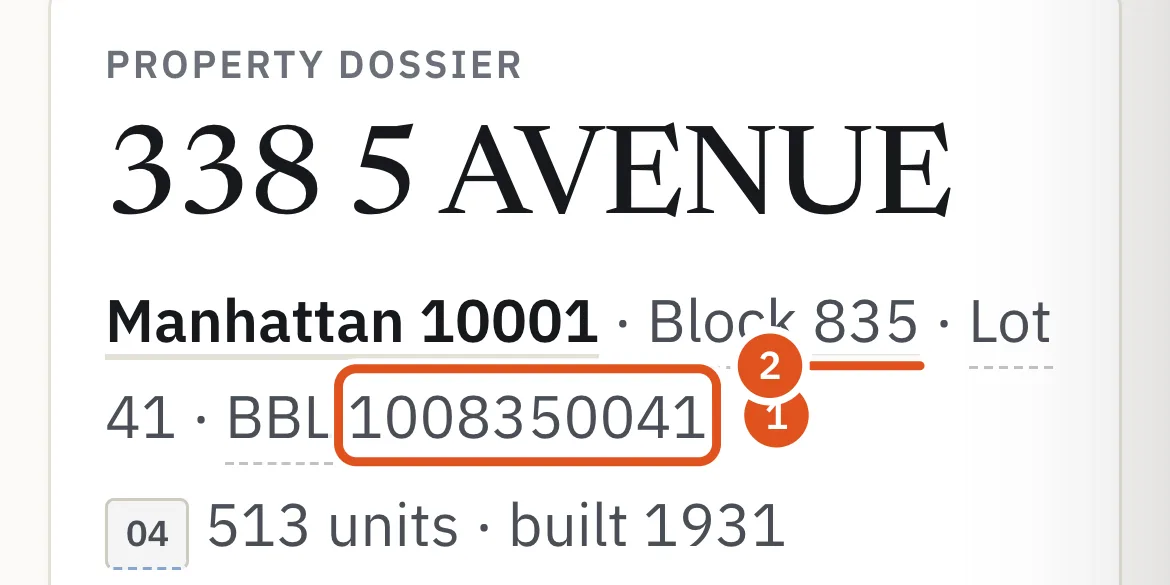
- The ten-digit BBL
- The block, which opens the block's page
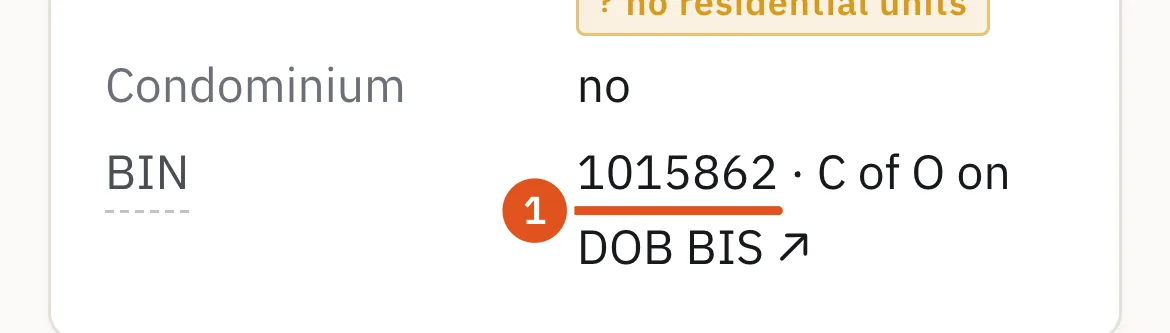
- The building's BIN
Questions people ask
How do I find a property's BBL? Search the address in the Department of Finance's Property Information Portal or its property tax records; the BBL is also printed on the tax bill and on the Notice of Property Value.
Is a BBL the same as an address? No. A building can have several addresses, or none, and one lot can hold several buildings. The BBL names the land; the address is how the street finds it.
Why does my condo apartment have its own BBL? Because in a condominium each unit is a separate parcel that is taxed and sold on its own. The building's billing lot, numbered 7501 to 7599, stands for the condominium as a whole.
Do co-op apartments have their own BBL? No. A co-op building is one lot owned by the cooperative corporation, and buyers purchase shares in it, so the apartments share the building's BBL.
What is the difference between a BBL and a BIN? The BBL identifies a lot of land and is used for taxes and deeds; the BIN identifies a building and is used by the Department of Buildings. A lot can have several BINs.
Can a BBL change? Yes. When lots are merged, split or turned into a condominium, the Department of Finance gives the new lots new numbers. A property's records before the change sit under the old BBL.
Related
- Department of Finance (DOF) — What New York City's Department of Finance does for property — the yearly assessment roll, the property tax bill and its calendar, the City Register that records deeds and mortgages, the transfer taxes, exemptions and the charges other agencies put on a property's account.
- Department of Buildings (DOB) — What New York City's Department of Buildings does, how a building permit works from filing to sign-off, what a Certificate of Occupancy is, and how DOB violations and stop work orders are issued and cleared.
- Building class codes and land use: what A1, C6, D4, O4 and R4 mean — How the Department of Finance's two-character building class describes every property in New York City, the 25 letter families from A to Z, the codes beginners meet most, how a building class relates to the tax class, and City Planning's eleven land-use categories built from it.
- PLUTO, NYC Open Data and the public registries behind a property — What NYC Open Data is, what City Planning's PLUTO lot file holds and where its fields come from, how city-owned land is marked, what the New York Department of State's business registry says about the companies that own buildings — and how BlockLot uses each.
Sources
- BlockLot Intelligence — BlockLot's own analysis of the public records below, computed October 11, 2026.
- DCP — PLUTO Data Dictionary, August 2026 (26v2)
- DCP — PLUTO README, August 2026 (26v2)
- DCP — Property Address Directory user guide
- DCP — Geosupport System User Programming Guide (2017)
- DOF — Digital Tax Map
- DOF — Dividing and merging lots
- DOF — Rule on mergers and apportionments of tax lots (19 RCNY chapter 54)
- DOF — Condominium apportionment and approval process
- DOF — Property Information Portal user guide
- DOF — Annual Report of the NYC Property Tax, Fiscal Year 2026
- New York Real Property Law § 339-y (condominium units as parcels)
- DOB — Covered buildings list disputes guide (billing BBLs)
- 311 — Find a property's borough, block and lot
- NYC Open Data — Building Footprints