Learn NYC property · Deeds, mortgages and sales
Mortgages, satisfactions, assignments and CEMAs
What a mortgage is and who the mortgagor and mortgagee are, the mortgage recording tax, and the documents that follow a loan in ACRIS — assignments when it is sold, CEMAs when it is refinanced, satisfactions when it is paid off — plus reverse mortgages, HMDA and loan-to-value.
A mortgage is the agreement that gives a lender the right to take a property if the money borrowed against it is not repaid. It comes with a promissory note, the borrower's promise to repay — the amount, the interest rate, the schedule. The note is the debt; the mortgage is the security for it, and it is the mortgage that is recorded against the property in ACRIS for everyone to see.
A mortgage can pay for a purchase, or let an owner borrow against a property it already owns. Either way, the record tells a reader who lent against a building, when, and for how much — though not what is owed today.
Mortgagor and mortgagee
The names run the opposite way from what many expect. The mortgagor is the borrower — the owner who gives the mortgage. The mortgagee is the lender who receives it. On a mortgage in ACRIS the mortgagor is party 1 and the mortgagee party 2; Deeds has the table for every kind of document.
The mortgage recording tax
Recording a mortgage on New York City property costs the mortgage recording tax, a City tax and a State tax charged together on the loan amount. A refinancing is taxed too, in most cases. The combined rates, as the Department of Finance publishes them:
| Loan | 1–3 family, condo | Other |
|---|---|---|
| Under $500,000 | 2.05% | 2.05% |
| $500,000 or more | 2.175% | 2.80% |
"1–3 family, condo" means a one- to three-family house or a residential condominium unit; "other" is every other property, apartment buildings included, not only offices and shops. On a building with six or fewer homes the lender pays 0.25 percentage points of it — the State's special additional tax — and may not pass that part on; the State's tax department counts the rest as the borrower's. A loan on a co-op apartment pays no mortgage recording tax: a co-op owner holds shares, not real property, so the loan is secured by a UCC financing statement instead of a mortgage. In calendar year 2024 the tax came to $1.06 billion.
What the City Register recorded, year by year
Mortgage documents (ACRIS type MTGE) by the year written on them, in Manhattan, the Bronx, Brooklyn and Queens. Agreements that consolidate or modify a mortgage are not counted. BlockLot Intelligence, computed October 10, 2026.
Borrowing follows interest rates. By BlockLot Intelligence's count, mortgages recorded in the four boroughs ACRIS covers peaked at 88,389 in 2021, when rates were at their lowest and owners refinanced, and fell to 35,859 in 2023. In 2025 the City Register recorded 43,358 mortgages, 40,281 satisfactions and 24,295 assignments.
The documents that follow a mortgage
A mortgage rarely ends where it started. These are the documents that record what happened to it, each with its own ACRIS document type:
- Assignment of mortgage. The lender sells the loan, and the new owner records an assignment. Loans are commonly sold; the borrower's terms do not change, and the new owner must tell the borrower within 30 days. A borrower can look up who services a loan on the website of MERS, the Mortgage Electronic Registration Systems. On an assignment, party 1 is the old lender and party 2 the new one.
- Satisfaction of mortgage. When the loan is paid off, the lender must sign a satisfaction and present it for recording within 30 days. A lender that is late owes the borrower $500, rising to $1,000 after 30 more days and $1,500 after 60 more. A partial release frees part of the property — one lot, or one condo unit — from a mortgage that covers more.
- Subordination. A lender agrees that its mortgage will rank behind another, usually so a new first lender can take the first position in a refinance.
- Agreements, including consolidations and modifications — see the next section.
How long a satisfaction takes to reach the record: by BlockLot Intelligence's count, a median 6 days from the date written on it to its recording.
Refinancing, and the CEMA
A CEMA — a consolidation, extension and modification agreement — is how New York borrowers refinance without paying the recording tax twice. Instead of paying off the old loan with a satisfaction, the old lender assigns it to the new lender. The new lender records a new mortgage only for the new money, and an agreement then combines the two into one loan. The State's Tax Law taxes a supplemental mortgage only on new or further debt, so tax is due on the new money alone, not on the balance carried over. A borrower who owes $600,000 and refinances into a $700,000 loan this way pays recording tax on $100,000.
The order matters: the State's tax department has held that once the old mortgage is satisfied, there is nothing left to consolidate, and the whole new loan is taxed. The agreement is filed with a sworn statement claiming the exemption.
A purchase-money mortgage is one given at the purchase, to pay part of the price; any later loan is a refinance. ACRIS does not say which is which.
By BlockLot Intelligence's reading — a mortgage on the same lot dated within 90 days of a deed — 61.1% of the single-lot sales of $10,000 or more recorded between July 1, 2025 and June 30, 2026 were financed by a recorded mortgage. The rest were paid in cash, or financed in a way that left no mortgage on that lot.
One sale, financed
When 10 East 53rd Street sold for $310,000,000 on August 5, 2026, the City Register recorded 11 documents against the lot on the same day: the deed, 4 mortgages, 2 assignments and 2 consolidation and spreader agreements. In one of the assignments the seller's lender transferred its existing mortgage to the buyer's lender — by our reading of the documents, the assignment route a CEMA uses, applied to a purchase.
Blanket mortgages and spreaders
A blanket mortgage covers several properties at once — a portfolio of buildings, or a new condominium before its units are sold. A spreader agreement extends an existing mortgage to another property. When a condo unit is sold out of a building under a blanket or construction mortgage, the buyer's own mortgage gets a credit for the recording tax already paid on the unit's share, if the first unit sells within two years of the blanket mortgage. ACRIS files a document against the first lot it names, so a blanket mortgage may show on one lot of the several it covers.
Reverse mortgages and HUD
A reverse mortgage lets an older owner borrow against the home and receive the money as a lump sum, monthly payments or a line of credit, with nothing to repay until the owner moves out or dies. In New York they are generally for owners 60 and older; the federal version, the Home Equity Conversion Mortgage (HECM), is for owners 62 and older and is insured by the Federal Housing Administration.
When the balance of a HECM reaches 98% of the loan's maximum claim amount, the lender may assign it to the Secretary of Housing and Urban Development, who then holds and services it. In ACRIS that is an assignment of mortgage whose new holder is HUD. A Reverse mortgage assigned to HUD says the loan has grown close to its limit — not that the owner is in default.
HMDA and loan-to-value
The Home Mortgage Disclosure Act (HMDA), passed in 1975, requires covered mortgage lenders — banks and other mortgage companies — to report each application they receive: the loan, its purpose, the outcome and the property's census tract. The public version leaves out the address and other details that could identify a borrower, so it describes lending in a neighborhood, not on a building.
Loan-to-value (LTV) compares a mortgage with the property's value: a $600,000 loan on a $1,000,000 home is 60% LTV. The public record cannot give it, because ACRIS records each mortgage's original amount, not what is still owed, and never the payments made along the way.
Where you see this in BlockLot
A building's Mortgages & liens drawer lists every recorded document that is not a deed — mortgages, satisfactions, assignments, agreements — with the lender and the amount, each linked to its image in ACRIS. The Mortgage lending table shows HMDA's figures for the building's census tract, and an area's page counts the mortgages recorded in it and how many financed a purchase.
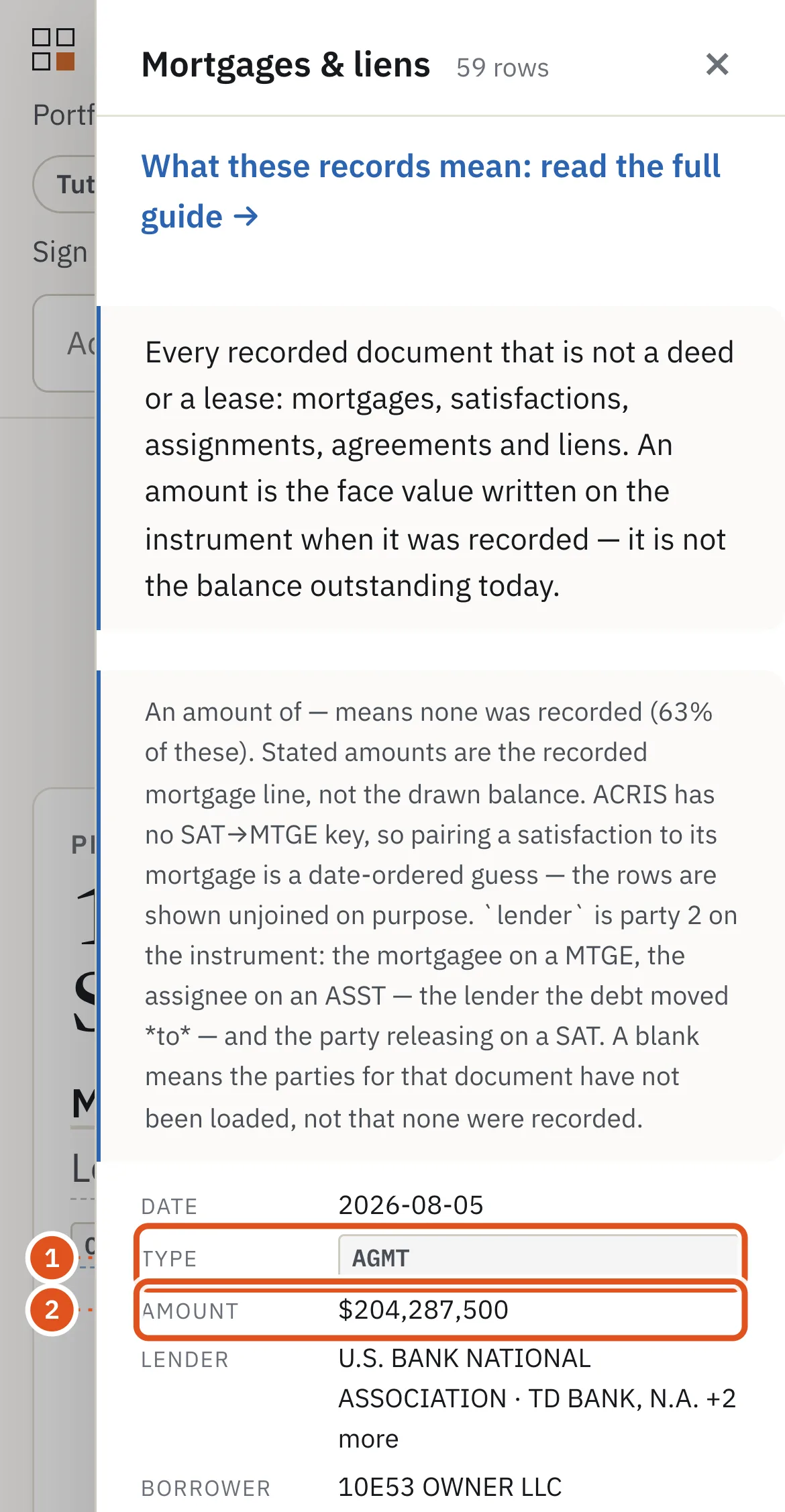
- The document type
- The amount written on it
Questions people ask
Is a mortgage the same as a loan? Not quite. The loan is the debt, written in the promissory note; the mortgage is the security that lets the lender foreclose if the debt is not paid. Only the mortgage is recorded.
Why does ACRIS show a mortgage on a house that was paid off? The lender has 30 days to present the satisfaction for recording, and some are late or never recorded. Until a satisfaction is recorded, the mortgage still appears on the record.
How much is the mortgage recording tax in New York City? 2.05% of a loan under $500,000; from $500,000, 2.175% on a one- to three-family house or condo unit and 2.8% on any other property. A co-op loan pays none.
What is a CEMA and does it save money? A consolidation, extension and modification agreement lets the old loan be assigned to the new lender instead of paid off, so recording tax is due only on the new money. On a large balance the saving can be substantial.
Can I see how much is left on someone's mortgage? No. The public record shows each mortgage's original amount and, eventually, its satisfaction — not the balance. That is also why loan-to-value cannot be read from it.
What does "assigned to HUD" mean on a reverse mortgage? The lender handed the loan to the federal housing department, which it may do once the balance nears the loan's limit. The owner keeps the home on the same terms.
Related
- Deeds in New York City: the kinds of deed, and grantor and grantee — What a deed is, the kinds New York law describes — bargain and sale, quitclaim, executor's, referee's — transfer-on-death and life estate deeds, who the grantor and grantee are, and what party 1 and party 2 mean on any document in ACRIS.
- UCC filings, federal tax liens, mechanic's liens and other liens on property — The claims besides mortgages that can sit on a New York City property — UCC financing statements on co-op loans and fixtures, IRS federal tax liens, mechanic's liens, condominium common-charge liens and judgments — where each is filed, how long it lasts and how it ends.
- Foreclosure in New York: from the 90-day notice and lis pendens to the referee's deed — How a foreclosure works in New York, a judicial state — the 90-day pre-foreclosure notice, the lawsuit and its lis pendens, the settlement conference, the judgment and the referee's auction, the referee's deed — plus deeds in lieu, short sales, tenants' rights and how often foreclosure sales happen in New York City.
- Transfer taxes: the NYC RPTT, the State transfer tax and the mansion tax — The taxes due when New York City property changes hands — the City's Real Property Transfer Tax, the State's real estate transfer tax and its higher New York City rate, and the mansion tax — with their rates, who pays each, and worked numbers for homes and buildings.
- ACRIS and the City Register: where deeds and mortgages are recorded — What the Office of the City Register records, what ACRIS is and how to search it, how long a deed or mortgage takes to reach the record, what is not in ACRIS — Staten Island, lis pendens, records before 1966 — and how owners can be alerted when something is recorded against their property.
- Ground leases, net leases and recorded memoranda of lease — What a ground lease is and who owns what under one, how a net lease shifts a building's costs to its tenant, why long leases are recorded in ACRIS as memoranda of lease, how transfer and property taxes treat leases, and what Battery Park City shows about all of it.
Sources
- BlockLot Intelligence — BlockLot's own analysis of the public records below, computed October 11, 2026.
- CFPB — What is a mortgage?
- CFPB — Mortgage key terms
- DOF — Mortgage Recording Tax
- DOF — Statistical profile of the Mortgage Recording Tax, 2024
- NYS Department of Taxation and Finance — Mortgage recording taxes
- New York Tax Law § 253 (the recording tax, and the lender's share)
- New York Tax Law § 255 (supplemental mortgages)
- NYS Department of Taxation and Finance — TSB-M-89(6.1)R, refinancing by assignment
- NYS Department of Taxation and Finance — TSB-M-04(9)R, spreader agreements
- NYS Department of Taxation and Finance — TSB-A-20(1)R, a supplemental mortgage after a discharge
- NYS Department of Taxation and Finance — TSB-A-14(1)R, who pays which part of the tax
- New York Real Property Law § 275 (satisfaction within 30 days)
- New York RPAPL § 1921 (discharge of a mortgage)
- New York Real Property Law § 339-ee (condominium units and blanket mortgages)
- CFPB — What happens if my mortgage is sold?
- CFPB — How can I tell who owns my mortgage?
- 24 CFR § 206.107 (assigning a HECM to HUD)
- HUD — FHA reverse mortgage assignments (2023)
- NYS Department of Financial Services — Reverse mortgages
- CFPB — The Home Mortgage Disclosure Act
- CFPB — What is a loan-to-value ratio?
- NYS Office of Real Property Tax Services — legal opinion on purchase-money mortgages