Learn NYC property · Zoning and land use
Air rights, unused floor area and zoning lot mergers
What New York City's air rights are, how unused floor area moves to a neighbouring lot through a zoning lot merger or further through a transfer of development rights, how the deals are recorded, and what BlockLot means by a soft site and an assemblage candidate.
Air rights — more formally development rights — are the floor area a lot's zoning allows that its buildings do not use. A two-storey building on a lot zoned for ten storeys has, in principle, eight storeys of unused floor area, and in New York City that unused floor area can be sold to a neighbour who wants to build bigger.
For an owner, air rights can be an asset worth millions without building anything. For a developer, buying them is often the only way to make a project large enough to pay. For a buyer, they explain why a small old building on a big lot can sell for far more than its rents suggest.
Unused floor area
The unused floor area of a lot is what its zoning allows minus what is built: the lot area times the floor area ratio that governs, less the building's floor area. On a 5,000-square-foot lot with an FAR of 6.0 and a 10,000-square-foot building, 30,000 square feet are allowed and 20,000 remain unused. A building already over its allowance has none.
Unused floor area cannot float freely around the city. It can be used on its own lot by enlarging the building, moved next door by joining the lots for zoning, or moved further only where the Zoning Resolution creates a special route.
The zoning lot
Zoning counts floor area on the zoning lot, which need not be a single tax lot. The Zoning Resolution defines four kinds: a lot that existed as one parcel in 1961; a tract within one block that was under one ownership in 1961; adjoining lots within one block, touching for at least 10 feet, under one owner when the permit is filed; or adjoining lots within one block, touching for at least 10 feet, that their owners declare to be one zoning lot. A zoning lot therefore may or may not match the lots on the Department of Finance's tax map.
Zoning lot mergers
A zoning lot merger joins neighbouring lots into one zoning lot, so the floor area allowed on all of them can be placed anywhere on it — usually in one new building, using what the older buildings next door leave unused. It happens as of right, without a public review, as long as the merged lot as a whole meets every zoning rule. City Planning's handbook notes that mergers are often used to move an older building's unused floor area next door.
Between different owners the merger is made by a declaration of restrictions, signed by every "party in interest" — the owners, mortgage lenders and others with a recorded interest that could be harmed — or by their recorded waiver, and recorded against every lot with the City Register. City Planning's 2018 handbook describes the owners' side deal as a zoning lot development agreement, which sets the price and the terms. Before the Department of Buildings issues a permit, a title insurance company must certify that every party in interest has signed or waived. Once made, the zoning lot stays one even if the private agreement behind it is broken, until it is formally divided.
Because a merger must stay within one block and the lots must touch, it cannot carry floor area across a street. That needs a transfer.
The zoning lot description
Before any permit for a new building or an enlargement, the applicant must record a full description of the zoning lot — its boundaries, the tax lots and block it covers, and who owns them — with the City Register. ACRIS files these as zoning lot descriptions, and they are a reliable trace of development.
By BlockLot Intelligence's count, 2,237 were recorded in 2025, and 20,965 in the ten years from 2016.
Documents of the type ACRIS calls a zoning lot description, counted once each by the year the City Register recorded it. BlockLot Intelligence, computed October 11, 2026.
Most are recorded within days of being signed — a median 7 days over the last three years, by BlockLot Intelligence's count, against 15 days for development rights deeds.
Days from the date written on each document to the day the City Register recorded it: the bar is the median, the band the middle half. Each document counted once. BlockLot Intelligence, computed October 11, 2026.
Transfers of development rights
A transfer of development rights moves floor area from one zoning lot to another that is not joined to it — across a street, or further — where the Zoning Resolution provides a route. Each route has its own conditions and caps on how much the receiving lot may grow.
- From a landmark. A designated landmark may transfer its unused floor area to a lot on the same block, across a street or across an intersection, by certification of the City Planning Commission's chair; the receiving lot may grow by up to 20%, or 30% in the densest commercial and manufacturing districts, and more by special permit. The landmarks guide has the detail.
- East Midtown. Around Grand Central, landmarks may transfer floor area to qualifying sites anywhere in the subdistrict, and each transfer pays 20% of its price into a fund for the area's public spaces. Near the terminal a site may reach an FAR of 27.
- The Theater Subdistrict in Midtown lets listed theatres sell their floor area within the subdistrict, with a payment per square foot into a theatre fund.
- The High Line Transfer Corridor in West Chelsea lets lots under the High Line send their floor area to receiving sites in the Special West Chelsea District.
A transfer is permanent and is recorded with the City Register against both lots. ACRIS files sales of floor area as development rights deeds and air rights deeds.
By BlockLot Intelligence's count, 472 development rights deeds and 36 air rights deeds were recorded in the ten years from 2016. Many mergers are recorded under other document types — declarations and agreements — so these counts are a floor, not a total. Some air space is also given lot numbers of its own, the air-rights lots numbered 9000 to 9989.
A worked example: Grand Central and 270 Park Avenue
Grand Central Terminal, owned by the Metropolitan Transportation Authority, stands on a lot of 134,203 square feet zoned C5-3, a district whose commercial FAR is 15.0. The terminal uses a fraction of that, and City Planning's 2017 East Midtown study counted more than 1.2 million square feet of development rights still unused on its site.
A few blocks north, JPMorgan Chase Bank's new headquarters at 270 Park Avenue, on Park Avenue, stands on a lot of 80,333 square feet in the same district.
- What its own lot allows: 15.0 × 80,333 = 1,204,995 square feet.
- What was transferred: 666,766 square feet from Grand Central, under the East Midtown rules.
- What was approved: about 1,871,764 square feet in a tower of some 70 storeys — the two lines above added together — approved by the City Council in May 2019 (Resolution 888).
In the public record, a development rights deed between Midtown GCT Ventures LLC and JPMorgan Chase Bank, N.A. was signed on December 4, 2018 and recorded on December 12, 2018, stating an amount of $208,364,375. The Department of Finance now records 2,050,615 square feet of building on the lot — its gross measure, not zoning's, which is why it differs from the approved figure.
Soft sites and assemblage candidates — BlockLot's readings
Two words on BlockLot's pages are our own reading of the public record, not City designations.
A soft site, in BlockLot, is a lot built to less than half of what its governing FAR allows. It is a lot where a new or bigger building could make sense — often an old low building on a well-zoned lot.
By BlockLot Intelligence's count of City Planning's lot file, 179,550 lots — 25.8% of those it can read — are soft sites by that test, most of them houses in districts that allow more.
An assemblage candidate is a group of neighbouring lots on one block, sharing a boundary on the tax map, where each pair of neighbours is under-built or held by one owner group — lots that could be combined into one zoning lot for a larger building. BlockLot adds up their unused floor area together.
Both leave out what the arithmetic cannot judge: public land, lots in special or mixed districts, and lots split between districts get no figure; and neither applies bonuses, transfers, landmark status or the shape rules that may make floor area impossible to use. They are where to look, not conclusions.
Where you see this in BlockLot
A building's page leads its Zoning & use card with the unused floor area when there is any — "buildable sq ft unused", with its working — or how far over the allowance it is. A block's page sums the unused floor area of its lots and counts its soft sites and assemblage candidates in the Development potential card, and an owner's page totals the unused floor area of the portfolio.
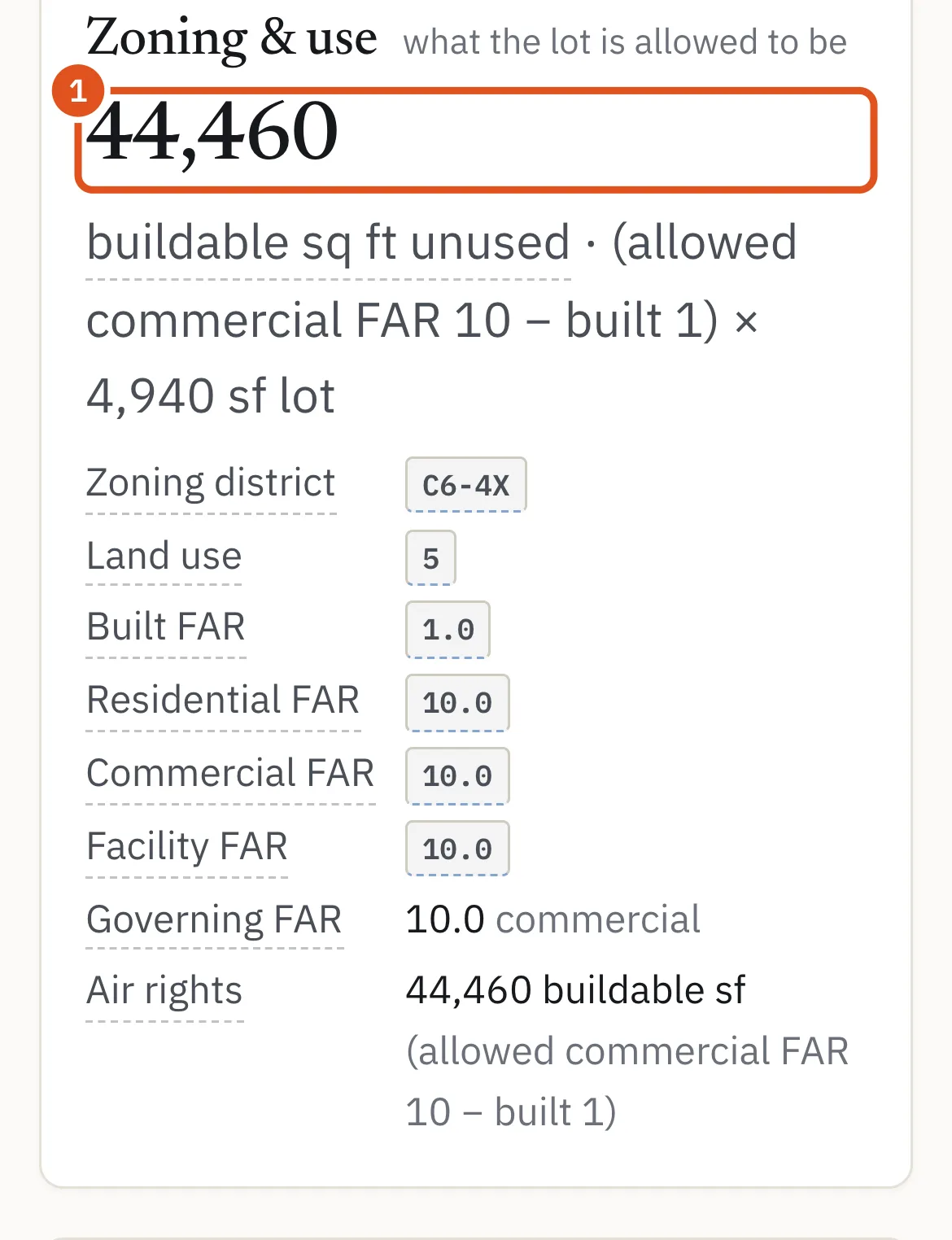
- buildable square feet unused
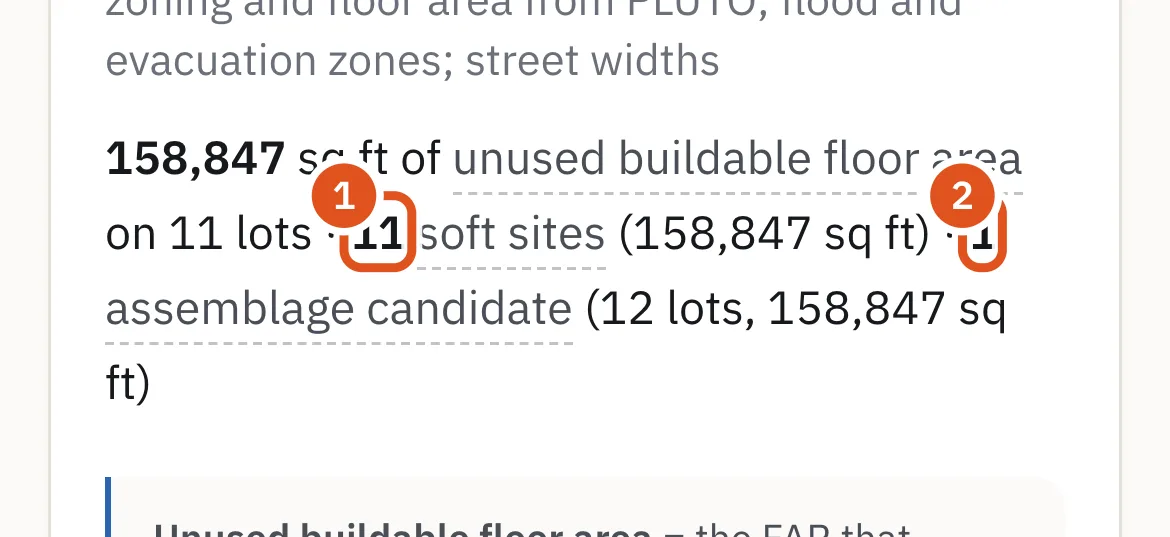
- BlockLot's reading of the block
Questions people ask
What are air rights in New York City? The floor area a lot's zoning allows that its buildings do not use. They can be used on the lot, moved to a neighbouring lot through a zoning lot merger, or sold further away where the Zoning Resolution allows a transfer.
How much are air rights worth? It depends on the location and on what the buyer can build with them; there is no City price list. Sales are recorded in ACRIS, and some deeds state an amount, but many deals are part of larger agreements.
Can I sell my air rights to a building across the street? Usually only if your building is a landmark, or the lots are in a special district with a transfer route such as East Midtown or the High Line corridor. Otherwise floor area moves only between adjoining lots on the same block, through a zoning lot merger.
Does selling air rights need City approval? A zoning lot merger does not; it is recorded, and the Department of Buildings checks it when the new building is permitted. Transfers from landmarks and in special districts need a certification or permit from the City Planning Commission.
What is a zoning lot development agreement? The private contract between neighbouring owners that sets the price and conditions of a zoning lot merger. The declaration that actually joins the lots is recorded with the City Register.
What is a soft site? In BlockLot, a lot built to less than half of what its zoning allows — a place where a bigger building could be built. It is our reading of the public record, not a City designation.
Related
- Floor area ratio (FAR): built, residential, commercial and community facility — What a floor area ratio is, how zoning sets one for homes, businesses and community facilities, which one governs a building, what City of Yes changed, and why some older buildings stand far above their district's allowance.
- Zoning districts: R, C and M, overlays and special districts — How New York City's Zoning Resolution divides the city into residence, commercial and manufacturing districts, how to read a code like R7A or C4-5X, and what commercial overlays, special purpose districts, limited height districts and split lots add.
- Landmarks and historic districts: what designation by the Landmarks Preservation Commission means — How New York City designates individual, interior and scenic landmarks and historic districts, what an owner must do afterwards — permits, upkeep, fines — and how a landmark can sell its unused floor area.
- ACRIS and the City Register: where deeds and mortgages are recorded — What the Office of the City Register records, what ACRIS is and how to search it, how long a deed or mortgage takes to reach the record, what is not in ACRIS — Staten Island, lis pendens, records before 1966 — and how owners can be alerted when something is recorded against their property.
- BBL, block and lot: how New York numbers its land and buildings — What a BBL is, how borough, block and lot make up its ten digits, why condominiums have billing lots and unit lots, how lots are merged and split, and how the BIN that identifies a building differs.
- Deeds in New York City: the kinds of deed, and grantor and grantee — What a deed is, the kinds New York law describes — bargain and sale, quitclaim, executor's, referee's — transfer-on-death and life estate deeds, who the grantor and grantee are, and what party 1 and party 2 mean on any document in ACRIS.
Sources
- BlockLot Intelligence — BlockLot's own analysis of the public records below, computed October 11, 2026.
- Zoning Resolution 12-10 (zoning lot, floor area, party in interest)
- Zoning Resolution 75-421 and 75-422 (transfers from landmarks)
- Zoning Resolution 74-79 (landmark transfer special permit)
- Zoning Resolution 81-64 and 81-642 (East Midtown)
- Zoning Resolution 81-744 (Theater Subdistrict transfers)
- Zoning Resolution 98-33 (High Line Transfer Corridor)
- DCP — NYC Zoning Handbook, 2025 edition (zoning lot mergers)
- DCP — Zoning Handbook, 2018 edition (zoning lot development agreements)
- DCP — Greater East Midtown rezoning, final environmental impact statement (2017), chapter 1
- City Council Resolution 888 of 2019 (270 Park Avenue)
- DOB — DOB NOW: Build, new building FAQ (zoning exhibits)
- LPC — Transfer of development rights
- NYC Open Data — ACRIS document control codes
- NYC Open Data — ACRIS Real Property Master