Learn NYC property · Local Laws
Local Law 97: building emissions limits
New York City's Local Law 97 caps the greenhouse gas emissions of buildings over 25,000 square feet: who is covered, how the limit is set, the annual report, the $268-a-ton penalty, and what changes in 2030.
Local Law 97 of 2019 — LL97 — is New York City's climate law for buildings: it puts a yearly cap on the greenhouse gas emissions of most buildings over 25,000 square feet, and fines the owner for every ton over the cap. The caps took effect in 2024 and tighten in 2030 and again every few years after, on the way to near-zero emissions in 2050.
The law reaches the boilers and electricity use of tens of thousands of apartment buildings, offices, hotels, schools and stores. For an owner it is a yearly report and, for some buildings, a yearly bill; for a buyer or a lender it is a cost that a building's energy use can predict years ahead.
The law and its amendments
The Council passed Local Law 97 in April 2019; the Mayor neither signed nor vetoed it, so it became law on May 19, 2019, and it took effect on November 15, 2019. It added two articles to the City's Administrative Code: Article 320, the emissions limits, and Article 321, a lighter one-time duty for rent-regulated and certain other buildings. Later laws adjusted it — Local Law 147 of 2019, Local Laws 95, 116 and 117 of 2020, the 2022 code revision and Local Law 77 of 2023 — and the Department of Buildings (DOB) has filled in the details by rule. The Council record shows no amendment since 2023; a 2024 bill to ease the law died at the end of the Council's session in December 2025.
Who is covered
Using the Department of Finance's records, a building is covered if it is:
- a single building of more than 25,000 gross square feet;
- two or more buildings on the same tax lot that together exceed 50,000 square feet; or
- two or more condominium buildings governed by the same board that together exceed 50,000 square feet.
On a covered lot, every building must comply, even a small one.
DOB publishes a Covered Buildings List each year — a spreadsheet of every covered lot and building, which also flags the benchmarking, energy-audit and lighting laws that apply. Owners look up their borough-block-lot (BBL) or building number (BIN) there. The 2026 list was published on March 23, 2026.
Some buildings are outside Article 320: City buildings and public housing (NYCHA), which have their own targets; power plants; and garden-style housing whose homes each have their own heating. Others go to Article 321 instead: buildings where more than 35% of the homes are rent-regulated, houses of worship, buildings owned by a housing development fund company, and buildings in a project-based federal housing program. Until 2020 one rent-regulated apartment was enough to move a building to Article 321; Local Law 116 of 2020 set the line at more than 35%, and a building with fewer regulated homes than that has its limits from 2026, with its first report due in 2027. Mitchell-Lama and other income-restricted buildings have limits only from 2035.
How the limit is set
A building's emissions limit — the building emissions limits are set one building at a time — is its floor area multiplied by the limit for its use, in metric tons of carbon dioxide equivalent per square foot; a building with several uses adds up each use's share. For 2024 to 2029, DOB's rule sets the limit for an apartment building at 0.00675 tons a square foot and for an office at 0.00758; in 2030 to 2034 they fall to about 0.00335 and 0.00269 — roughly half for an apartment building and a third for an office.
A building's emissions are counted in tCO₂e (also written tCO2e) — metric tons of carbon dioxide equivalent, the standard unit that puts every greenhouse gas on the scale of carbon dioxide. The report converts each fuel the building used into tCO₂e with fixed coefficients set in the law: for 2024 to 2029, 0.000288962 tons for every kilowatt-hour of grid electricity, 0.00005311 for every thousand BTU of natural gas, and 0.00004493 for district steam. For 2030 DOB's rule cuts the electricity coefficient to 0.000145, as the grid gets cleaner — so an all-electric building's emissions halve without any work.
The annual report
Under Article 320 the owner files an emissions report with DOB every May 1, for the calendar year before, certified by a registered design professional — a licensed architect or engineer. The first was due May 1, 2025, for 2024. A condominium files one report through its board.
DOB gives 60 days' grace, to June 30, and an owner who applies by then can have until late August. For the first year only, DOB extended the deadline to December 31, 2025 for owners who applied by August 29; it has said that extension does not carry into 2026, when reports were due May 1 and no later than June 30.
The Article 321 duty was one-time: by December 31, 2024, either meet what would be the building's 2030 limit, or carry out thirteen low-cost energy measures — set heating temperatures, fix leaks, insulate pipes, add radiator controls, upgrade lighting and the like — and report by May 1, 2025.
Penalties
- Over the limit: $268 for every metric ton of CO₂e over the cap, every year.
- Report not filed: up to $0.50 a square foot of floor area for each month it is missing, for up to 12 months.
- A false statement: a misdemeanor, with a fine of up to $500,000.
- Article 321: $10,000 a building for not filing, and $10,000 for failing to comply.
DOB's rule lets an owner who made good faith efforts — who filed, benchmarked, did the lighting upgrades, and has work underway or a professional decarbonization plan filed by May 1, 2025 — have the penalty reduced. Some special uses and non-profit hospitals could apply for an adjustment of the limit until January 1, 2025; an adjustment for capital constraints, such as landmark rules or financial hardship, is still open.
An owner can also deduct renewable energy credits from emissions caused by grid electricity, if the clean power comes from a source delivering into New York City, and can buy offsets worth up to 10% of the limit — since 2025 only from the City's Affordable Housing Reinvestment Fund, which pays to electrify affordable housing.
How the first year went
DOB's report on 2024, published in September 2026, counted 19,963 properties required to comply. 95% filed. Of the Article 320 properties that filed, 9,951 — 95% — were within their 2024 limit and 470 were over, 124 of them by more than half; 149 asked for a penalty reduction for good faith efforts. Of the Article 321 filings, 83% took the thirteen-measure route.
That was the plan: when the law passed, about four in five covered buildings were already under the 2024 limits. The City's advisory board estimated that about 20% of buildings would need work for 2024 and about 75% for 2030.
By BlockLot Intelligence's count of DOB's violations, DOB has issued 4,043 violations for not filing the Article 320 report, on 776 tax lots — one violation for each building on the lot — and 901 for not filing the Article 321 report.
Every Local Law 97 violation in the Department of Buildings' file, by kind. One violation is one building and one reporting year. BlockLot Intelligence, computed October 11, 2026.
A worked example: the Empire State Building
The Empire State Building, owned by a company, reported its energy use for 2024 under the benchmarking law: about 30.8 million kilowatt-hours of electricity, 64.4 million thousand-BTU of district steam and 5.5 million of natural gas, over 2,852,257 square feet. With Local Law 97's coefficients that comes to about 12,097 tons of CO₂e — 8,914 from electricity, 2,892 from steam, 291 from gas.
Counting the whole building as office — 2.69 million of its square feet are — its 2024 limit is about 21,620 tons, so it emitted a little over half its cap. The 2030 test is closer. With the same energy use, the lower 2030 electricity and steam coefficients bring emissions to about 7,544 tons, against a 2030 office limit of about 7,675: just under, with 2% to spare. This is our arithmetic from the published benchmarking data, not the building's own report, which counts each use by its own limit and is certified by a professional.
Where you see this in BlockLot
On a building's page, the Compliance & distress signals card lists the building's active DOB safety violations by kind; an unfiled emissions report shows there as GHG Emissions - LL97. The Energy (LL84 / LL33) row gives the building's latest reported emissions in tCO₂e.
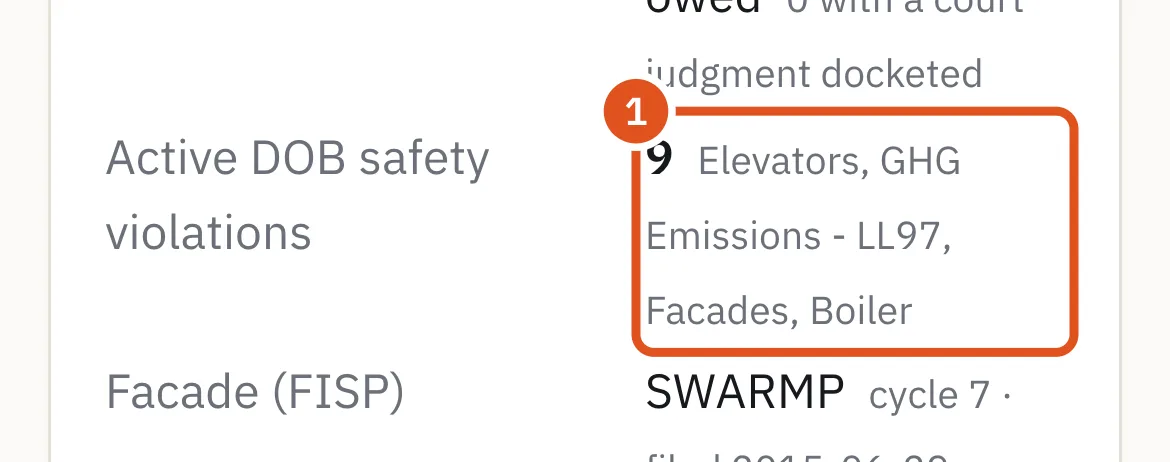
- GHG Emissions - LL97 among them
Questions people ask
Does Local Law 97 apply to my building? It applies to buildings over 25,000 square feet, and to two or more buildings on one lot, or under one condominium board, that together exceed 50,000. DOB's Covered Buildings List shows every covered lot and building.
What is the fine? $268 for every metric ton of CO₂e over the limit, every year. Not filing the report costs up to $0.50 a square foot for each month it is late, for up to a year.
When is the report due, and who signs it? Every May 1, for the calendar year before, certified by a registered design professional. There is a 60-day grace period to June 30, and an extension to late August if requested in time.
Are rent-stabilized buildings exempt? No. A building where more than 35% of homes are rent-regulated had a one-time duty under Article 321 — thirteen energy measures by the end of 2024, or meeting the 2030 limit — reported by May 1, 2025. A building with fewer regulated homes has limits from 2026.
How much stricter does it get in 2030? Much stricter: the limits fall to roughly half or less, and DOB's advisory board estimated about three-quarters of buildings would need work, against a fifth for 2024. The electricity coefficient also halves, which rewards electric heating.
Can an owner buy credits instead? Partly. Renewable energy credits from clean power delivered into the City can offset emissions from electricity, and offsets from the Affordable Housing Reinvestment Fund can cover up to 10% of the limit.
Related
- NYC Local Laws for building owners — What a New York City Local Law is, how one is made and numbered, and the Local Laws that put duties on building owners — energy and emissions, facades and gas piping, lead paint, mold and pests, storefronts, short-term rentals and broker fees.
- Energy benchmarking and grades: Local Laws 84 and 33 — New York City's benchmarking law (Local Law 84, widened by Local Law 133) makes large buildings report their energy and water use every year; Local Law 33 turns the ENERGY STAR score into an A to F grade posted at the door.
- Energy audits and retro-commissioning: Local Law 87 — New York City's Local Law 87 makes buildings over 50,000 square feet audit their energy use and tune their systems every ten years, in a year set by the tax block; with Local Law 88's lighting and sub-meter duties.
- Department of Buildings (DOB) — What New York City's Department of Buildings does, how a building permit works from filing to sign-off, what a Certificate of Occupancy is, and how DOB violations and stop work orders are issued and cleared.
Sources
- BlockLot Intelligence — BlockLot's own analysis of the public records below, computed October 11, 2026.
- City Council — Local Law 97 of 2019 (Int 1253-2018), legislative record
- City Council — Local Law 97 of 2019, enacted text
- City Council — Local Law 116 of 2020 (the 35% rent-regulated rule)
- City Council — Local Law 77 of 2023 (the latest amendments)
- City Council — Int 772-2024 (filed at the end of session, not enacted)
- DOB — LL97 greenhouse gas emissions reductions
- DOB — 1 RCNY § 103-14, the Article 320 rule
- DOB — 1 RCNY § 103-17, the Article 321 rule
- DOB — LL97 violations and penalties
- DOB — Local Law 97: 2024 compliance and reporting rates
- DOB — 2026 Covered Buildings List
- DOB — Deadlines for sustainability laws in 2026 (service notice, February 27, 2026)
- DOB — First-year extension to December 31, 2025 (service notice, June 16, 2025)
- DOB — LL97 Advisory Board report
- DOB — 1 RCNY § 101-03, fees