Learn NYC property · Zoning and land use
Lot size, frontage and depth: corner lots, through lots, irregular lots and wide streets
How New York City measures a lot — its area, frontage and depth — what makes a lot a corner, through or interior lot, why irregular lots and wide streets matter under zoning, and what the minimum lot sizes became after City of Yes.
A lot's size and shape — how big it is, how much of it faces the street, how deep it runs, whether it sits on a corner — decide much of what zoning lets an owner build on it. In New York City these measurements come from the Department of Finance's tax map, and City Planning's lot file, PLUTO, carries them for every lot.
They matter more than they look. The lot area, multiplied by the floor area ratio, gives the building's maximum size; the frontage sets how wide a building can be and whether a lot may be divided; a corner lot may cover more of its ground and needs no rear yard; and a lot on a wide street may be allowed a bigger building than the same lot around the corner.
Area, frontage and depth
Lot area is the area of the lot in square feet. For a regular lot the Department of Finance (DOF) computes it as frontage times depth; for an irregular one it measures the shape on its digital tax map. A tax lot that contains a street that was mapped but never built counts the street in its area.
Lot frontage is the length of the lot along the street, in feet. When a lot faces two streets, DOF's records generally use the side of the building's address, City Planning notes.
Lot depth is how far the lot runs back from the street. In zoning it is the mean distance between the front and rear lot lines; on a corner lot, the greater of the depths measured from each street.
A building's page shows these as its lot dimensions — frontage by depth — as DOF records them, not as surveyed. Its building dimensions are the building's own frontage and depth from the same records.
How big is a typical lot? By BlockLot Intelligence's count of City Planning's lot file, the middle lot in the city is 2,523 square feet, 25 feet wide and 100 feet deep. 48.8% of the lots whose dimensions are recorded are exactly 100 feet deep, and the two commonest sizes are 20 by 100 feet (7.5%) and 25 by 100 feet (6.7%) — the long, narrow lots of the row-house blocks. Staten Island's lots are the largest, Brooklyn's the narrowest.
| Borough | Lot area | Frontage |
|---|---|---|
| Manhattan | 2,523 sq ft | 25.2 ft |
| Bronx | 2,518 sq ft | 25 ft |
| Brooklyn | 2,148 sq ft | 22 ft |
| Queens | 2,858 sq ft | 29.1 ft |
| Staten Island | 3,920 sq ft | 40 ft |
Medians of the lot area and frontage the Department of Finance records — half the lots are smaller, half larger; each column is its own median. The median depth is 100 feet in every borough. BlockLot Intelligence, computed October 10, 2026.
An irregular lot is one that is not a simple rectangle: a wedge at a diagonal street, an L-shaped parcel, a lot with a notch. DOF flags them, and its area is measured from the map rather than multiplied out. For an irregular lot, the recorded frontage and depth can only approximate its shape.
By BlockLot Intelligence's count, 15.9% of the city's lots are irregular.
Tax lot and zoning lot
These measurements describe the tax lot on DOF's map. Zoning measures the zoning lot, which may be one tax lot or several joined together — so the area that counts for zoning can be larger than the tax lot's, as the air rights guide explains. Lots are divided or merged on the tax map through DOF's Tax Map Office, on form RP-602; dividing a lot with buildings on it also needs the Department of Buildings to certify that the new lots comply with zoning.
Corner, through and interior lots
Zoning sorts lots by how they meet the street.
- A corner lot stands where two or more streets meet at an angle of 135 degrees or less, or is bounded by streets on every side. Only the part within 100 feet of each street counts as the corner: a big lot can be part corner, part interior.
- A through lot runs from one street to a parallel street behind it, with frontage on both, without being a corner lot.
- An interior lot is any lot that is neither — the ordinary mid-block lot with one frontage.
City Planning's lot file records DOF's own lot types, which use slightly different words: its "inside" lot is zoning's interior lot, its "interior" lot has no street frontage at all, and a lot of several types — a corner on the water — is filed under one, so a few corners are counted as waterfront lots. By BlockLot Intelligence's count, 100,055 lots, 11.7% of the city's, are corners.
The lot type the Department of Finance records, as City Planning's lot file carries it. A lot of several types — a corner on the water — is counted once, under the lowest of its type codes. Island and submerged lots, and lots of no recorded type, are left out. BlockLot Intelligence, computed October 10, 2026.
What a corner changes
Zoning treats corners generously, because a corner lot already faces two streets.
- Lot coverage — the share of the lot a building may cover, seen from above — is higher. In R1 to R5 a one- or two-family house may cover 80% of a corner lot against 40% to 60% elsewhere, and in R6 and denser districts an apartment building may cover 100% of a corner lot against 80%.
- Yards: every yard along a street is a front yard, but no rear yard is needed within 100 feet of a corner. In R1 to R5, one of the two front yards may be 5 feet shallower than the district requires.
Wide streets and narrow streets
The Zoning Resolution defines a wide street as a street 75 feet wide or more, with a few named exceptions, and a narrow street as any street less than 75 feet wide. Width matters because zoning lets bigger buildings line wide streets:
- In R6, R7-1, R7-2 and R8, the part of a lot within 100 feet of a wide street gets a higher residential floor area ratio — 3.00 instead of 2.20 in R6, 4.00 instead of 3.44 in R7-1 and R7-2 — and taller height limits: 75 feet instead of 55 in R6.
- Above the base of a building, the setback from the street wall is 10 feet on a wide street and 15 feet on a narrow one.
- City of Yes's small apartment buildings in R3 to R5 need a lot of at least 5,000 square feet that fronts a wide street or the short end of a block.
Minimum lot size
Zoning sets a minimum lot size for building a house: no new home may be built on a lot smaller than its district's minimum area and width. The City of Yes for Housing Opportunity amendment of December 5, 2024 lowered them.
| Detached house in | Lot area | Width |
|---|---|---|
| R1-1 | 7,125 sq ft | 75 ft |
| R1-2, R1-2A | 4,750 sq ft | 50 ft |
| R2, R3-1, R3-2, R4, R5 | 2,850 sq ft | 30 ft |
| R3A, R4A, R5A, R6 and up | 2,375 sq ft | 25 ft |
Before December 2024, R1-1 needed 9,500 square feet and 100 feet, and most detached houses in R3 to R5 needed 3,800 square feet and 40 feet. Other kinds of homes need at least 1,700 square feet and 18 feet. A lot that already existed on December 5, 2024 below the minimum may still be built on, as long as it has not been made smaller since.
A worked example: the Empire State Building's lot
The Empire State Building, owned by a company, stands on a irregular corner lot. DOF records a frontage of 197.5 feet and a depth of 500 feet, and a lot area of 91,351 square feet — less than frontage times depth, because the lot is irregular and its area is measured from the map. That lot area, times its district's floor area ratio, is where the floor area guide's arithmetic starts.
Where you see this in BlockLot
A building's page shows the lot area, the lot's dimensions and the building's in its Lot & building card. A block's page lists each street the block faces with its mapped width and whether it is a wide street, and the commercial and deal searches can be narrowed to corner lots and lots on wide streets.

- frontage by depth
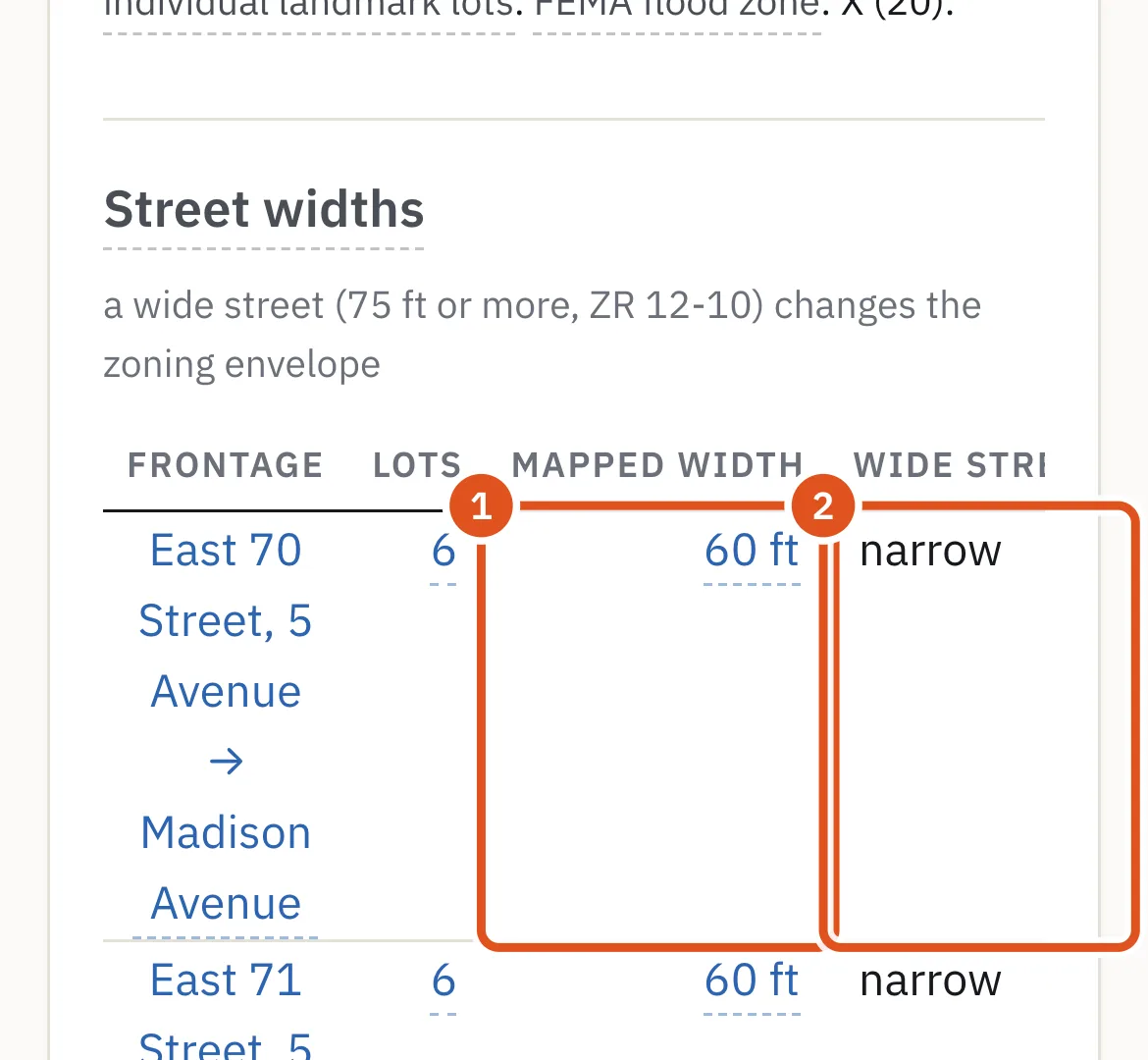
- the street's width on the City Map
- narrow, under 75 feet
Questions people ask
What is the standard lot size in New York City? There is no official standard, but 100 feet deep is by far the commonest depth, and lots 20 or 25 feet wide are the commonest at that depth — about 2,000 to 2,500 square feet.
How do I find a lot's size? On the Department of Finance's digital tax map, or in City Planning's PLUTO file; BlockLot shows it on every building's page. These are recorded measurements, not a survey.
What is a corner lot, and why does it matter? A lot where two streets meet. Zoning lets a building cover more of a corner lot and needs no rear yard near the corner, so corners often allow bigger buildings.
What is a wide street in NYC zoning? A street 75 feet wide or more, with a few named exceptions. In several residence districts, lots within 100 feet of a wide street may build more and taller.
Can I split my lot into two? Only if both new lots meet the district's minimum area and width, and DOF and the Department of Buildings approve the division. City of Yes lowered the minimums in December 2024.
What is an irregular lot? A lot that is not a simple rectangle. Its area is measured from the tax map, and its recorded frontage and depth can only approximate its shape.
Related
- BBL, block and lot: how New York numbers its land and buildings — What a BBL is, how borough, block and lot make up its ten digits, why condominiums have billing lots and unit lots, how lots are merged and split, and how the BIN that identifies a building differs.
- Zoning districts: R, C and M, overlays and special districts — How New York City's Zoning Resolution divides the city into residence, commercial and manufacturing districts, how to read a code like R7A or C4-5X, and what commercial overlays, special purpose districts, limited height districts and split lots add.
- Floor area ratio (FAR): built, residential, commercial and community facility — What a floor area ratio is, how zoning sets one for homes, businesses and community facilities, which one governs a building, what City of Yes changed, and why some older buildings stand far above their district's allowance.
- Air rights, unused floor area and zoning lot mergers — What New York City's air rights are, how unused floor area moves to a neighbouring lot through a zoning lot merger or further through a transfer of development rights, how the deals are recorded, and what BlockLot means by a soft site and an assemblage candidate.
- PLUTO, NYC Open Data and the public registries behind a property — What NYC Open Data is, what City Planning's PLUTO lot file holds and where its fields come from, how city-owned land is marked, what the New York Department of State's business registry says about the companies that own buildings — and how BlockLot uses each.
- Flood zones and hurricane evacuation zones: FEMA's maps, NYC's projections and Know Your Zone — What a FEMA flood zone (VE, AE, A, X) and a base flood elevation mean for a New York City property, why the City uses both FEMA's 2007 map and its 2015 preliminary map, what the projected floodplains show, and how the six hurricane evacuation zones differ from all of them.
Sources
- BlockLot Intelligence — BlockLot's own analysis of the public records below, computed October 11, 2026.
- Zoning Resolution 12-10 (lot area, lot depth, lot width, corner lot, through lot, interior lot, wide street)
- Zoning Resolution 23-10 to 23-12 (minimum lot area and width, as amended December 5, 2024)
- Zoning Resolution 23-22 (residential FAR within 100 feet of a wide street)
- Zoning Resolution 23-361 and 23-362 (lot coverage)
- Zoning Resolution 23-321 (front yards in R1 to R5)
- Zoning Resolution 23-344 (rear yards near corners)
- Zoning Resolution 23-432 and 23-433 (heights and setbacks on wide and narrow streets)
- DCP — NYC Zoning Handbook, 2025 edition
- DCP — PLUTO Data Dictionary, August 2026 (26v2): LotArea, LotFront, LotDepth, IrrLotCode, LotType
- DOF — Dividing and merging lots
- DOF — Digital tax map
- NYC Open Data — PLUTO