Learn NYC property · Value and property tax
The pied-à-terre surcharge (non-primary residence surcharge)
NYC's 2026 pied-à-terre surcharge on high-value homes that are no one's primary residence: who owes it, the rates, and its legal status.
The pied-à-terre surcharge — in the law, the non-primary residence property surcharge — is a yearly charge New York City adds to the property tax of an expensive home that is no one's primary residence: a second home, a city apartment kept for visits, a house left empty. It is not part of the ordinary property tax. It is worked out on its own, on the Department of Finance's (DOF) market value, and added to the same bill.
It is new. The State enacted it in May 2026, the first bills fall due on January 1, 2027, and it is being challenged in court. This page explains what the law says, how the City is applying it, and what is still unsettled.
The law
The surcharge is Part HH of the State's revenue budget bill for fiscal year 2027 (S.9009-C / A.10009-C), signed by the Governor on May 28, 2026 as Chapter 59 of the Laws of 2026. It did two things at once: it added a new article to the State Tax Law (Article 30-C), and it wrote a matching chapter into the City's own Administrative Code (Title 11, chapter 32) — so the City Council did not need to pass a local law. It also gave the City's Tax Commission the job of hearing appeals.
The law applies to the fiscal years that begin on or after July 1, 2026, and it expires on June 30, 2031 unless it is renewed. Its stated aim is to tax second homes worth $5 million or more measured by what comparable homes sell for — but because DOF does not value co-ops and condominiums that way today, the law starts with a transitional phase.
DOF adopted rules for it in July 2026 (chapter 62 of title 19 of the City's rules), and amended them in August 2026 to give owners more time to answer.
Which homes it covers
- Houses — one-, two- and three-family homes in tax class 1, but not vacant land.
- Condominium units in tax class 2.
- Co-op apartments — the surcharge is worked out for each apartment that crosses the threshold and is not a primary residence, and billed to the co-op building.
Rental buildings and commercial property are not covered. Nor are homes that have no certificate of occupancy yet, or a sponsor's unsold units still being offered under an offering plan. A condominium unit that combines more than three apartments falls outside the definition, though DOF can treat units as one where an owner divided them to avoid the surcharge.
The thresholds and the rates
In the first two years (fiscal years 2026/27 and 2027/28) the surcharge reaches houses with a DOF market value of $5 million or more, and condominium and co-op units with a value of $1 million or more. A co-op apartment's value is the building's DOF market value times the apartment's share of the co-op's shares. The rate is applied to the whole market value:
| Home | Market value | Rate |
|---|---|---|
| House | $5M to $15M | 0.8% |
| House | $15M to $25M | 1.05% |
| House | over $25M | 1.3% |
| Condo or co-op unit | $1M to $3M | 4.0% |
| Condo or co-op unit | $3M to $5M | 5.25% |
| Condo or co-op unit | over $5M | 6.5% |
A value exactly on a bracket line — $15 million, say — falls in the lower bracket.
The condo and co-op rates look high because the values they apply to are low: State law makes DOF value a co-op or condominium building as if it were a rental, so its DOF value is a fraction of what its apartments sell for (see Market value).
From fiscal year 2028/29 the threshold becomes $5 million for every kind of home, condominium and co-op units are to be valued from comparable sales for this purpose — not as rentals — and the house rates of 0.8%, 1.05% and 1.3% apply to all of them.
No exemption, abatement or credit reduces the surcharge, and its revenue is kept outside the ordinary property tax levy and the class shares.
What counts as a primary residence
A home escapes the surcharge if, on the taxable status date — January 5 before the fiscal year — it is the primary residence of:
- an owner who is a person, or a member of the owner's immediate family (a spouse, child, sibling, parent, grandparent or grandchild); or
- a tenant who is a person, under a genuine arm's-length lease of at least a year.
Where a company, partnership or trust owns the home, the "owners" are the people holding a majority interest in it, or a trust's sole beneficiaries.
How DOF decides
Each year DOF publishes a supplemental market value roll listing the homes the surcharge could reach, then makes an initial determination from the records it holds — for example whether an owner filed a New York resident income tax return giving the address as home, or had STAR. Being on the roll does not mean a home owes the surcharge. An owner told that the home looks like a non-primary residence can send proof — a resident tax return, a lease, a family member's occupancy — and DOF then makes a final determination. DOF can audit what was sent for up to six years, and a false or bad-faith filing carries a penalty of up to half the surcharge.
For the first year, DOF published the roll on July 24, 2026 and began mailing letters on July 23. By DOF's own account to the City Council in August 2026, about 960,000 homes were on the roll and about 17,000 received a letter; owners with a senior or disabled homeowners' exemption, or otherwise already shown to live there, were not sent one. The deadline to answer has been extended several times; the latest, on DOF's page and on 311, is October 13, 2026.
Billing and collection
The surcharge appears on the property's tax bill and is due like property tax. For FY 2026/27 it is due with the second half, on January 1, 2027. For a co-op, DOF adds each affected apartment's surcharge to the building's bill and the co-op collects it from that shareholder. Unpaid, it becomes a tax lien on the property, enforced like any other property tax.
Appealing
A final determination, or the market value it rests on, can be appealed to the NYC Tax Commission on form TC107. For the first two years the deadlines are March 1, 2027 for class 2 homes and March 15, 2027 for class 1 — or 30 days after DOF's final determination, if that is later. An initial determination can be taken straight to the Tax Commission only together with a challenge to the value. After the Tax Commission, the route is the State courts.
The court challenges
The surcharge is being litigated. At a press conference on September 30, 2026, the Mayor said a court had ruled against the City's rollout the day before and that the City had appealed, and that separate suits filed in Suffolk County challenge whether the tax is lawful at all; the City says it believes the law is constitutional. As of October 9, 2026 the law is in force, DOF's pages still describe the process above, and no appellate decision has been published by the City. Check DOF's surcharge page for changes.
The revenue
The Governor and the Mayor put the surcharge at at least $500 million a year for the City, and the State Comptroller's review of the City's financial plan shows $500 million a year budgeted from fiscal 2027.
Before 2026
The idea is older. A 2019 State Senate bill (S.44) would have let the City tax non-primary residences worth more than $5 million; it never left committee. Separately, the 2019 State budget raised the City's taxes on the sale of expensive homes — taxes paid once, at the closing, not every year.
Where you see this in BlockLot
On a home's page, the Value & tax card shows DOF's Market value and the Tax class — the two facts the surcharge starts from: a class 1 house at $5 million or more, or a class 2 condominium unit at $1 million or more, is in the first-phase range. BlockLot does not know whether anyone lives there, so it never says whether a home owes the surcharge, and its tax estimate does not include it.
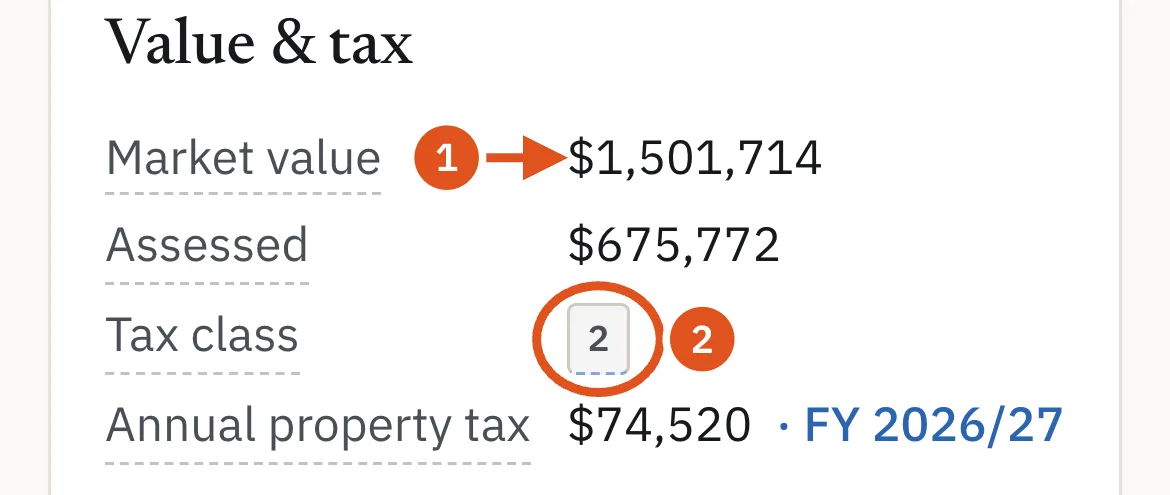
- Market value — the surcharge is a percentage of it
- Class 1 house or class 2 unit
Questions people ask
What is the NYC pied-à-terre tax? A yearly surcharge on top of the ordinary property tax, on high-value homes that are no one's primary residence. The State enacted it in May 2026 for fiscal years 2026/27 to 2030/31, and the City's Department of Finance runs it.
How much is it? For a house worth $5 million or more on DOF's roll, 0.8% to 1.3% of the market value a year. For a condominium or co-op unit worth $1 million or more in the first two years, 4% to 6.5%; from 2028/29, the house rates on a sales-based value of $5 million or more.
I live in my apartment. Do I owe it? No — a home that is the owner's, a close relative's or a long-term tenant's primary residence on January 5 is outside it. If DOF sent a letter, answering it with proof is how a home is taken off.
When is it billed? On the property tax bill due January 1, 2027, for the first year. A co-op pays it with the building's bill and collects it from the shareholder.
Is it the same as the "mansion tax"? No. The mansion tax is a State tax paid once, by the buyer, on a home bought for $1 million or more; the surcharge is charged every year a home is not anyone's primary residence.
Is it being challenged in court? Yes. The City has appealed a September 2026 ruling against its rollout, and other suits challenge the law itself. As of October 2026 the law stands and DOF is applying it.
Related
- Market value (NYC property tax) — What the Department of Finance's "market value" is, why it is not what a property would sell for, how DOF estimates it for each tax class — with the income formula — and how and when an owner can challenge it.
- Assessed value and how the NYC property tax is calculated — How New York City turns a market value into a tax bill — the four tax classes, the 6% and 45% assessment ratios, the yearly caps and five-year phase-ins, exemptions and abatements, the tax rates — worked through on a real building.
- Challenging an assessment: RPIE, the Tax Commission and SCAR — How to challenge a NYC property assessment: DOF's Request for Review, the Tax Commission, the RPIE filing, SCAR and Article 7 — with success rates.
- The Notice of Property Value and the assessment calendar — What New York City's Notice of Property Value shows, line by line, and the assessment calendar from January to October, with the 2026 dates.
Sources
- NY State Senate — S.9009-C (FY2027 Revenue budget bill), Chapter 59 of 2026
- NY State Assembly — A.10009-C, text of Part HH
- DOF — Non-primary residence property surcharge
- DOF — Property assessments (the supplemental market value roll)
- NYC Rules — Surcharge on certain non-primary residences (19 RCNY chapter 62, July 2026)
- NYC Rules — Emergency amendment of the appeal deadline (August 2026)
- NYC Tax Commission — Surcharge appeal (form TC107)
- NYC311 — Non-primary residence property surcharge
- DOF — Testimony to the City Council, August 18, 2026
- Mayor's Office — Announcement of the surcharge, April 15, 2026
- Mayor's Office — Owners notified, July 23, 2026
- Mayor's Office — Press conference transcript, September 30, 2026
- Governor — FY2027 budget signed, May 28, 2026
- NYS Comptroller — Review of the City's adopted financial plan (Report 8-2027)
- NY State Senate — S.44 of 2019 (the earlier proposal)
- NYS Department of Taxation — Real estate transfer tax
- NYS Department of Taxation — 2019 transfer tax changes (TSB-M-19(1)R)