Learn NYC property · Local Laws
Lead paint: Local Law 1 of 2004 and an owner's duties
New York City's lead paint law: which homes it covers, the annual notice, yearly inspections where a child under six lives, the 2025 XRF testing deadline, turnover work, HPD's lead violations and what they cost.
Lead paint — lead-based paint, in the law's words — is paint containing lead at or above a set level; in New York City since December 1, 2021, 0.5 milligrams per square centimetre, half the federal level. The law presumes it is in buildings put up before 1960. When it peels, or is ground into dust where windows and doors rub, it poisons young children, and New York City's housing law makes the owner responsible for finding and controlling it.
The law matters to every owner of an older rental building, and HPD writes up tens of thousands of lead violations a year. For a buyer, the building's lead records — and its lead violations — are part of what is bought: the records pass to the next owner, and missing ones cost money.
The law
Local Law 1 of 2004, the City's Childhood Lead Poisoning Prevention Act, passed over the Mayor's veto in February 2004 and took effect on August 2, 2004. It sits in the Housing Maintenance Code, and the Department of Housing Preservation and Development (HPD) enforces it. A run of later laws tightened it: Local Law 66 of 2019 lowered the lead level to 0.5; Local Law 64 of 2019 defined a child as living in a home if the child spends ten or more hours a week there; Local Law 29 of 2020 brought in rented one- and two-family homes; Local Law 31 of 2020 required every home to be tested; and four laws of 2023 added common areas, records and abatement deadlines. The Council record shows none since 2023.
Which homes it covers
The law covers rental homes in buildings of three or more homes built before 1960 — and those built from 1960 to 1977 where the owner knows there is lead paint. Since February 2021 it also covers one- and two-family houses with at least one home rented to someone outside the owner's family. Homes the owner or the owner's family live in are exempt.
In a pre-1960 building, paint in a home where a child under six lives, and in the common areas, is presumed to be lead paint unless testing shows otherwise. A home or a building found free of lead paint, or with its lead paint safely covered, can get an exemption from HPD.
The owner's year
- The annual lead notice. Between January 1 and 16 the owner gives every tenant a notice asking whether a child under six lives there; tenants return it by February 15. Where it does not come back, the owner must try to inspect, and tell the Health Department if refused entry. A new tenant gets the same question with the lease.
- The yearly inspection. In every home with a child under six, and in the common areas, the owner checks at least once a year for peeling paint, chewable surfaces and worn friction surfaces, and gives the tenant the results.
- Safe work. Work that disturbs lead paint must follow lead-safe practices, by firms with the federal Environmental Protection Agency's certification, and end with a dust test by an independent inspector.
- Lead turnover work. Before a new tenant moves in, the owner fixes every lead hazard, makes floors, sills and window wells smooth and cleanable, and removes or permanently covers lead paint on door and window friction surfaces. Since Local Law 123 of 2023, the same work is due in a home where a child under six lives even without a turnover — by July 1, 2027 where the child lived there on January 1, 2025, or within three years after a child moves in.
- Records. Every notice, inspection, test and job is kept for ten years; HPD can demand them, and they pass to the next owner.
The 2025 testing deadline
Local Law 31 of 2020 required an XRF test — XRF testing is a scan with an X-ray fluorescence analyser that reads the lead in paint without scraping it — of every covered home, and since Local Law 111 of 2023 of the common areas, by an independent EPA-certified inspector. The deadline was August 9, 2025, or a year after a child under six moves in if sooner. It was not extended; HPD's May 2026 bulletin says it has passed, and that owners must keep trying to test homes they could not get into, and test any untested home when it falls vacant.
Violations
When an HPD inspector finds peeling or deteriorated lead paint in a home where a child under six lives, HPD writes a lead-based paint hazard violation — a lead paint hazard is Class C, immediately hazardous, and lead paint violations of this kind are the law's most common. HPD tests the paint with its own XRF analyser: at 0.6 or more it is lead, at 0.5 the reading is inconclusive and still a violation, and where testing is not possible the paint is presumed lead. The owner has 21 days to correct it and five more to certify, with the work done by a certified firm and passed by a dust test. The penalty is $250 a day, up to $10,000.
If the owner does not correct it, HPD must reinspect and do the work itself through its Emergency Repair Program within 45 days, and bill the owner; an unpaid bill becomes a lien on the building. Separate violations come from audits: HPD audits the lead records of hundreds of buildings a year, and missing records carry their own penalties — up to $1,500 a violation for turnover records — which can be cleared with three years of records and $1,000 for each missing year.
By BlockLot Intelligence's count of HPD's records, HPD issued 17,045 lead paint hazard violations in fiscal 2026, counted by the year of the inspection as HPD reports them to the Council.
Violations HPD issued for peeling or deteriorated lead paint in a home — tested positive, presumed, or inconclusive — by the City fiscal year (July to June) of the inspection, as HPD reports them to the Council. One violation is one surface or room; an apartment can have several. BlockLot Intelligence, computed October 10, 2026.
Most of the law's violations are for the paint itself; the rest are for the paperwork and the turnover work.
Every HPD violation issued in the last 365 days under the lead-paint sections of the Housing Maintenance Code, by what it orders. BlockLot Intelligence, computed October 10, 2026.
How long they take to close, by BlockLot Intelligence's count: of the hazard violations from inspections between October 10, 2024 and October 10, 2025, 61.4% closed within a year, a median 81 days after the inspection; 33.0% are still open.
Why it matters
The Health Department investigates when a child's blood lead level reaches 3.5 micrograms per decilitre; when it finds lead hazards it issues a Commissioner's Order to Abate, which also triggers an XRF test and an HPD audit of the owner's records. In 2024 the department counted 4,655 children under six at or above that level — down 93% since 2005, and 90% of them living in moderate- or high-poverty neighbourhoods.
A worked example
A 72-home building on Sherman Avenue in Inwood, Manhattan, built in 1920 and owned by a company, shows the law at work. Since January 2024 HPD has written 88 lead paint hazard violations there — 64 for paint that tested positive and 24 for inconclusive readings — and six for turnover work not done. 67 of the hazard violations have since closed. Over the same period HPD gave 27 lead repair orders for the building to its own contractors, worth $86,564 in all — work the owner did not do in time, billed to the building.
Where you see this in BlockLot
On a building's page, the Violations drawer lists HPD's violations with the class and HPD's own description, which cites the lead paint section of the code; open ones come first. The HPD repair charges drawer shows the lead work HPD's contractors did.
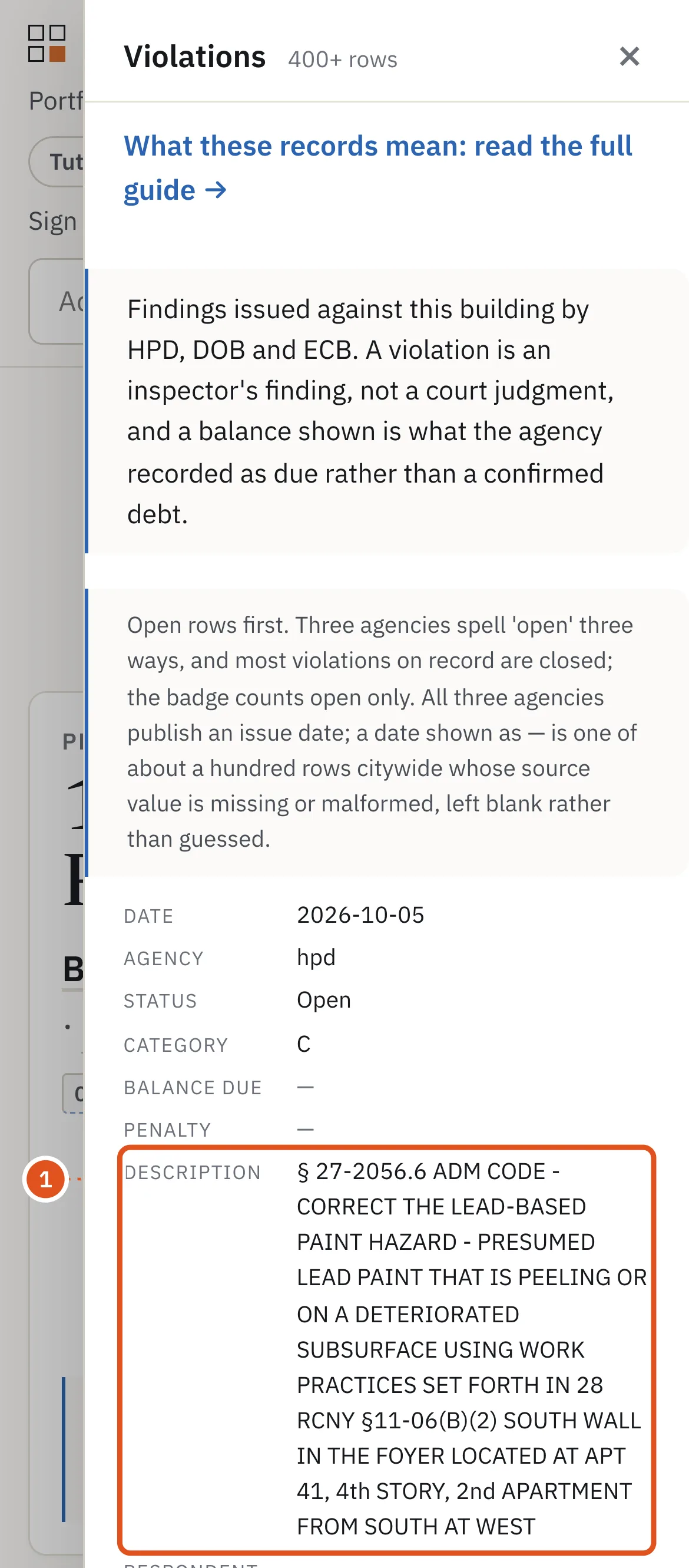
- Correct the lead-based paint hazard
Questions people ask
Does Local Law 1 apply to my building? It applies to rented homes in buildings of three or more homes built before 1960, to 1960–1977 buildings where the owner knows of lead paint, and since 2021 to rented one- and two-family houses. Homes the owner's family lives in are exempt.
When does a child "live" in an apartment? When a child under six spends ten or more hours a week there — a grandchild cared for during the day counts.
When is the annual lead notice due? Owners send it between January 1 and 16; tenants return it by February 15.
What was the August 2025 lead deadline? Every covered home, and the common areas, had to be XRF-tested by an independent certified inspector by August 9, 2025. The deadline has passed and was not extended.
What must an owner do when an apartment turns over? Before the new tenant moves in: fix every lead hazard, make floors, sills and window wells cleanable, and remove or cover lead paint on door and window friction surfaces.
How long does an owner have to fix a lead violation? It is Class C: 21 days to correct and five more to certify. After that HPD can do the work and bill the building, and the penalty runs at $250 a day up to $10,000.
Related
- NYC Local Laws for building owners — What a New York City Local Law is, how one is made and numbered, and the Local Laws that put duties on building owners — energy and emissions, facades and gas piping, lead paint, mold and pests, storefronts, short-term rentals and broker fees.
- Mold and pests: Local Law 55 of 2018 and the bedbug report — New York City's Asthma-Free Housing Act (Local Law 55 of 2018): an owner's duty to inspect for and fix mold, mice, rats and roaches, how HPD classes mold by its size, licensed mold work, and the annual bedbug report.
- HPD violations: Class A, B, C and I — What HPD housing violations are, what Class A, B, C and I mean, how long an owner has to fix and certify each, how a violation is closed or dismissed, and what happens when a Class C is ignored.
- HPD emergency repairs, repair charges and 7A administrators — How HPD's Emergency Repair Program fixes hazards an owner ignores and bills the owner, how repair charges become liens, and what a 7A administrator does.
- Smoke and carbon monoxide detectors, window guards and self-closing doors — The safety devices New York City requires in apartments — smoke, carbon monoxide and natural gas detectors, window guards and self-closing doors — who installs and maintains them, what HPD's violations for them mean, and how fast they are fixed.
Sources
- BlockLot Intelligence — BlockLot's own analysis of the public records below, computed October 10, 2026.
- City Council — Local Law 1 of 2004 (Int 101-A)
- City Council — Local Law 66 of 2019 (0.5 mg/cm²)
- City Council — Local Law 29 of 2020 (one- and two-family rentals)
- City Council — Local Law 31 of 2020 (XRF testing)
- City Council — Local Law 111 of 2023 (common areas, the August 9, 2025 date)
- City Council — Local Law 123 of 2023 (abatement where a child under six lives)
- HPD — Lead-based paint
- HPD — Annual notice and investigations
- HPD — Paint testing requirement and exemptions
- HPD — Lead-based paint violations: correcting and certifying
- HPD — Safe work practices
- HPD — Required audit compliance and record keeping
- HPD — Penalties and fees
- HPD — Get Ahead of Lead bulletin for property owners (May 2026)
- HPD — Report to the City Council on Local Law 1, fiscal year 2025
- Mayor's Management Report, Fiscal 2026 — HPD
- Health Department — Report to the City Council on elevated blood lead levels (September 2025)
- NYC Open Data — Housing Maintenance Code Violations