Learn NYC property · Local Laws
Short-term rental registration: Local Law 18 of 2022
New York City's short-term rental law: what counts as a short-term rental, who may host and register with the Office of Special Enforcement, the Prohibited Buildings List, booking services' duties and the penalties.
A short-term rental in New York City is a stay of fewer than 30 days in a home — the night-by-night or week-by-week rentals booked through online platforms. The City allows only a narrow kind of short-term rental, and since 2023 short-term rentals need a registration: every host must first register with the City, and every booking platform must check that registration before it takes a fee.
The Office of Special Enforcement (OSE), a Mayor's office that enforces the City's laws against illegal short-term rentals and illegal conversions, runs the registration.
This matters to more people than hosts. For an owner or a co-op or condominium board, short-term rentals in a building are a question of safety, insurance and who is living there; the law gives them a way to shut the door. For a buyer of a one- or two-family house, the rules decide whether a spare room can earn money. For a tenant, they decide whether hosting is legal at all.
The rule underneath: permanent residence
The rule comes first from State law. An apartment building of three or more homes is, in the State's Multiple Dwelling Law, a class A multiple dwelling: a building for permanent residence, which the law defines as the same person or family living there for 30 days or more in a row. Shorter stays are allowed only for people living within the household of the permanent occupant — house guests, or lawful boarders and lodgers — and the occupant may not take money to let someone stay while away.
So renting a whole apartment for under 30 days while the occupant is somewhere else is illegal in a class A building, registration or not. Advertising such a stay is a separate State offence, with civil penalties of up to $1,000, $5,000 and $7,500 for a first, second and third violation.
A Class B multiple dwelling — a hotel, or another building legally approved for transient stays — is outside the registration law. Class B here means the building's legal occupancy, not its tax class.
What a host may do
The City's rules allow a short-term rental only when:
- the host is the permanent occupant and lives in the home during the stay;
- there are no more than two paying guests at a time (the Office of Special Enforcement does not count children under four);
- the guests share the household — they can reach every part of the home, and no guest room locks the host out;
- the host has a current registration number, shown in every listing.
The same limits apply in a one- or two-family house. An owner may host up to two paying guests in the unit the owner lives in, with a registration, but may not rent out the whole house for under 30 days: the Building Code treats these homes as places people live for more than a month at a time. A bill to let owners host without being present in their own one- or two-family home was introduced in April 2026 and, as of October 2026, has not left committee. It is not law.
Who may register
Local Law 18 of 2022 created short-term rental registration. The Council passed it in December 2021 and it became law without the Mayor's signature in January 2022; it took effect on January 9, 2023, its penalties on May 9, 2023, and the Office of Special Enforcement opened its registration portal with its rules on March 6, 2023. Enforcement against booking platforms began on September 5, 2023. The Council record shows no amendment since.
A registration can be issued only to a natural person who is the permanent occupant — the owner, or a tenant who certifies that the lease does not forbid it. One person may hold one registration, for one home. The application asks for a photo ID, two proofs of living there, the lease if the applicant rents, and every listing the host already has. The Office of Special Enforcement writes to the owner of record when it receives a complete application.
The law bars registration altogether for:
- rent-regulated homes — rent-stabilized and rent-controlled apartments, and homes regulated through the 421-a or other tax programs or a regulatory agreement;
- public housing (NYCHA) and rooming units;
- buildings on the Prohibited Buildings List;
- homes with uncorrected hazardous conditions — among them a Class C HPD violation or a Class 1 DOB violation on the home, any Fire Code violation, work without a permit, or a vacate or stop-work order.
The fee is $145, not refundable, and a registration lasts up to four years — or until the end of a tenant's lease, if sooner. A host can renew from six months before it runs out; the first renewals were expected in the autumn of 2026.
The Prohibited Buildings List
The Prohibited Buildings List is the owner's tool. An owner — or a co-op or condominium board, or the owner's managing agent — applies online and certifies that the leases and occupancy agreements for the whole building forbid short-term rentals; a single floor or apartment cannot be listed. The Office of Special Enforcement then refuses registrations in the building, and may move to revoke one granted before the building was listed. Buildings where every home is barred by law, such as fully rent-regulated buildings and NYCHA, are added on the City's own initiative. In its report on the 2025 fiscal year the office said more than 21,000 buildings were on the list, placed there by more than 14,000 owners and managers.
Booking services
A booking service — one of the booking services or platforms through which a stay is booked and paid — may not charge or collect a fee for a short-term rental until it has checked, through the City's electronic verification system, that the listing carries a valid registration matching the host's name, the address and the listing, or that the home is in a Class B building. The platform pays $2.40 a listing a year for the check, and must report every short-term rental transaction to the City each month.
Penalties
- A host renting without a registration: up to $5,000, or three times the rent earned if that is less, for each violation.
- Other host violations: up to $5,000 each; the rules' schedule for most of them runs $100, $500 and $1,000 for a first, second and third offence. A false statement on an application can cost $1,000 and the registration.
- A booking service taking a fee without verifying: up to $1,500 a transaction, or three times the fee it earned; failing to report carries its own penalty.
A registration can be revoked after a hearing — for illegal use, a false statement, three violations in two years, or the building joining the Prohibited Buildings List.
How many hosts have registered
The Office of Special Enforcement reports each year to the Council. At June 30, 2026 it counted 3,338 active registrations, 68% of them in one- or two-family homes and 76% held by the home's owner. In the year to that date it received 1,187 applications, granted 464 and denied 342; most denials were applications whose problems the applicant never fixed, and 65 were for rent-regulated homes. By June 2026, 17 registrations had been revoked and 15 more were in revocation proceedings.
BlockLot does not hold the registrations: the City publishes them as a spreadsheet on the office's own site, not as an Open Data feed we can read nightly, so there is no BlockLot Intelligence figure on this page.
An example
Take an owner who lives on the first floor of a two-family house in Queens and rents the second floor to a tenant on a lease. The owner may register and host up to two paying guests in the first-floor home, while living there, with the registration number on every listing. The owner may not rent the whole first floor for a long weekend away, and may not rent the second floor short-term when the tenant leaves. The tenant, for the tenant's own home, could register only if the lease allows it — and not at all if the home were rent-stabilized.
Where you see this in BlockLot
BlockLot does not show short-term rental registrations, but a building's page answers the questions the law turns on. The Lot & building card gives the number of homes — a one- or two-family house or a multiple dwelling — and the rent-stabilized units on record, which can never be registered. The Violations drawer lists open Class C HPD and Class 1 DOB violations, which bar a registration until they are corrected.
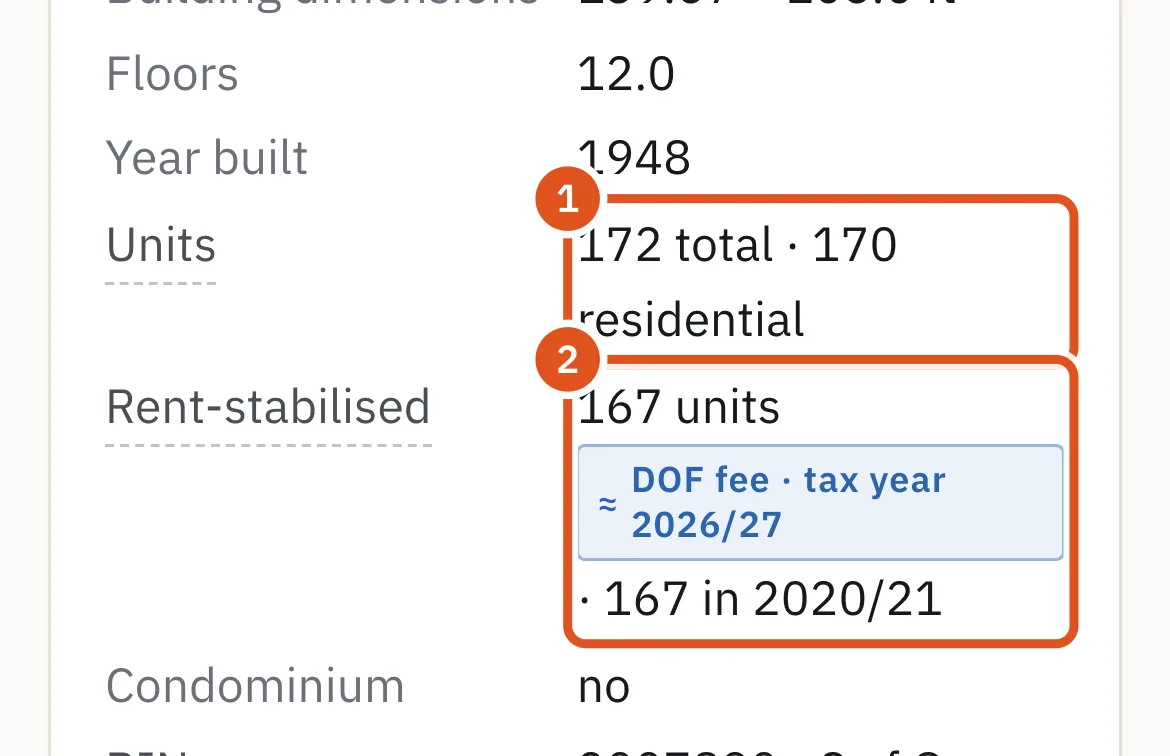
- Homes in the building: a multiple dwelling
- Homes that can never be registered
Questions people ask
Can I rent out my New York City apartment while I am away? Not for fewer than 30 days. A short-term rental is legal only when the permanent occupant lives in the home during the stay, with no more than two paying guests, and holds a registration.
Do I need to register to host in my own house? Yes. One- and two-family homes are covered too: an owner may host up to two paying guests in the unit the owner lives in, with a registration, but may not rent out the whole house for under 30 days.
How much does registration cost and how long does it last? $145, not refundable, for up to four years — or until the end of a tenant's lease, if sooner. Renewal opens six months before the registration runs out.
Can a rent-stabilized tenant register? No. Rent-regulated homes, public housing and rooming units cannot be registered at all.
How can a landlord or co-op stop short-term rentals in its building? By applying to put the whole building on the Prohibited Buildings List, certifying that every lease and occupancy agreement in it forbids short-term rentals. The City then refuses registrations there.
What happens to a platform that books an unregistered home? It may not take a fee without first verifying the registration with the City. The penalty is up to $1,500 a transaction, or three times the fee it earned.
Related
- NYC Local Laws for building owners — What a New York City Local Law is, how one is made and numbered, and the Local Laws that put duties on building owners — energy and emissions, facades and gas piping, lead paint, mold and pests, storefronts, short-term rentals and broker fees.
- The FARE Act: who pays the broker fee — New York City's FARE Act (Local Law 119 of 2024): since June 11, 2025 a broker who works for the landlord cannot charge the tenant, every fee must be disclosed, and DCWP enforces it.
- HPD violations: Class A, B, C and I — What HPD housing violations are, what Class A, B, C and I mean, how long an owner has to fix and certify each, how a violation is closed or dismissed, and what happens when a Class C is ignored.
- Building class codes and land use: what A1, C6, D4, O4 and R4 mean — How the Department of Finance's two-character building class describes every property in New York City, the 25 letter families from A to Z, the codes beginners meet most, how a building class relates to the tax class, and City Planning's eleven land-use categories built from it.
Sources
- City Council — Local Law 18 of 2022 (Int 2309-A of 2021), legislative record
- City Council — Local Law 18 of 2022, enacted text
- Office of Special Enforcement — Rules for short-term rental registration and booking services (43 RCNY chapters 21 and 22)
- Office of Special Enforcement — Registration Law
- Office of Special Enforcement — What is Local Law 18?
- Office of Special Enforcement — FAQ for prospective hosts
- Office of Special Enforcement — Prohibited Buildings List
- Office of Special Enforcement — Renew your registration
- Office of Special Enforcement — Registration and listing data
- Office of Special Enforcement — Short-term rental registration report, fiscal year 2026
- Office of Special Enforcement — Data and reports
- Office of Special Enforcement — New report on Local Law 18 (fiscal year 2025)
- New York State Senate — Multiple Dwelling Law § 4 (permanent residence)
- New York State Senate — Multiple Dwelling Law § 121 (advertising)
- City Council — Int 0879-2026 (one- and two-family homes, in committee)