Learn NYC property · Rent regulation and tenant protection
Rent control in New York City, and how it differs from rent stabilization
NYC rent control explained: which apartments are still controlled, the Maximum Base Rent system, the 2.55% increase for 2026, succession, and how it differs from rent stabilization.
Rent control is New York City's oldest system of rent regulation: it caps the rent of apartments whose tenants — or a family member who succeeded them — have lived there since before July 1, 1971, in buildings of three or more apartments built before February 1, 1947. Every other regulated apartment in the city is rent-stabilized instead. The two systems are run by the same State agency and are often confused, but they work differently.
Rent control matters far less than it once did — about 24,000 apartments, against about a million stabilized ones — but it still decides the rent in some of the city's oldest buildings. For an owner or a buyer, a controlled apartment brings a low, slow-rising rent while the tenant stays, and a step up when the apartment is vacated; for a tenant, it brings protections that pass to family.
Where it came from
Rent control began as a federal wartime measure: on November 1, 1943 rents across the city were frozen at their March 1943 levels. Federal law left new construction out from February 1, 1947 — which is why rent control still applies only to older buildings. New York State took over in 1951, when about 2.1 million apartments were controlled, and handed the system to the City in 1962, by then 1.8 million. In 1971 the State provided that an apartment vacated voluntarily on or after July 1, 1971 leaves rent control, and from then on the controlled stock shrank steadily. The State took over running it again in 1984, and it has been run since by HCR, New York State Homes and Community Renewal, through its Office of Rent Administration.
Which apartments are rent-controlled
In New York City an apartment is generally rent-controlled when:
- it is in a building of three or more apartments built before February 1, 1947; and
- the tenant, or a lawful successor, has lived there continuously since before July 1, 1971.
An apartment in a one- or two-family house is controlled only if the tenant has lived there since April 1, 1953. The 2023 Housing and Vacancy Survey counted 24,020 rent-controlled apartments: 14,050 still lived in by tenants who were there before July 1971, and 9,970 by successors. Their median rent was $988 a month, against $1,500 for stabilized apartments. The survey counted successors for the first time in 2023, so its figure cannot be compared directly with older counts; counted the old way, the number of original tenants fell from 16,400 in 2021 to 14,050.
How the rent is set
A controlled apartment has two rents. The Maximum Base Rent (MBR) is a ceiling HCR recalculates every two years from the costs of running the building — taxes, water and sewer charges, operating and maintenance costs, and a return on the building's value. For the 2026/27 cycle HCR set the Standard Adjustment Factor, the increase it applies to MBRs, at 11.5%.
The Maximum Collectible Rent is what the tenant actually pays, and it is usually below the MBR. Since the 2019 Housing Stability and Tenant Protection Act it may rise each year by the lower of 7.5% or the average of the Rent Guidelines Board's five most recent one-year increases for stabilized leases — 2.55% on January 1, 2026 — until it reaches the MBR.
An owner collects the increase only after certifying to HCR that the building's rent-impairing violations, and 80% of its other violations, are cleared, that essential services are provided and that most of the maintenance allowance was spent; HCR then issues an order of eligibility and the owner serves each tenant the new figures. While an HCR order reducing the rent for a lost service is in force, no increase can be collected. The 2019 law also ended fuel-cost pass-alongs for controlled tenants. Rents can rise in only three other ways: a building-wide Major Capital Improvement approved by HCR, collected at no more than 2% a year; new work inside the apartment with the tenant's written consent; or a hardship increase HCR approves.
Tenants 62 or older, or disabled, with household income of $50,000 or less can have increases frozen through the City's SCRIE and DRIE programs.
Leases, succession and records
Rent-controlled tenants are statutory tenants: the owner need not offer a lease, and the tenant need not sign one — the protection comes from the law, not from a lease. A family member who lived in the apartment with the tenant as their primary home for the two years before the tenant died or moved out for good — one year if they are 62 or older or disabled — can succeed to it and keep its protection. Family includes close relatives and anyone who can show emotional and financial commitment and interdependence with the tenant.
Controlled apartments are not registered with HCR every year the way stabilized ones are, so an annual registration history will not show them. HCR keeps rent-control records and the MBR filings; the tenant or the owner can get them, and NYC311 points tenants to HCR's rent information line, its online portal and the borough rent offices to check an apartment's status. An overcharged controlled tenant can complain to HCR, with refunds limited to the two years before the complaint.
When a tenant leaves
When a controlled tenant leaves and no one succeeds them, the apartment is decontrolled. In a building of six or more apartments it becomes rent-stabilized — since 2019 always, and permanently; before 2019 it became stabilized only if the new rent was below the deregulation threshold. In a building of three to five apartments it leaves regulation altogether.
The owner sets the first stabilized rent, and the new tenant can challenge it within 90 days through a Fair Market Rent Appeal, which HCR decides using the Rent Guidelines Board's special guideline and the rents of comparable apartments. The Board's Order 58 sets that guideline at 49% above the MBR for apartments decontrolled after September 30, 2026.
The flow is now small. By the Board's count of HCR registrations, 229 controlled apartments became stabilized in 2025 — 146 of them in Manhattan — and 40,424 from 1994 to 2025:
| Year | Became stabilized |
|---|---|
| 2021 | 244 |
| 2022 | 225 |
| 2023 | 183 |
| 2024 | 203 |
| 2025 | 229 |
How it differs from rent stabilization
| Rent control | Rent stabilization | |
|---|---|---|
| Buildings | 3+ apartments, pre-1947 | 6+ apartments, mostly pre-1974 |
| Who sets increases | HCR's MBR system | Rent Guidelines Board |
| Lease | None needed | Renewal leases |
| Yearly registration | No | Yes |
See rent stabilization for the larger system, and the Good Cause Eviction law for unregulated apartments — rent-controlled apartments are outside it, because their own law protects them more.
What BlockLot holds
BlockLot does not hold rent-control records: no public dataset lists controlled apartments, and HCR keeps their records private to tenants and owners. The stabilized counts BlockLot shows come from the City's $20-a-unit fee for stabilized apartments, which controlled apartments do not pay — so a building's controlled apartments are not in that number. What a building's page does show is whether rent control can apply at all: the year built and the number of apartments, in its Lot & building card.
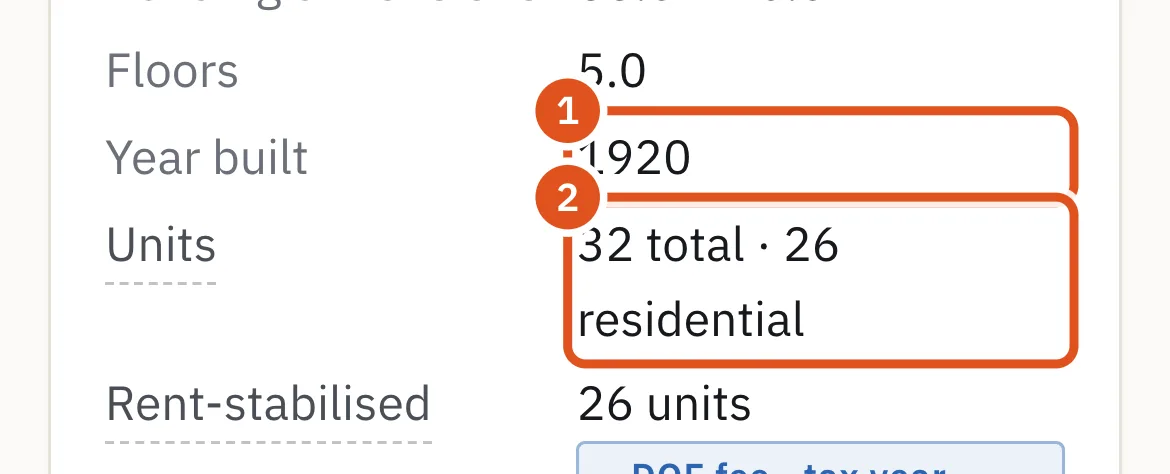
- Before 1947: rent control can apply
- Three or more apartments
Questions people ask
What is the difference between rent control and rent stabilization? Rent control covers apartments in pre-1947 buildings of three or more units whose tenants have been there since before July 1971; its rents follow HCR's Maximum Base Rent system and tenants need no lease. Rent stabilization covers about a million apartments, mostly in pre-1974 buildings of six or more units, with increases set by the Rent Guidelines Board and renewal leases.
How many rent-controlled apartments are left? The 2023 Housing and Vacancy Survey counted 24,020 — 14,050 with tenants there since before July 1971 and 9,970 with family successors — down from more than a million in 1971.
How much can a rent-controlled rent go up? Since 2019, by the lower of 7.5% or the average of the last five one-year guidelines for stabilized leases — 2.55% on January 1, 2026 — until it reaches the Maximum Base Rent, and only if the owner has certified that violations are cleared and services provided.
Can I inherit a rent-controlled apartment? A family member who lived there as their primary home for the two years before the tenant died or left — one year if 62 or older or disabled — can succeed to it.
What happens when a rent-controlled tenant moves out? The apartment is decontrolled. In a building of six or more apartments it becomes rent-stabilized; in a smaller building it leaves regulation.
How do I find out if my apartment is rent-controlled? Ask HCR: it keeps rent-control records and MBR filings, which the tenant and the owner can obtain. A stabilized-registration history alone will not show it.
Related
- Rent stabilization in New York City — NYC rent stabilization explained: which buildings, the Rent Guidelines Board's 2026 freeze, leases and renewals, the 2019 HSTPA, deregulation history, and how to check an apartment.
- MCI and IAI rent increases: Major Capital and Individual Apartment Improvements — How NYC rent-regulated rents rise for improvements: Major Capital Improvements (MCIs) and Individual Apartment Improvements (IAIs), the 2019 and 2024 limits, and how tenants check them.
- Housing Court, HP actions and HPD litigation — Housing Court for owners and buyers: HP actions, the cases HPD brings, harassment findings, marshal evictions and HPD's Speculation Watch List.
Sources
- HCR — Rent control
- HCR — Fact Sheet #1: Rent Stabilization and Rent Control
- HCR — Fact Sheet #22: The Maximum Base Rent program
- HCR — Standard Adjustment Factor report, 2026/27 MBR cycle
- HCR — 2026/27 Maximum Base Rent notices (RN-26S)
- HCR — Fact Sheet #30: Succession Rights
- HCR — Records access
- Rent Guidelines Board — Rent control FAQ
- Rent Guidelines Board — History of the Board and of rent regulation
- Rent Guidelines Board — Changes to the Rent Stabilized Housing Stock in 2025 (May 2026)
- Rent Guidelines Board — Order #58 (the special guideline for decontrolled apartments)
- HPD — 2023 NYC Housing and Vacancy Survey, selected initial findings
- NY Senate — S6458 of 2019, the Housing Stability and Tenant Protection Act
- NYC311 — Rent-regulated apartments