Learn NYC property · Local Laws
Energy audits and retro-commissioning: Local Law 87
New York City's Local Law 87 makes buildings over 50,000 square feet audit their energy use and tune their systems every ten years, in a year set by the tax block; with Local Law 88's lighting and sub-meter duties.
Local Law 87 of 2009 — LL87 for short — requires New York City's largest buildings to have their energy use audited, and their heating, cooling and other systems checked and tuned, once every ten years, and to file the results with the Department of Buildings (DOB). The audit lists what could be done to save energy; the tuning — retro-commissioning — fixes what is wrong now.
For an owner it is a cost every decade and a report that shows where the building wastes energy — and so where it stands against the emissions limits of Local Law 97. For a buyer, a recent audit is a ready list of the building's energy problems and what fixing them would cost.
Who is covered
Using the Department of Finance's records, Local Law 87 covers:
- a building of more than 50,000 gross square feet;
- two or more buildings on the same tax lot that together exceed 100,000 square feet;
- two or more condominium buildings under the same board that together exceed 100,000 square feet.
Tax class 1 property — one- to three-family homes — is left out; landmarks and vacant buildings are not. The duty falls on the owner of record, a condominium's board of managers or a co-op's board of directors. DOB's yearly Covered Buildings List, shared with the benchmarking and emissions laws, marks each lot the law reaches.
The Council passed Local Law 87 in December 2009 as part of a package with the benchmarking law (Local Law 84) and Local Law 88, and the Mayor signed it on December 28, 2009. Local Law 106 of 2018 let a co-op with buildings on several tax blocks file one report, and the 2022 code revision redrew the due-year chart. The Council record shows no change since.
The ten-year cycle
The year a building is due is set by the last digit of its tax block: a block ending in 0 files in 2020 and 2030, one ending in 6 in 2026 and 2036, one ending in 9 in 2029 and 2039. The report is due by December 31 of that year, and every ten years after. For the 2025 filing year only, DOB moved the deadline to March 31, 2026; 2026's filers are due on December 31, 2026.
A new building does not file until its first temporary certificate of occupancy is ten years old, and a building that has had a major renovation meeting the energy code can defer for ten years.
What the report holds
The filing is the Energy Efficiency Report, or EER, with two parts:
- an energy audit — energy audits under the law are at least a Level 2 audit under the ASHRAE standard DOB's rule names — which measures how the building uses energy, system by system, and lists every reasonable measure to save it, with its cost, its yearly saving and its payback;
- retro-commissioning — testing the base building's systems against a checklist (heating and cooling schedules and set points, sensors and controls, ventilation, steam traps, boiler tuning, hot-water temperatures, lighting controls, leaks, pipe insulation) and correcting what is found before the report is filed.
Both must be done within the four years before filing, by professionals from outside the building's staff with the credentials DOB's rule lists, and the report is filed by a registered design professional — a licensed engineer or architect. The filing fee is $375.
An owner can skip the audit with an ENERGY STAR certification in two of the three years before filing, or a recent LEED certification for existing buildings, and can skip retro-commissioning with a recent LEED certification that included its commissioning credits. An owner who cannot finish in time can ask for up to two one-year extensions for good faith efforts, or a yearly extension for financial hardship.
Penalties
Not filing is a violation carrying $3,000 for the first year and $5,000 for every year after that the report is still missing.
By BlockLot Intelligence's count of DOB's violations, DOB issued 1,471 Local Law 87 violations in 2024, the latest year with any; in all the file holds 14,144, on 5,318 buildings. None dated 2025 or 2026 was in the file in October 2026, the year DOB moved the 2025 deadline into March 2026.
Violations the Department of Buildings issued in each whole calendar year, whatever reporting year they were for. BlockLot Intelligence, computed October 11, 2026.
Local Law 88: lighting and sub-meters
Local Law 88 of 2009 (LL88), passed with it, set a single deadline for lighting and sub-metering: by January 1, 2025, buildings over 25,000 square feet (the line was 50,000 until 2016) had to bring their lighting up to the energy code, and install sub-meters for every tenant space over 5,000 square feet, with a monthly statement of each tenant's use. Owners reported compliance by May 1, 2025, or by May 1, 2026 if they filed a compliance plan by the end of 2025. Each missing report carries a $1,500 penalty a year, and each unmetered tenant space $500 a year.
A worked example
The Empire State Building stands on tax block 835, which ends in 5, so its Energy Efficiency Reports fall due in 2025 and 2035; the 2025 report, like every one due that year, could be filed until March 31, 2026. 120 Broadway, in lower Manhattan, is on block 47, so its next report is due by December 31, 2027.
Where you see this in BlockLot
On a building's page, the Compliance & distress signals card lists the building's active DOB safety violations by kind. A Local Law 87 report not filed shows as Retro-Commissioning - LL87; an unfiled benchmarking report as Benchmarking - LL84. The block number in the page's header tells the building's Local Law 87 year.
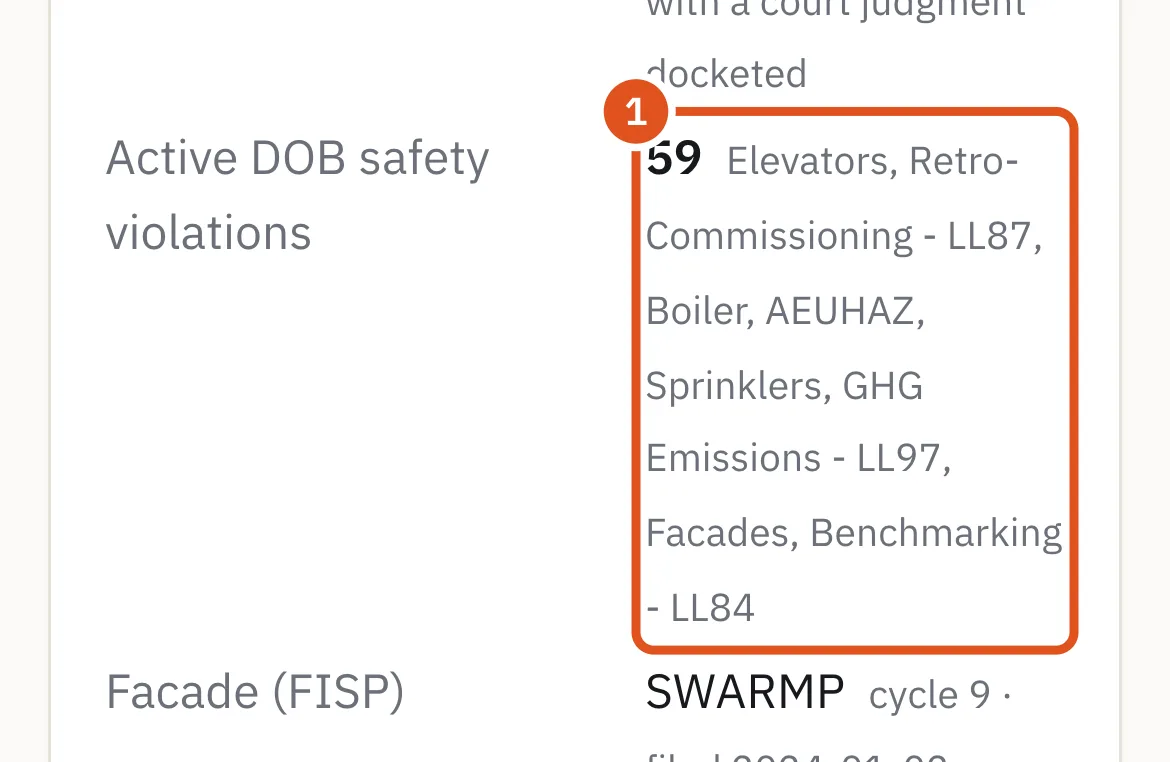
- Retro-Commissioning - LL87 among them
Questions people ask
Which buildings need a Local Law 87 audit? Buildings over 50,000 square feet, and two or more buildings on one lot or under one condominium board totalling more than 100,000. One- to three-family homes are left out.
When is my building's report due? In the year ending with the same digit as the tax block: a block ending in 7 is due in 2027 and every ten years after, by December 31.
What is retro-commissioning? Testing a building's heating, cooling, hot-water, lighting and control systems against a checklist and fixing what is out of order, before the report is filed.
What does it cost if the report is not filed? $3,000 for the first year and $5,000 for every year after that it is still missing.
Who can do the audit? A licensed engineer or architect from outside the building's staff, holding one of the energy credentials DOB's rule lists; the report is filed by a registered design professional.
What did Local Law 88 require? By January 1, 2025, lighting brought up to the energy code in buildings over 25,000 square feet, and sub-meters for tenant spaces over 5,000 square feet.
Related
- NYC Local Laws for building owners — What a New York City Local Law is, how one is made and numbered, and the Local Laws that put duties on building owners — energy and emissions, facades and gas piping, lead paint, mold and pests, storefronts, short-term rentals and broker fees.
- Local Law 97: building emissions limits — New York City's Local Law 97 caps the greenhouse gas emissions of buildings over 25,000 square feet: who is covered, how the limit is set, the annual report, the $268-a-ton penalty, and what changes in 2030.
- Energy benchmarking and grades: Local Laws 84 and 33 — New York City's benchmarking law (Local Law 84, widened by Local Law 133) makes large buildings report their energy and water use every year; Local Law 33 turns the ENERGY STAR score into an A to F grade posted at the door.
- Department of Buildings (DOB) — What New York City's Department of Buildings does, how a building permit works from filing to sign-off, what a Certificate of Occupancy is, and how DOB violations and stop work orders are issued and cleared.
- Mold and pests: Local Law 55 of 2018 and the bedbug report — New York City's Asthma-Free Housing Act (Local Law 55 of 2018): an owner's duty to inspect for and fix mold, mice, rats and roaches, how HPD classes mold by its size, licensed mold work, and the annual bedbug report.
- Storefront registration and vacancy: Local Law 157 — New York City's storefront registry (Local Law 157 of 2019): which owners register their ground- and second-floor storefronts with the Department of Finance each year, the vacancy filings, what DOF publishes, and how many storefronts stand empty.
Sources
- BlockLot Intelligence — BlockLot's own analysis of the public records below, computed October 11, 2026.
- City Council — Local Law 87 of 2009 (Int 0967-2009)
- DOB — Local Law 87 of 2009, enacted text
- City Council — Local Law 126 of 2021 (the 2022 construction codes)
- DOB — Admin Code chapter 3, Articles 308, 310 and 311 (2022 construction codes)
- DOB — 1 RCNY § 103-07, energy audits and retro-commissioning
- DOB — Energy audits and retro-commissioning (LL87)
- DOB — LL87 frequently asked questions
- DOB — LL87 violations, fees and payments
- DOB — 2025 EER deadline moved to March 31, 2026 (service notice)
- DOB — Deadlines for sustainability laws in 2026 (service notice)
- DOB — Lighting upgrades and sub-metering (LL88)
- DOB — 1 RCNY § 103-18, LL88 reports and penalties
- DOB — 1 RCNY § 101-03, fees
- NYC Open Data — LL87 energy audit data