Learn NYC property · Local Laws
NYC Local Laws for building owners
What a New York City Local Law is, how one is made and numbered, and the Local Laws that put duties on building owners — energy and emissions, facades and gas piping, lead paint, mold and pests, storefronts, short-term rentals and broker fees.
A Local Law is a law passed by the New York City Council. Most of the rules that put duties on building owners in New York City — filing an energy report, inspecting a facade, checking for lead paint, registering a storefront — come from Local Laws, and owners, managers and brokers speak of them by number: "Local Law 97", "LL97", or "Local Law 97 of 2019".
For an owner or a buyer, the Local Laws are much of the cost of keeping a building legal in New York City: reports with deadlines, inspections by licensed professionals, and fines when they are missed. Which laws apply depends on the building — its size, its age, its use, who lives there — and this page is the map.
How a Local Law is made
A Local Law starts as a bill in the City Council, numbered by the year it is introduced — Int 1253-2018, for example. When the Council passes it, the Mayor can sign it, veto it, or let it become law without signing; the Council can override a veto. Local Law 1 of 2004, on lead paint, passed over the Mayor's veto; Local Law 97 of 2019 and the FARE Act of 2024 became law unsigned. Once enacted, the bill gets its Local Law number, counted from one each calendar year: Local Law 97 of 2019 was the 97th law of 2019, and Local Law 1 of 2004 was the first of 2004. The same number can therefore mean different laws in different years — there are a Local Law 1 of 2004 on lead paint and a Local Law 1 of 2018 on tenant harassment.
Most Local Laws amend the City's Administrative Code (the Admin Code), the collected body of City law: the Housing Maintenance Code (lead paint, mold, pests), the construction codes (energy, emissions, facades, gas piping), the tax title (the storefront registry) and the consumer title (broker fees). City agencies then write rules — the Rules of the City of New York — that fill in forms, fees and deadlines. The Council's legislation site, Legistar, holds every bill, its votes and its enacted text, and is where later amendments show up first; agency web pages sometimes lag behind it.
The laws, at a glance
In the table each law is shortened the way owners and professionals write it — LL and the number, with the year it was enacted.
| Law | What it requires | Applies to |
|---|---|---|
| LL97 (2019) | An emissions limit and a yearly report | Most buildings over 25,000 sq ft |
| LL84 and LL133 | A yearly energy and water report, by May 1 | Buildings over 25,000 sq ft |
| LL33 and LL95 | The energy grade posted at the door | The same buildings |
| LL87 (2009) | An energy audit every ten years | Buildings over 50,000 sq ft |
| LL88 (2009) | Lighting upgrades and sub-meters by 2025 | Buildings over 25,000 sq ft |
| LL11 (1998) | A facade inspection every five years | Buildings over six stories |
| LL152 (2016) | A gas piping inspection every four years | All but one- and two-family homes |
| LL1 (2004) | Lead paint notices, inspections, turnover work | Rentals built before 1960 |
| LL55 (2018) | Inspecting for and fixing mold and pests | Buildings of three or more homes |
| LL69 (2017) | A bedbug report every December | Buildings of three or more homes |
| LL157 (2019) | Registering every storefront each year | Owners of shops at street level |
| LL159 (2019) | Relocation costs billed to the owner | Buildings under a vacate order |
| LL18 (2022) | Registering short-term rentals | Hosts, and booking platforms |
| LL119 (2024) | The landlord's broker paid by the landlord | Apartment rentals |
The facade and gas piping programs are run by the Department of Buildings, as the energy laws are. Under the Facade Inspection Safety Program — still called Local Law 11 — buildings taller than six stories have their facades inspected every five years by a qualified inspector, and a facade found unsafe must be protected at once, usually with a sidewalk shed. Under Local Law 152, a licensed master plumber inspects a building's gas piping every four years, on a schedule set by community district.
Energy and emissions
Four laws work together on large buildings. Benchmarking (Local Law 84) measures a building's energy use every year; the energy grade (Local Law 33) shows it at the door; the ten-yearly audit (Local Law 87) lists what could be saved; and the emissions limits (Local Law 97) put a price on what is not. The Department of Buildings publishes one Covered Buildings List each year marking which of them reach each lot, and its 2026 deadlines were May 1 for benchmarking and emissions reports, October 31 for posting the grade, and December 31 for the year's energy audits.
By BlockLot Intelligence's count of DOB's violations, DOB issued 2,689 violations in the last 12 months for not benchmarking, 933 for not posting the grade, and 4,043 for not filing a Local Law 97 emissions report.
Violations the Department of Buildings issued in the last 365 days under the energy laws, by what the owner failed to do. One violation is one building and one reporting year. BlockLot Intelligence, computed October 11, 2026.
Healthy homes
The Housing Maintenance Code's Local Laws are enforced by the Department of Housing Preservation and Development (HPD) through its inspections and violations. Lead paint brings a yearly notice to tenants, a yearly inspection where a child under six lives, and work before every new tenant moves in; mold and pests bring a yearly inspection of every apartment and a duty to fix the leaks and holes behind them; and every building of three or more homes files a bedbug report each December. Local Law 159 lets HPD charge an owner for sheltering tenants a vacate order displaced, where the owner's neglect caused it, and the Certification of No Harassment can block permits at buildings where tenants were harassed.
Registries and renting
Two laws make owners and hosts tell the City what they have. Local Law 157 has owners register every ground- and second-floor storefront each year with the Department of Finance, and report the empty ones twice a year; Local Law 18 has every short-term rental host register with the Office of Special Enforcement, and bars platforms from taking a fee for an unregistered stay. The FARE Act changed who pays when an apartment is rented: since June 11, 2025, the broker the landlord hires is paid by the landlord.
Where you see this in BlockLot
A building's page gathers the records these laws produce. The Compliance & distress signals card shows the facade's last filing, boiler and elevator filings, the energy grade, LL159 relocation charges and the building's active DOB safety violations by kind — benchmarking, energy audits, emissions reports, gas piping; the Violations drawer has HPD's lead paint, mold and pest violations; and the Storefront history card has the storefront registry.
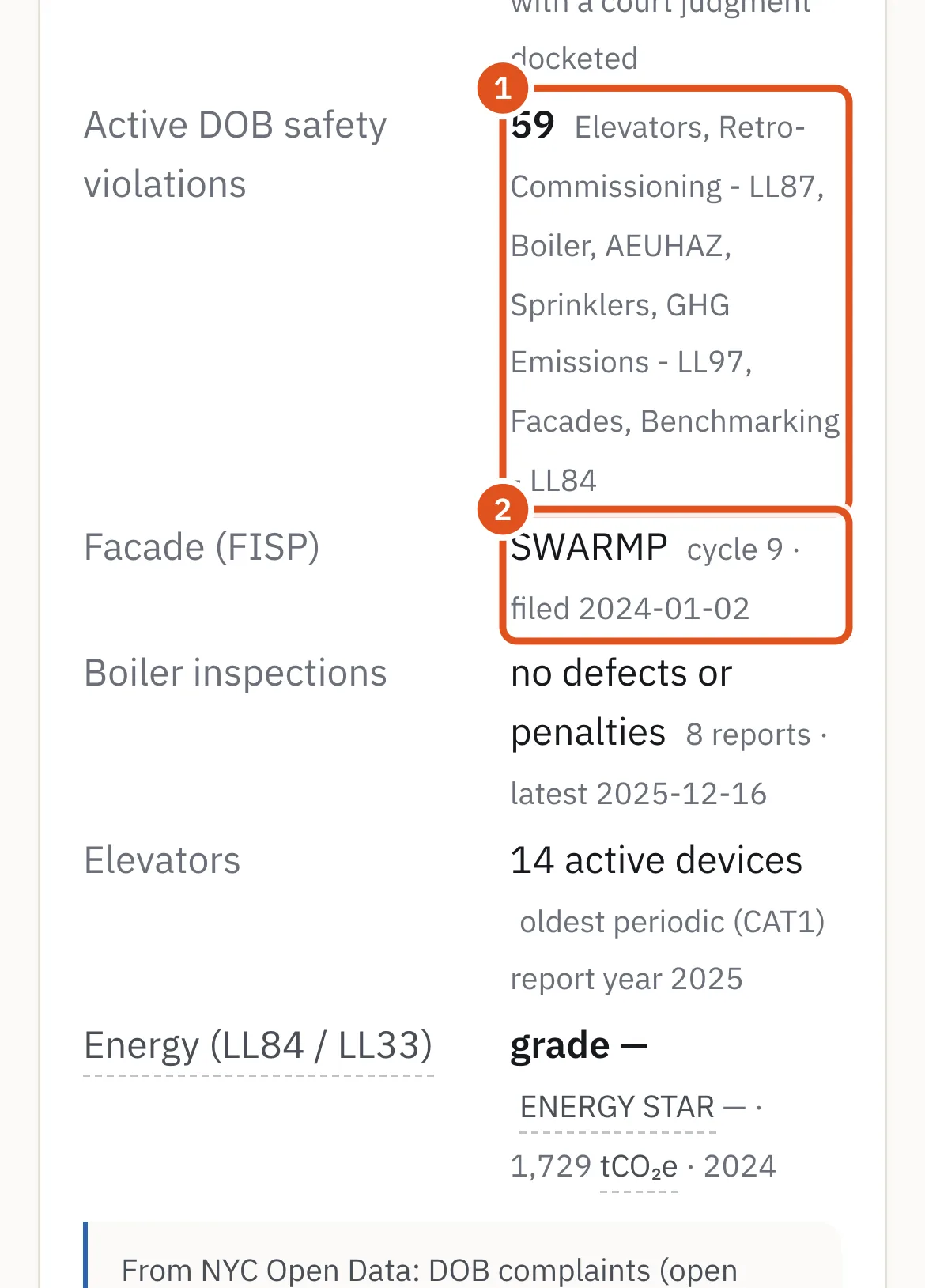
- Each law's unfiled reports, by kind
- The facade's last filing
Questions people ask
What is a Local Law in New York City? A law passed by the City Council, numbered by the year it was enacted — Local Law 97 of 2019 was the 97th of that year. Most amend the City's Administrative Code.
Which Local Laws apply to my building? It depends on size, age and use. Buildings over 25,000 square feet face the energy and emissions laws; buildings over six stories the facade program; rental buildings built before 1960 the lead paint law; buildings of three or more homes the mold, pest and bedbug laws; and owners of storefronts the storefront registry.
Where can I read a Local Law? On the City Council's legislation site, Legistar, which holds every bill, its history and its enacted text; the current text sits in the Administrative Code.
What does LL97 mean? Local Law 97 of 2019, the emissions limits for large buildings. Owners and professionals shorten Local Laws to LL and the number.
Who enforces the Local Laws? The agency the law names: the Department of Buildings for energy, emissions, facades and gas piping; HPD for lead paint, mold, pests and bedbugs; the Department of Finance for storefronts; the Office of Special Enforcement for short-term rentals; and the Department of Consumer and Worker Protection for broker fees.
Related
- Local Law 97: building emissions limits — New York City's Local Law 97 caps the greenhouse gas emissions of buildings over 25,000 square feet: who is covered, how the limit is set, the annual report, the $268-a-ton penalty, and what changes in 2030.
- Energy benchmarking and grades: Local Laws 84 and 33 — New York City's benchmarking law (Local Law 84, widened by Local Law 133) makes large buildings report their energy and water use every year; Local Law 33 turns the ENERGY STAR score into an A to F grade posted at the door.
- Energy audits and retro-commissioning: Local Law 87 — New York City's Local Law 87 makes buildings over 50,000 square feet audit their energy use and tune their systems every ten years, in a year set by the tax block; with Local Law 88's lighting and sub-meter duties.
- Lead paint: Local Law 1 of 2004 and an owner's duties — New York City's lead paint law: which homes it covers, the annual notice, yearly inspections where a child under six lives, the 2025 XRF testing deadline, turnover work, HPD's lead violations and what they cost.
- Mold and pests: Local Law 55 of 2018 and the bedbug report — New York City's Asthma-Free Housing Act (Local Law 55 of 2018): an owner's duty to inspect for and fix mold, mice, rats and roaches, how HPD classes mold by its size, licensed mold work, and the annual bedbug report.
- Storefront registration and vacancy: Local Law 157 — New York City's storefront registry (Local Law 157 of 2019): which owners register their ground- and second-floor storefronts with the Department of Finance each year, the vacancy filings, what DOF publishes, and how many storefronts stand empty.
- Short-term rental registration: Local Law 18 of 2022 — New York City's short-term rental law: what counts as a short-term rental, who may host and register with the Office of Special Enforcement, the Prohibited Buildings List, booking services' duties and the penalties.
- The FARE Act: who pays the broker fee — New York City's FARE Act (Local Law 119 of 2024): since June 11, 2025 a broker who works for the landlord cannot charge the tenant, every fee must be disclosed, and DCWP enforces it.
- Vacate orders: HPD, DOB and FDNY, and who pays for relocation — HPD, DOB and FDNY vacate orders: partial or full, how they are lifted, tenants' rights, and the relocation charges an owner can be billed.
- Certification of No Harassment (CONH) — What a Certification of No Harassment is, which buildings need one and for what work, how HPD investigates, what happens if harassment is found — and why the program became permanent in 2026.
Sources
- BlockLot Intelligence — BlockLot's own analysis of the public records below, computed October 11, 2026.
- City Council — Legislation (Legistar)
- City Council — Local Law 97 of 2019, legislative record
- City Council — Local Law 1 of 2004, legislative record
- City Council — Local Law 119 of 2024 (the FARE Act), legislative record
- American Legal Publishing — The New York City Administrative Code
- DOB — Admin Code chapter 3, maintenance of buildings (2022 construction codes)
- DOB — 2026 Covered Buildings List
- DOB — Deadlines for sustainability laws in 2026 (service notice)
- DOB — Facade Inspection & Safety Program
- DOB — Gas piping inspections
- HPD — Lead-based paint
- HPD — Indoor allergen hazards: mold, mice, roaches and rats
- DOF — Storefront registry
- Office of Special Enforcement — Registration Law
- DCWP — The FARE Act