Learn NYC property · Rent regulation and tenant protection
SRO buildings: single room occupancy, rooming houses and hotel tenants
What an SRO (single room occupancy) building is in New York City, how SRO and hotel rooms are rent-stabilized, permanent tenants, the 0% hotel guideline for 2026, and the SRO harassment rule.
An SRO — single room occupancy — is a home of one room, lived in by one or two people, who usually share a kitchen or bathroom with others on the floor. New York City has SRO buildings, rooming houses and old residential hotels where most of the homes are single rooms, and many of those rooms are rent-stabilized.
SROs matter out of proportion to their number. They are among the cheapest homes in the city and have long been a home of last resort; for that reason the City protects their tenants with rules found nowhere else — above all, an owner who wants to convert or gut an SRO building must first prove it has not harassed its tenants, and cannot buy its way out of a finding. For a buyer, an SRO's rooms and their tenants come with the building.
What the law calls an SRO
The State's Multiple Dwelling Law defines single room occupancy as one or two people living in a single room. A building used wholly or partly that way stays a Class A multiple dwelling — the class for permanent homes — and since a 2010 State law (chapter 225, signed July 16, 2010) its rooms must be lived in for at least 30 days at a time, like any Class A home. Renting such rooms for shorter stays is not allowed.
- The City's Housing Maintenance Code calls such a home a rooming unit: one or more rooms used as a unit without both a lawful bathroom and a lawful kitchen of its own. The building must provide at least one toilet, washbasin and bath or shower for every six occupants of rooming units, and a toilet on every floor that has one.
- A rooming house is a building with fewer than 30 sleeping rooms rented out, other than a hotel; a hotel has 30 or more. A lodging house rents beds for a night or less than a week at a time. These transient buildings are Class B multiple dwellings — see short-term rental registration for the difference that makes.
- State law forbids SRO use in a wooden building, limits a room to two adults, requires sprinklers in every room of a non-fireproof SRO building, and bans movable cooking appliances and heaters in sleeping rooms.
The Department of Finance has its own building class for these buildings, HR, which it describes as one or two people housed in individual rooms in a multiple dwelling of affordable housing; rooming houses may instead be in class C5, converted dwellings or rooming houses.
Rent stabilization for rooms
Hotels, SROs and rooming houses built on or before July 1969 with six or more homes are generally covered by rent stabilization, according to HCR, the State agency that runs it. The Class B buildings — SRO hotels and rooming houses — have been covered since June 4, 1981; their rooms need not have a kitchen or a bathroom.
An occupant is protected once they become a permanent tenant: by living there continuously as their primary home for at least six months, or by asking for a lease of six months or more — which the owner must provide within 15 days — or by holding such a lease. A family member living with them is protected too. Unlike apartment owners, hotel and SRO owners need not offer renewal leases, but a permanent tenant has the right to stay whether or not a lease is renewed.
A new permanent tenant's rent may be no higher than the previous permanent tenant's last rent, if within six years, plus the guideline then in force, and it must be registered with HCR. Hotels owe the services they provided — maid service, linen changes, furniture and a staffed lobby; SROs and rooming houses owe those they gave when they became covered in 1981. When services are cut, HCR can reduce the rent.
The hotel guideline
The Rent Guidelines Board sets a separate yearly hotel guideline for these rooms. Hotel Order #56, adopted on June 25, 2026, allows 0% for leases beginning from October 1, 2026 to September 30, 2027, for every kind of hotel, rooming house, lodging house and SRO; the year before, Order #55 was also 0%. When a tenant leaves voluntarily, the next tenant's rent may not exceed the rent charged on September 30 of that year.
By the Board's count of HCR registrations, 18,004 hotel and SRO rooms were registered in 2025, of which 9,777 were rent-stabilized, 1,655 vacant and 6,499 temporarily exempt — down from 25,779 registered in 2010. The average stabilized rent was $1,462 a month in 2025, the median $1,336.
Protection from lockouts
Anyone who has lived in a room for 30 days or more can be removed only by a court case and a City Marshal — see evictions and City Marshals. HCR says this applies to hotel occupants even without a lease or permanent-tenant status. One protection does not extend to them: the court's power to delay a residential eviction for up to a year excludes rooms in hotels, lodging houses and rooming houses.
The SRO harassment rule
The City's oldest anti-harassment rule is for SROs. An owner of an SRO building anywhere in the city must obtain HPD's Certification of No Harassment before the Department of Buildings will approve demolition, a change of use, adding or removing kitchens or bathrooms, or changing the number or layout of the homes. For SROs HPD looks back three years before the application, and an SRO owner outside the special districts cannot cure a finding of harassment by providing affordable housing elsewhere. HPD defines an SRO for this purpose broadly: a Class A building used as a rooming house or for single room occupancy, a Class A building with rooming units, or any Class B multiple dwelling.
Hotels, short stays and supportive housing
Because SRO rooms must be rented for 30 days or more, renting them by the night is illegal; the City's Office of Special Enforcement says renting a whole unit for under 30 days is lawful only in Class B buildings such as hotels. Hosts of other short stays must register under Local Law 18 of 2022.
Many SRO buildings are now supportive housing, owned and run by non-profit organizations with services on site. HPD lends up to $100,000 a home to rehabilitate existing supportive housing, SROs included, and runs a federal program that pays rental assistance on SRO rooms for formerly homeless single adults, who pay about 30% of their income.
New shared housing
The City wants to make room again for homes like SROs. City of Yes for Housing Opportunity, the zoning change the Council approved on December 5, 2024, cleared the way for more housing with shared facilities such as kitchens. HPD's Shared Housing Roadmap (November 2025) describes shared housing — independent rooms sharing bathrooms or kitchens — and how mid-century laws discouraged building it. A Council bill to allow new shared-housing units under the building and housing codes, Int. 0066-2026, was heard and laid over in committee on February 9, 2026, and is not law.
A worked example
127 West 43rd Street in Midtown Manhattan is owned by The Woodstock Housing Development Fund Corporation, a housing development fund corporation. The Department of Finance classes the building as an SRO, and it shows how the public records count rooms.
By BlockLot Intelligence's reading of the City's records, the tax roll lists the building — built in 1902, class HR — with 0 residential units, because its homes are rooms rather than apartments; yet for tax year 2026/27 the City billed the stabilization fee for 296 of them. For an SRO, the fee is often the only public count of how many homes the building holds.
Where you see this in BlockLot
A building's page shows DOF's building class — HR for an SRO — and, in the Lot & building card, its residential units beside the rent-stabilized units from the City's fee. For an SRO the two can disagree completely, as above. BlockLot does not count SRO buildings or rooms citywide: the building class misses SROs classed otherwise, and no public dataset lists rooming units.
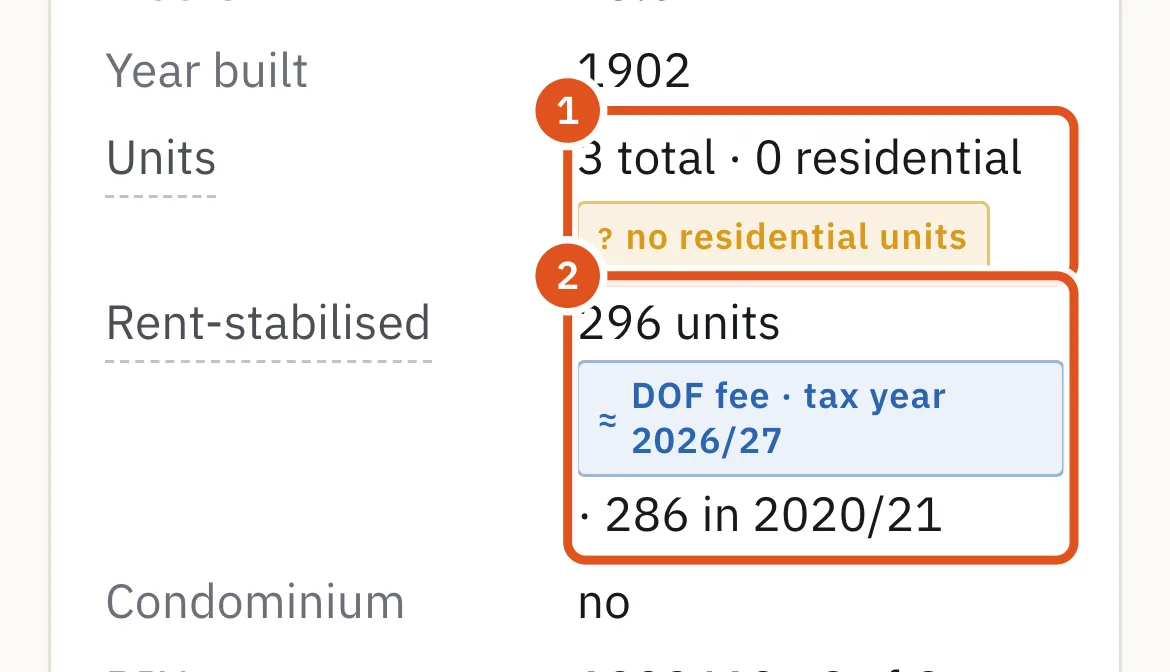
- Rooms are not counted as apartments
- Registered rooms, from the fee
Questions people ask
What is an SRO in New York City? A home of one room for one or two people, usually sharing a kitchen or bathroom. The State's Multiple Dwelling Law defines it, and a building used that way remains a Class A building for permanent homes.
Are SRO rooms rent-stabilized? Often. Hotels, SROs and rooming houses built on or before July 1969 with six or more homes are generally covered, and an occupant is protected once they become a permanent tenant — after six months, or by asking for a lease.
How much can an SRO rent go up? Only by the Rent Guidelines Board's hotel guideline, which is 0% for leases beginning from October 1, 2026 to September 30, 2027, as it was the year before. HCR-approved improvement and hardship increases can be added.
Can an SRO tenant be locked out? No. Anyone who has lived in a room for 30 days or more can be removed only by a court case and a marshal; a lockout is a crime.
Can an owner convert an SRO building? Only after HPD certifies that the owner has not harassed its tenants in the past three years. An SRO owner cannot cure a finding of harassment, so the covered work cannot be approved while the denial stands.
Can SRO rooms be rented to tourists? No. Since 2010 rooms in Class A buildings, SROs included, must be rented for 30 days or more.
Related
- Rent stabilization in New York City — NYC rent stabilization explained: which buildings, the Rent Guidelines Board's 2026 freeze, leases and renewals, the 2019 HSTPA, deregulation history, and how to check an apartment.
- Certification of No Harassment (CONH) — What a Certification of No Harassment is, which buildings need one and for what work, how HPD investigates, what happens if harassment is found — and why the program became permanent in 2026.
- Short-term rental registration: Local Law 18 of 2022 — New York City's short-term rental law: what counts as a short-term rental, who may host and register with the Office of Special Enforcement, the Prohibited Buildings List, booking services' duties and the penalties.
- Evictions and City Marshals in New York City — How a New York City eviction works, from the 14-day rent demand to the City Marshal: notices, nonpayment and holdover cases, warrants, stays, illegal lockouts and the yearly numbers.
- HUD-assisted housing: project-based Section 8, Section 202 and 811 contracts — HUD rental assistance contracts on NYC buildings: project-based Section 8, Section 202 and 811, how tenants' rent works, what happens when a contract expires, and opt-outs.
Sources
- BlockLot Intelligence — BlockLot's own analysis of the public records below, computed October 11, 2026.
- NY Senate — Multiple Dwelling Law § 4, definitions
- NY Senate — Multiple Dwelling Law § 248, single room occupancy
- DOB — the Housing Maintenance Code (Admin Code title 27, chapter 2)
- HCR — Fact Sheet #42: Hotels, SROs and rooming houses (rev. November 2023)
- Rent Guidelines Board — Hotel Order #56, 2026-27
- Rent Guidelines Board — Hotel Order #55, 2025-26
- Rent Guidelines Board — 2026 hotel explanatory statement
- NY Senate — RPAPL § 768, unlawful eviction
- NY Senate — RPAPL § 753, a stay of eviction
- HPD — Certification of No Harassment
- HPD — CONH and cure fact sheet (April 2025)
- HPD — CONH rules for SRO buildings
- Laws of New York 2010, chapter 225 (DOB copy)
- Mayor's Office of Special Enforcement — FAQ for building owners
- HPD — Supportive housing
- HPD — Shared Housing Roadmap
- NYC Council — Int. 0066-2026, shared housing
- DOF — Building classifications