Learn NYC property · Zoning and land use
City of Yes and Mandatory Inclusionary Housing: the zoning changes of 2023 to 2024
What the three City of Yes zoning amendments changed — carbon neutrality, economic opportunity and housing opportunity — with the Universal Affordability Preference, parking, accessory units and conversions, and how Mandatory Inclusionary Housing requires affordable homes in rezoned areas.
City of Yes is the name of three citywide amendments to New York City's Zoning Resolution, adopted between December 2023 and December 2024, that together made the largest changes to the City's zoning since 1961: one for carbon neutrality, one for economic opportunity and one for housing opportunity. They rewrote rules for rooftop solar and building retrofits, for where businesses may operate, and — the one most people mean — for how much housing may be built and where.
For an owner or a buyer, City of Yes changed what a lot can become: many lots may now hold more homes than before, parking is no longer required in much of the city, a one- or two-family house may add a small extra apartment, and many older office buildings may become housing. Alongside it, Mandatory Inclusionary Housing still decides what share of new homes must be affordable in neighbourhoods the City has rezoned.
The three amendments
| Amendment | Commission | Council |
|---|---|---|
| Carbon Neutrality | September 11, 2023 | December 6, 2023 |
| Economic Opportunity | March 6, 2024 | June 6, 2024 |
| Housing Opportunity | September 25, 2024 | December 5, 2024 |
- City of Yes for Carbon Neutrality removed zoning limits on how much of a roof solar panels may cover, made energy storage easier to install, eased the rules on wall thickness and height that stood in the way of electrification retrofits — the kind that laws such as Local Law 97 push owners towards — and made room for electric-vehicle charging in public garages.
- City of Yes for Economic Opportunity simplified which businesses may go where, replacing the old numbered use groups with ten new ones; it removed deadlines for filling vacant storefronts, let more kinds of business open on ground and upper floors, made room for small-scale clean production, laboratories and more home-based businesses.
- City of Yes for Housing Opportunity — adopted by the Council 31 to 20 on December 5, 2024, with the Council's own changes, and in effect that day — is the housing amendment described below. City Planning estimates it will enable about 82,000 new homes over 15 years. When it passed, the Mayor, the Governor and the Council Speaker announced $5 billion of City and State commitments for housing and infrastructure alongside it.
What Housing Opportunity changed
The Universal Affordability Preference
The Universal Affordability Preference (UAP) lets a building in a medium- or high-density district — R6 and denser, and their commercial equivalents — include about 20% more floor area, if the extra homes are permanently affordable. The affordable homes must average 60% of the area median income, in no more than three income bands with none above 100%; on larger sites a fifth of the affordable floor area must be at 40%. The Department of Housing Preservation and Development (HPD) administers it. UAP applies only outside Mandatory Inclusionary Housing areas, and it replaced the older voluntary programme.
The Zoning Resolution now shows two residential floor area ratios for these districts: R6A rises from 3.00 to 3.90 for qualifying affordable or senior housing, R10 from 10.00 to 12.00. By BlockLot Intelligence's count of City Planning's lot file, 187,925 lots in R6 to R10 districts, and 29,812 lots in commercial and mixed districts, now list a higher residential FAR for affordable or senior housing — whether through UAP or, where it is mapped, Mandatory Inclusionary Housing.
The area median income (AMI) is the yardstick for all of these programmes: a household's income as a percentage of the median for the New York City region, adjusted for household size, as published each year.
More homes in lower-density areas
- Town Center zoning allows two to four storeys of housing above a ground-floor shop on commercial streets in lower-density neighbourhoods, the kind of building common before 1961.
- Transit-oriented development lets a qualifying residential site in R3 to R5 — a lot of 5,000 square feet or more near transit, on a wide street or the short end of a block — hold a small apartment building. The Council's changes left R1 and R2 districts out.
- An accessory dwelling unit (ADU), which the Resolution calls an ancillary dwelling unit, is one extra home of up to 800 square feet on the lot of a one- or two-family house — in a backyard cottage, an attic, a basement or a garage. The owner must live on the property when it is first occupied. Backyard units are not allowed in historic districts, and no ADU may be built in a basement or a backyard in mapped flood-risk areas.
Parking, conversions and small homes
Parking is no longer required for new housing in an inner transit zone — about 2.6 million residents live there, by City Planning's count — and is much reduced in an outer zone; beyond them the old requirements largely remain, with more exemptions.
Office and other non-residential buildings that existed by December 31, 1990 may now be converted to housing anywhere in the city, where the cutoff used to be 1961, or 1977 in some areas. A fixed limit of one home per 680 square feet of floor area, and none at all in Manhattan below 96th Street and in Downtown Brooklyn, makes room for studios and small apartments. Housing with shared kitchens is now allowed by zoning, though other City laws still have to change before it can be built.
The amendment also created new districts — R11 and R12, the city's densest, which may be mapped only with Mandatory Inclusionary Housing — and loosened rules for adding buildings on the open land of large campuses, such as churches and co-op complexes; public-housing campuses are excluded.
Mandatory Inclusionary Housing
Mandatory Inclusionary Housing (MIH), adopted by the City Council on March 22, 2016, requires permanently affordable homes in new buildings in neighbourhoods the City has rezoned for more housing. It is not optional: where an MIH area is mapped, any new building, enlargement or conversion of more than 10 homes or 12,500 square feet of residential floor area must set aside a share of its floor area for affordable homes. Each rezoning chooses which of the options apply:
| Option | Affordable | Income |
|---|---|---|
| 1 | 25% (10% at 40% AMI) | 60% of AMI |
| 2 | 30% | 80% of AMI |
| 3, deep affordability | 20% | 40% of AMI |
| 4, workforce | 30% | 115% of AMI |
The workforce option is not available in the Manhattan core, must be mapped with another option, and ends ten years after it is mapped. Small buildings may pay into a City fund instead, and since December 2024 a building already bound by a government affordability agreement meets the rule through that agreement. City of Yes changed MIH only modestly: it let the deep-affordability option be mapped on its own, and raised MIH's floor area to match UAP where UAP would have allowed more.
City Planning's August 2026 data counts about 290 mapped MIH areas from some 275 rezonings since April 2016 — 46 adopted in 2025 and 21 so far in 2026. The legal list is Appendix F of the Zoning Resolution; City Planning's map is for reference only, not for deciding a single lot. HPD administers the affordable homes and their income limits. No current official count of homes built under MIH is published, so none is given here.
Voluntary Inclusionary Housing, created in 1987, gave extra floor area in R10 districts and designated areas for affordable homes, generally at 80% of AMI. Since December 5, 2024 it applies only to projects that qualified before; UAP took its place.
What came after
In November 2025, voters approved four City Charter changes on land use: a fast track for publicly financed affordable housing in the community districts that have produced the least of it, an expedited review for smaller land-use changes, an appeals board of the Mayor, the Council Speaker and the borough president for affordable-housing projects, and a digital City Map. The Board of Standards and Appeals proposed rules for the fast track in 2026. Some City of Yes rules have deadlines still running: projects keeping the old inclusionary rules must record their regulatory agreements by December 5, 2026.
A worked example: the Empire State Building's lot
The Empire State Building's district, C5-3, has a residential equivalent of R10, so City Planning's lot file lists 10.0 as its standard residential FAR — and, since City of Yes, 12.00 for affordable or senior housing. Commercial use still governs this office tower; the figures matter for what housing could be built on such a lot, or for a conversion.
Where you see this in BlockLot
A building's Zoning & use card shows the district and the FARs City Planning publishes for it, with the governing FAR and any unused floor area; the definition of each FAR says which programme a higher figure belongs to.
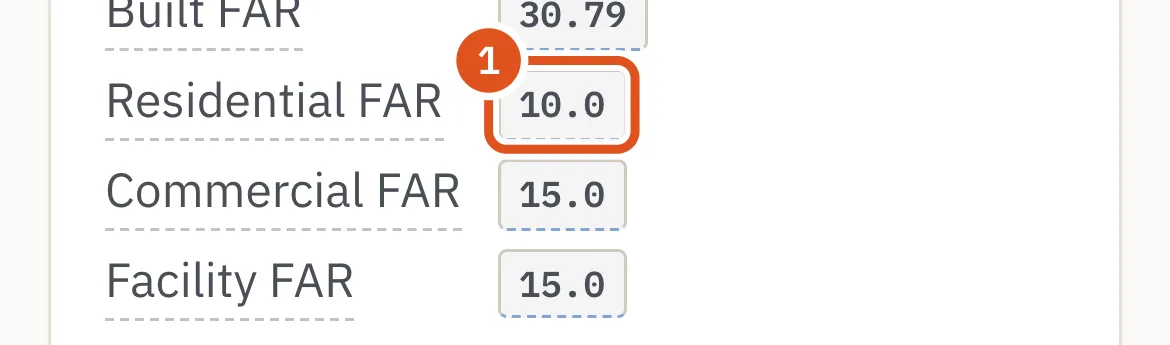
- the standard residential allowance
Questions people ask
What is City of Yes? Three citywide zoning amendments adopted in 2023 and 2024 — for carbon neutrality, economic opportunity and housing opportunity. The housing one, adopted on December 5, 2024, allows more homes across the city and removed many parking requirements.
Can I build an ADU in New York City? On the lot of a one- or two-family house, generally yes, since December 2024 — one unit of up to 800 square feet, with the owner living on the property. Backyard units are not allowed in historic districts or in mapped flood-risk areas, and the building code and other rules still apply.
Is parking still required for new buildings? Not in the inner transit zone, which covers much of the city closest to the subway; requirements are reduced in an outer zone and largely remain beyond it.
What is the difference between MIH and UAP? MIH is required, in neighbourhoods the City has rezoned; UAP is optional, outside them, and rewards affordable homes with extra floor area.
How do I know if a lot is in an MIH area? City Planning's ZoLa map shows MIH areas, and Appendix F of the Zoning Resolution is the legal list.
Did City of Yes change landmark rules? It changed how landmarks transfer unused floor area: since December 2024 a transfer to a lot on the same block or across the street can be approved by certification, without a full public review.
Related
- Zoning districts: R, C and M, overlays and special districts — How New York City's Zoning Resolution divides the city into residence, commercial and manufacturing districts, how to read a code like R7A or C4-5X, and what commercial overlays, special purpose districts, limited height districts and split lots add.
- Floor area ratio (FAR): built, residential, commercial and community facility — What a floor area ratio is, how zoning sets one for homes, businesses and community facilities, which one governs a building, what City of Yes changed, and why some older buildings stand far above their district's allowance.
- Department of Housing Preservation and Development (HPD) — What New York City's housing agency does — enforcing the Housing Maintenance Code, financing affordable homes, running the lotteries and Section 8 — and how every rental building must register with HPD each year, naming its owner and a managing agent.
- Air rights, unused floor area and zoning lot mergers — What New York City's air rights are, how unused floor area moves to a neighbouring lot through a zoning lot merger or further through a transfer of development rights, how the deals are recorded, and what BlockLot means by a soft site and an assemblage candidate.
- Flood zones and hurricane evacuation zones: FEMA's maps, NYC's projections and Know Your Zone — What a FEMA flood zone (VE, AE, A, X) and a base flood elevation mean for a New York City property, why the City uses both FEMA's 2007 map and its 2015 preliminary map, what the projected floodplains show, and how the six hurricane evacuation zones differ from all of them.
Sources
- BlockLot Intelligence — BlockLot's own analysis of the public records below, computed October 11, 2026.
- DCP — City of Yes for Housing Opportunity
- DCP — City of Yes for Economic Opportunity
- DCP — City of Yes for Carbon Neutrality
- City Council — LU 181 of 2024, City of Yes for Housing Opportunity (N 240290 ZRY), adopted December 5, 2024
- City Council — Summary of the Council's modifications (November 2024)
- City Planning Commission report N 240290 ZRY (September 25, 2024)
- Zoning Resolution 12-10 (ancillary dwelling unit, qualifying residential site)
- Zoning Resolution 23-22 (residential FAR, standard and affordable)
- Zoning Resolution, Article II Chapter 7 (UAP and Mandatory Inclusionary Housing, 27-111 to 27-134)
- Zoning Resolution 15-01 (conversions)
- Zoning Resolution, Appendix F (Mandatory Inclusionary Housing areas)
- DCP — Mandatory Inclusionary Housing
- DCP — Mandatory Inclusionary Housing areas, data (August 2026)
- HPD — Inclusionary Housing
- HPD — Mandatory Inclusionary Housing fact sheet (2025)
- HPD — Universal Affordability Preference fact sheet (2025)
- Office of the Mayor — release on the passage of City of Yes, December 5, 2024
- 2025 Charter Revision Commission — ballot proposals
- Board of Standards and Appeals — Targeted Affordable Housing Project rulemaking (April 2026)