Learn NYC property · Rent regulation and tenant protection
Rent stabilization tied to tax benefits: J-51, 421-a and 485-x
Why apartments in newer NYC buildings are rent-stabilized: the rent rules that come with 421-a, 485-x and J-51 tax benefits, the lease notice, and what happens when a benefit ends.
Buildings finished in New York City after 1973 are normally free of rent stabilization. Most rental buildings built since are stabilized anyway — some or all of their apartments — because their owners took a tax benefit that requires it: 421-a and its successor 485-x for new buildings, J-51 for renovations. The tax side of those programs — how much tax they remove and how it phases out — is on the property tax exemptions page. This page is about the rent side: which apartments the benefit puts under stabilization, for how long, and what happens when it ends.
The bargain matters to everyone in such a building. A tenant's rights may last only as long as the benefit, or for life, depending on the program and on a notice in the lease. For an owner or a buyer, the end of a benefit can change both the tax bill and the rent roll — and whether the apartments can leave stabilization often turns on paperwork done years earlier.
How common it is
The new buildings now drive the system's growth. By the Rent Guidelines Board's count, about 32,745 apartments entered stabilization in 2025, and 94% came through 421-a (29,456) and 485-x (1,203); J-51 added none. In the other direction, 2,708 apartments left when 421-a benefits expired and 209 when J-51 benefits did. From 1994 to 2025, 421-a and 485-x brought in 166,441 apartments, while 42,089 apartments stabilized by 421-a and 18,905 by J-51 left.
Matched against the City's tax roll, BlockLot Intelligence's count of the stabilization fee finds 157,534 stabilized apartments — 15.2% of all those billed — in 5,058 buildings that carry a 421-a, J-51 or 485-x exemption on the FY 2026/27 final roll:
Units counted from the stabilization fee, in buildings whose FY 2026/27 final roll carries the exemption. A building with two programs appears under both. BlockLot Intelligence, computed October 11, 2026.
That is our join of two public records, each checked against its publisher; no agency publishes a count to compare it with. It includes buildings that were stabilized before they took the benefit, as most J-51 buildings were.
421-a
Buildings started by the end of 2015
In a building whose construction started on or before December 31, 2015 — the program's older forms — every market-rate rental apartment is stabilized for as long as the benefit lasts, according to HPD, the City's housing agency, which runs 421-a. The affordable apartments in these buildings follow stricter rules: in buildings started from July 2008, they stay affordable and stabilized for at least 35 years from completion, and the tenant in place at the end keeps stabilization for as long as they stay.
The lease notice
A market-rate apartment that is stabilized only because of the benefit can leave stabilization when the benefit ends — but only if every lease and renewal given to the tenant living there carried a notice, in at least 12-point type, saying that the apartment will be deregulated at the end of the last lease signed during the benefit, and giving the approximate date the benefit ends. This notice is often called the 421-a rider. If any of that tenant's leases lacked it, the apartment stays stabilized until the tenant moves out.
HCR's own example: a benefit ran from April 1, 2014 to March 31, 2024; a tenant signed a two-year lease on June 1, 2023 that carried the notice; at the renewal date, June 1, 2025, the apartment leaves stabilization and the owner may charge a market rent.
Affordable New York, 2016 to 2022
For buildings started from January 1, 2016 to June 15, 2022 — the version called Affordable New York, or 421-a(16):
- Affordable apartments — a quarter or more of the building, at set shares of the area median income — must stay affordable and stabilized for 35 years from completion, or 40 for buildings of 300 or more apartments in parts of Brooklyn, Manhattan and Queens. The tenant in place at the end keeps stabilization while they stay.
- Market-rate apartments are stabilized if their first rent was below the Market Rate Threshold; an apartment first rented at or above it is permanently exempt. A stabilized market-rate apartment can leave on a vacancy once its legal rent reaches the threshold — the one way out of stabilization the 2019 law kept. The threshold is $3,217.40 for 2026, up from $3,123.69 in 2025. The owner must give the next tenant HCR's notice of the exemption (form MRTE-N), with the last regulated rent, and that tenant can challenge it within six years.
By the Rent Guidelines Board's count, 7,523 apartments left stabilization in 2025 for other reasons, mostly 421-a(16) market-rate apartments leaving at the threshold.
485-x
485-x, Affordable Neighborhoods for New Yorkers, replaced 421-a in the State budget of April 20, 2024, for buildings of six or more apartments started from June 16, 2022 to June 15, 2034. Its rent rules are simpler and stricter:
- Affordable apartments are permanently affordable and permanently stabilized — from completion, forever, even if the benefit is later revoked.
- Market-rate apartments are not stabilized because of 485-x; one is stabilized only if it would be anyway.
- Small buildings of six to ten apartments outside Manhattan, in the program's 10-year option, must keep at least half of their apartments permanently stabilized, with no income test.
J-51
Under the original J-51 program, for renovation work finished by June 29, 2022, every rental apartment in a building receiving the benefit is stabilized while it lasts — even in a building with fewer than six apartments or one that was not stabilized before. HCR says such apartments cannot be deregulated during the benefit, because of a high rent or for any other reason.
Most J-51 buildings were older stabilized buildings already, and the end of the benefit changes nothing for them. In a building stabilized only because of J-51, HCR says every tenant who lived there during the benefit keeps stabilization for their whole tenancy, unless the apartment was deregulated before the benefit and the lease carried the notice described above.
J-51 R and the 2026 renewal
The reformed program, J-51 R, covers work finished from June 30, 2022 to June 29, 2026; HPD relaunched it in February 2025. It requires stabilization only of the building's qualifying affordable apartments and of market-rate apartments already stabilized when the owner applied: they stay regulated for at least 15 years from the first benefit, and then until the tenant in place leaves. The owner must also give up any MCI increase for the work.
The Council passed Int. 1015-A on September 24, 2026 to extend J-51 to work finished before June 30, 2036. As passed, it keeps covered apartments regulated until their first vacancy after a 15-year restriction period, allows no exemption from regulation during that period, bars co-op or condominium conversion during it, and takes effect January 1, 2027. On October 9, 2026 it was awaiting the Mayor's signature.
A worked example
The American Copper Buildings, two rental towers at 626 First Avenue in Manhattan owned by a company, carry a 421-a exemption — the tax side is worked through on the exemptions page. DOF's exemption file records a 20-year 421-a benefit starting in 2019, running to 2039.
The rent side shows in the City's stabilization fee: for tax year 2026/27 the City billed it for 761 apartments, against 761 homes on the tax roll — every apartment in the towers registered as stabilized. Which rules decide their future — the older 421-a's or Affordable New York's — turns on the construction start date on the building's certificate of eligibility, and whether each market-rate apartment can leave at the end turns on the notices in its tenant's leases.
Where you see this in BlockLot
A building's Value & tax card lists its exemptions with DOF's code and term, and the Lot & building card the stabilized units counted from the fee — the two facts this page connects.
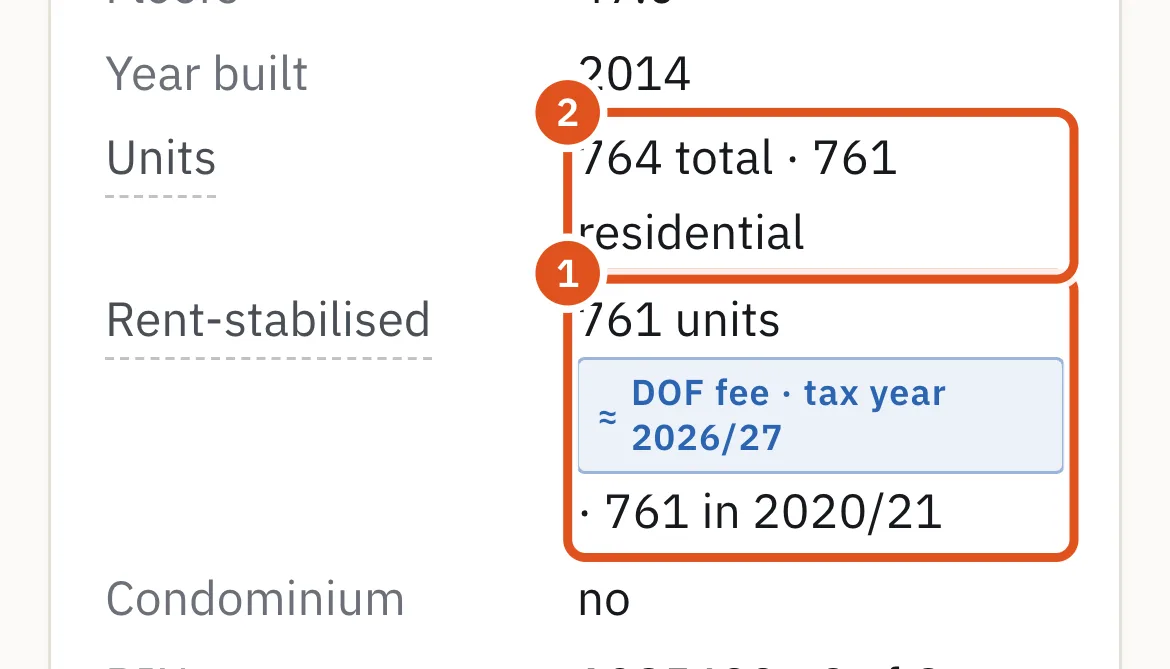
- Stabilized because of the tax benefit
- Every home in the towers
Questions people ask
My building gets 421-a. Is my apartment rent-stabilized? Usually, for a rental apartment. In buildings started by the end of 2015, every rental apartment is stabilized while the benefit lasts; in Affordable New York buildings, the affordable apartments are, and market-rate ones are if their first rent was below the Market Rate Threshold.
What happens to my apartment when the 421-a benefit ends? A market-rate apartment stabilized only by the benefit can leave at the first renewal after the end — but only if every lease the tenant signed carried the 12-point notice. If one lacked it, the apartment stays stabilized until the tenant moves out. Affordable apartments stay stabilized for 35 or 40 years, and the tenant then in place for as long as they stay.
What is the 421-a rider? The notice in the lease, in at least 12-point type, that the apartment is stabilized because of the benefit and will leave stabilization when it ends, with the approximate date. Without it on every lease, the owner cannot deregulate the apartment while that tenant stays.
Are apartments in new 485-x buildings stabilized? The affordable ones are, permanently. Market-rate apartments are not stabilized by the program.
Can a J-51 building deregulate my apartment? Not while the benefit lasts, for any reason. Most J-51 buildings were stabilized before and stay stabilized after; in one stabilized only by J-51, tenants who lived there during the benefit keep stabilization for their tenancy.
How do I find out whether my building has a tax benefit? The lease rider says so; DOF's records of the building's exemptions show it, as does a building's page in BlockLot; and the Rent Guidelines Board's lists of stabilized buildings flag 421-a and J-51 buildings.
Related
- Property tax exemptions: STAR, senior, disabled, veterans, clergy, J-51, 421-a and 485-x — NYC property tax exemptions explained: STAR, senior and disabled homeowners, veterans, clergy, 421-a, 485-x, J-51 and nonprofit property.
- Property tax abatements: co-op and condo, J-51, solar, green roof, ICAP and CEP/CRP — NYC property tax abatements explained: co-op and condo, J-51, solar, green roof, ICAP and CEP/CRP — who qualifies and what each is worth.
- Rent stabilization in New York City — NYC rent stabilization explained: which buildings, the Rent Guidelines Board's 2026 freeze, leases and renewals, the 2019 HSTPA, deregulation history, and how to check an apartment.
- MCI and IAI rent increases: Major Capital and Individual Apartment Improvements — How NYC rent-regulated rents rise for improvements: Major Capital Improvements (MCIs) and Individual Apartment Improvements (IAIs), the 2019 and 2024 limits, and how tenants check them.
Sources
- BlockLot Intelligence — BlockLot's own analysis of the public records below, computed October 11, 2026.
- HCR — Fact Sheet #41: Tax abatements and rent stabilization (rev. March 2025)
- HCR — Fact Sheet #36: Historical deregulation thresholds, with the 421-a(16) Market Rate Threshold (rev. March 2026)
- HCR — Notice of 421-a(16) Market Rate Threshold Exemption (MRTE-N)
- HCR — J-51 registration and rent-revision initiative (2019)
- HPD — 421-a and rent stabilization, tenant fact sheet
- HPD — 421-a
- HPD — 485-x: Affordable Neighborhoods for New Yorkers
- HPD — J-51
- HPD — J-51 reform (J-51 R)
- HPD — J-51 relaunched (February 12, 2025)
- NY Senate — Real Property Tax Law § 421-a
- NY Senate — Real Property Tax Law § 485-x
- NYC Council — Int. 1015-A of 2026 (the J-51 renewal)
- Rent Guidelines Board — Changes to the Rent Stabilized Housing Stock in 2025 (May 2026)
- Rent Guidelines Board — Rent-stabilized building lists