Learn NYC property · Building systems and inspections
Gas piping inspections (Local Law 152) and parapet inspections
New York City's Local Law 152 gas piping inspections — which buildings, who inspects, the community-district schedule, the 60-day filing, corrections and penalties, the 2025–2026 changes — and the yearly parapet observation.
Local Law 152 of 2016 (LL152) is the New York City law that requires the gas piping in almost every building to be inspected by a licensed master plumber at least once every four years, and the result certified to the Department of Buildings (DOB). This gas piping inspection follows the city's community districts, so a whole district comes due in the same year, and gas piping inspections run in four-year cycles. Missed gas piping certifications are now one of the largest sources of DOB violations: the Mayor's Management Report attributes roughly 40,000 of the rise in DOB violations in fiscal 2026 to them.
It sits beside two other 2016 laws: Local Law 150, which requires gas work to be done by qualified workers under a licensed master plumber, and Local Law 153, which requires owners to give tenants a notice telling them to call 911 first, then the gas utility, if they smell gas.
Which buildings
Every building except those in occupancy group R-3 — one- and two-family homes and a few similar small buildings. DOB publishes the list of covered properties, and its DOB NOW public portal tells an owner, by address, whether the building must comply and by when.
- A building with no gas piping files a one-time certification instead of an inspection (once, rather than every cycle, since the 2026 rule changes).
- A building with gas piping but no gas service files statements from the utility and the owner every cycle.
- A new building — one whose first certificate of occupancy came on or after December 6, 2016 — has its first inspection in the tenth year after that certificate, then follows its district's schedule.
Who inspects, and what
The inspection is made by a licensed master plumber, or by someone working under one's direct supervision. Since Local Law 142 of 2025 took effect on February 22, 2026, that person must also hold a DOB journeyman plumber registration and have completed at least seven hours of training. DOB must be told at least two days before an inspection.
The plumber examines the exposed gas piping, from the point where it enters the building to each appliance, and runs a leak survey of the public spaces — hallways, corridors, boiler and mechanical rooms — on floors with gas piping, using an instrument approved by the State. Apartments are not inspected inside, except as needed to reach the point where gas enters. The report lists gas leaks, illegal connections, piping that does not meet the code and anything else needing correction. A leak or other hazard found during the inspection is reported at once to the owner, the gas utility and DOB, and must be corrected immediately.
The schedule
Each year one sub-cycle of community districts is due, by December 31. The district number is the same in every borough: Manhattan's district 1 and the Bronx's district 1 are due together.
| Sub-cycle | Districts | Due in |
|---|---|---|
| A | 1, 3, 10 | 2024, 2028 |
| B | 2, 5, 7, 13, 18 | 2025, 2029 |
| C | 4, 6, 8, 9, 16 | 2026, 2030 |
| D | 11, 12, 14, 15, 17 | 2027, 2031 |
The first cycle ran from 2020 to 2023, its first two sub-cycles extended into mid-2021 and mid-2022. Sub-cycle C's buildings are due by December 31, 2026. 311, community districts and the map units explains how to find a building's district.
Filing, corrections and penalties
- The plumber gives the owner the report (form GPS1, which is not filed) and the certification (GPS2) within 30 days of the inspection.
- The owner files the certification with DOB within 60 days of the inspection. A certification filed later does not count, and the building must be inspected again.
- If conditions need correcting, the plumber's correction certification is due within 120 days, or 180 if the plumber said more time was needed. One 180-day extension of the due date is allowed per cycle.
- Owner and plumber keep the records for ten years.
Since July 27, 2026 every filing is made in DOB NOW: Safety, with a $35 fee for the inspection certification, a correction or an extension. Not certifying by the deadline costs $5,000, or $1,500 for a three-family building, and the violation is resolved only by paying and filing.
DOB writes the failure-to-file violations in one batch per sub-cycle. By BlockLot Intelligence's count of DOB's violation records, 110,668 have been issued so far, 21,505 of them in the latest batch, and 101,852 are still active.
DOB violations for failing to file a Local Law 152 gas piping inspection certification, grouped by the cycle and sub-cycle each names. Each sub-cycle's violations were issued in one batch, in the month shown. BlockLot Intelligence, computed October 11, 2026.
When the gas is shut off
If the utility shuts off gas because of a leak, only a licensed master plumber may repair the piping. The plumber files an emergency work notification and then a permit application in DOB NOW, DOB witnesses a pressure test, and the plumber asks DOB to authorize restoring the gas; the utility makes its own inspection before turning it back on. HPD expects owners to restore gas for heat, hot water and cooking immediately.
Parapets
A parapet is the part of a wall that rises above the roof line — the low wall around the edge of many flat roofs. Since January 1, 2024, every building with a parapet facing a street or other public way must have it observed once a year — the parapet observation, often called a parapet inspection — whatever the building's height (1 RCNY §103-15, in force since September 28, 2023). Detached one- and two-family homes are exempt, and so are buildings where a fence or barrier keeps people from reaching the wall below.
The observer need not be an engineer: the rule names a bricklayer, building superintendent, handyman, mason, architect or engineer, or anyone else able to spot hazards. The parapet is examined close up, from the roof or a fire escape: is it plumb, is it cracked or missing bricks or coping stones, are the railings, signs and equipment fixed to it stable? The report, with dated photographs, is kept by the owner for six years and shown to DOB on request; it is not filed. A facade report for a FISP building can count as the parapet report if it covers the same points.
An unsafe parapet is reported to DOB at once, protection — a shed, fence or netting — goes up immediately, and the repair is due within 90 days. Failing to show the report when DOB asks is a Class 2 violation, with a standard penalty of $1,250. Facades are covered in Facade inspections.
A worked example: the Empire State Building
The Empire State Building stands in Manhattan Community District 5, so it is in sub-cycle B. Its first gas piping inspection was due in the first cycle's sub-cycle B window, which ran into mid-2022; its second was due by December 31, 2025, and its third is due by December 31, 2029.
Where you see this in BlockLot
A missed gas piping certification shows on a building's Compliance & distress signals card in the Active DOB safety violations row, where the program is named Gas Piping - LL152. The Department of Buildings guide explains DOB safety violations in general.
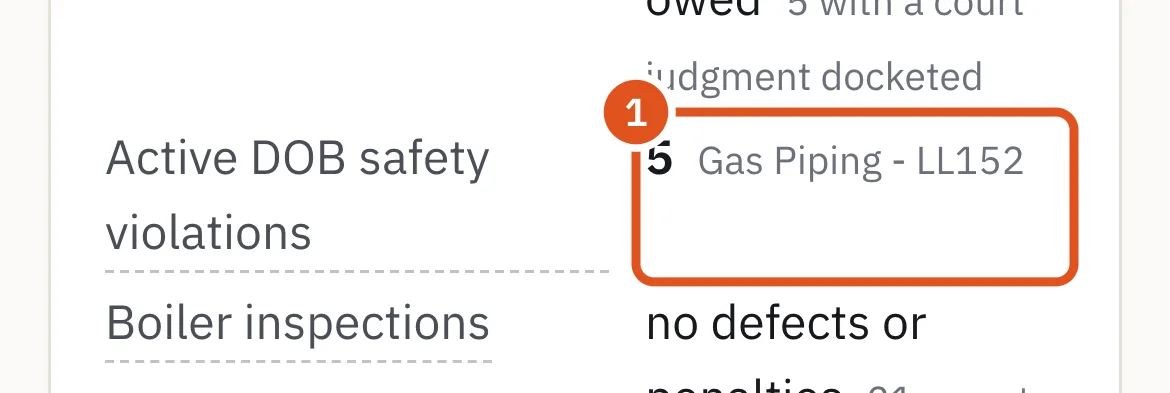
- Active violations and their programs
Questions people ask
Does my building need a gas piping inspection? Almost certainly, unless it is a one- or two-family home. DOB's public portal answers by address, and a building with no gas piping files a one-time certification instead.
When is my Local Law 152 inspection due? By December 31 of your community district's year: districts 4, 6, 8, 9 and 16 in 2026, districts 11, 12, 14, 15 and 17 in 2027, and so on every four years.
Who can do the inspection? A licensed master plumber, or a registered journeyman plumber with the required training working under one.
Will the plumber inspect inside my apartment? No. The inspection covers exposed piping from where gas enters the building and the public spaces; apartments are not inspected inside.
What happens if the owner does not file? DOB issues a violation with a $5,000 penalty ($1,500 for a three-family building), and it stays until the penalty is paid and the certification is filed.
What is a parapet inspection? A yearly close-up look at the low walls above a building's roof line that face the street, recorded in a report the owner keeps for six years.
Related
- Department of Buildings (DOB) — What New York City's Department of Buildings does, how a building permit works from filing to sign-off, what a Certificate of Occupancy is, and how DOB violations and stop work orders are issued and cleared.
- Facade inspections (FISP, Local Law 11) and sidewalk sheds — How New York City's Facade Inspection & Safety Program works — which buildings, who inspects, the Safe, SWARMP and Unsafe ratings, the cycles and their 2025 changes, penalties, and why sidewalk sheds stay up.
- Boiler inspections: who files, when, defects and penalties — Which New York City boilers must be inspected every year, who may inspect them, the 14-day filing deadline, how defects are corrected and affirmed, the penalties for late or missing reports, and how DEP's boiler rules differ.
- Smoke and carbon monoxide detectors, window guards and self-closing doors — The safety devices New York City requires in apartments — smoke, carbon monoxide and natural gas detectors, window guards and self-closing doors — who installs and maintains them, what HPD's violations for them mean, and how fast they are fixed.
- 311, community districts and the map units a property sits in — What 311 is and what happens to a building complaint made to it, and the map units every New York City lot is filed under — community districts and boards, City Council districts, census tracts and Neighborhood Tabulation Areas.
Sources
- BlockLot Intelligence — BlockLot's own analysis of the public records below, computed October 11, 2026.
- DOB — Periodic gas piping system inspections
- DOB — Local Law 152 FAQs
- DOB — Gas piping inspections, 1 RCNY §103-10 (June 10, 2026)
- DOB — Follow-up 8: certifications move to DOB NOW (July 8, 2026)
- DOB — Follow-up 7: Local Law 142 of 2025 and the rule changes (April 3, 2026)
- DOB — Cycle 2 violations, service notice (December 16, 2025)
- DOB — Cycle 2 violations, follow-up (March 20, 2026)
- City Council — Local Law 142 of 2025 (Int 0429-2024)
- Local Law 153 of 2016 (gas leak notice)
- DOB — Utility service restoration
- HPD — Gas
- DOB — Parapets
- DOB — Parapet FAQs
- DOB — Parapet observation, 1 RCNY §103-15
- DOB — 1 RCNY §103-15 promulgation history
- DOB — Annual parapet observation, service notice (November 14, 2023)
- DOB — Penalty schedule, 1 RCNY §102-01
- Mayor's Management Report, Fiscal 2026 — Department of Buildings
- NYC Open Data — DOB Safety Violations