Learn NYC property · Building systems and inspections
Smoke and carbon monoxide detectors, window guards and self-closing doors
The safety devices New York City requires in apartments — smoke, carbon monoxide and natural gas detectors, window guards and self-closing doors — who installs and maintains them, what HPD's violations for them mean, and how fast they are fixed.
New York City requires a handful of safety devices in and around every rental apartment: smoke detectors, carbon monoxide detectors and — from January 1, 2027 — natural gas detectors; window guards where a young child lives; and self-closing doors at the apartment's entrance and in the halls. The rules are in the City's Housing Maintenance Code and its Building Code, and the Department of Housing Preservation and Development (HPD) enforces them.
These devices matter out of proportion to their cost. HPD checks for them at every inspection, whatever the tenant called about, and a missing or broken one is written up as an HPD violation. They are among the most common violations in the city, and they are what a buyer of a rental building or a tenant moving in should check first. HPD violations explains the violation classes these devices fall into.
Smoke detectors
The owner of an apartment building — a multiple dwelling, in the law's words — must install at least one working smoke detector (or smoke alarm) in each apartment. In most apartment buildings smoke detectors go within 15 feet of the entrance to each room used for sleeping.
- Since April 1, 2014, every new smoke alarm must have a sealed battery that lasts at least ten years and sounds when the alarm reaches the end of its life (Local Law 112 of 2013). Older alarms of unknown age had to be replaced by April 1, 2021.
- The tenant keeps the detector working — HPD advises testing it every month — and replaces one that is lost, stolen or broken during the tenancy.
- The owner replaces a detector before the next tenant moves in, replaces one that fails within a year through a defect within 30 days of being told, and replaces each device at the end of its life.
- In an ordinary apartment building the owner may charge the tenant up to $25 for each new detector, $50 for a combined smoke and carbon monoxide unit, with a year to pay.
A missing or defective smoke detector is a Class B violation, with 30 days to correct. A missing notice about detectors in the building's lobby is a separate Class A violation.
Carbon monoxide detectors
A carbon monoxide detector has been required since Local Law 7 of 2004, and the rules for carbon monoxide detectors now sit in the same section of the Housing Maintenance Code as those for smoke detectors. Owners of apartment buildings, and of one- and two-family homes they do not live in, must install at least one in each apartment where anything burns fuel — a gas stove, a boiler, a water heater, a fireplace — within 15 feet of each bedroom door, and near the appliance. A building with no fuel-burning appliance and no attached garage can be exempt. The duties and charges are the same as for smoke detectors, and a missing or defective CO detector is likewise Class B.
Natural gas detectors
A natural gas detector (or natural gas alarm) must be installed in every apartment with gas piping or a gas appliance by January 1, 2027. Local Law 157 of 2016 created the requirement; Local Law 102 of 2025 set the date, with a possible delay to 2029 that DOB ruled out in June 2026 after finding enough makers of battery-powered alarms. The alarm goes three to ten feet from the gas appliance; the owner installs and replaces it, and the tenant keeps a battery unit working. HPD's gas-detector rules take effect on the same date.
Window guards
Window guards are metal bars or gates fixed across a window to stop a child falling out. In a building with three or more apartments, the owner must install approved guards on every window of an apartment where a child aged 10 or younger lives — first-floor windows and windows onto a balcony or terrace included — and on the windows of the public halls. Any tenant may ask for them in writing, for any reason. Windows onto a fire escape must not have them.
- Each January the owner sends every tenant an annual notice asking whether a child 10 or younger lives there; the tenant returns it by February 15, and if no answer comes the owner inspects by March 1.
- Since January 1, 2026, guards must be registered with the Health Department and stamped with their registration number; openings may be no wider than four and a half inches.
- The owner may charge a rent-regulated tenant at most $10 a guard.
The Health Department writes the specifications; HPD inspects and writes the violations. A missing window guard is Class C, with 21 days to correct.
Self-closing doors
A self-closing door shuts and latches by itself when it is opened and let go. Apartment entrance doors, stair doors and the other doors onto public halls must be self-closing doors, so that a fire in one apartment does not fill the stairs with smoke. Local Law 111 of 2018 required them in apartment buildings by July 31, 2021.
The rules were tightened after the fire at the Twin Parks North West building in the Bronx on January 9, 2022, where 17 people died after smoke spread through an open door. Local Law 63 of 2022 cut the time to fix a self-closing door to 14 days and set a penalty of $250 to $500, plus $250 a day until it is fixed; HPD now reinspects after the correction period. Local Law 71 of 2022 has HPD inspect the doors of 300 buildings a year on its own initiative. A defective self-closing door is a Class C violation. Tenants should not prop the doors open.
How common these violations are
By BlockLot Intelligence's count of HPD's records, inspectors wrote 131,006 violations for these four devices in the last 12 months — 66,924 for self-closing doors alone.
HPD violations from inspections in the last 365 days ordering a missing or defective device repaired or provided. Violations for not posting a notice are not counted. BlockLot Intelligence, computed October 10, 2026.
Most of these violations close, but few close within the correction period. Of the violations from inspections between October 10, 2024 and October 10, 2025, 85.4% of the self-closing-door violations have closed, a median 82 days after the inspection, and 71.1% of the smoke-detector ones, a median 105 days after.
Safety-device violations from HPD inspections 12 to 24 months ago that have since been closed: days from the inspection to the closing. Violations still open are not in the bars. The bar ends at the median; the pale band covers the middle half. BlockLot Intelligence, computed October 10, 2026.
A violation closes when the owner certifies the correction and HPD accepts it, or when an inspector finds it fixed; the time includes HPD's own steps as well as the repair.
A worked example: a Bronx walk-up
A 26-apartment walk-up on Creston Avenue in the Bronx, owned by a company, shows the pattern. In November 2025 an HPD inspector wrote violations for a defective self-closing apartment door, a defective door on the first floor, and a defective smoke detector and carbon monoxide detector in a fifth-floor apartment; the first-floor door was closed in December, the others by late February 2026. In April 2026 inspectors found a broken vestibule door — closed 24 days later — and defective smoke and carbon monoxide detectors in a second-floor apartment, closed in August.
Where you see this in BlockLot
A building's Violations drawer lists every HPD violation, with its class and status; the device violations read repair or replace the self-closing door, the smoke detecting device or the carbon monoxide detecting device, install the missing window guard. Open HPD violations are counted on the building's page, the owner's page and the area pages.
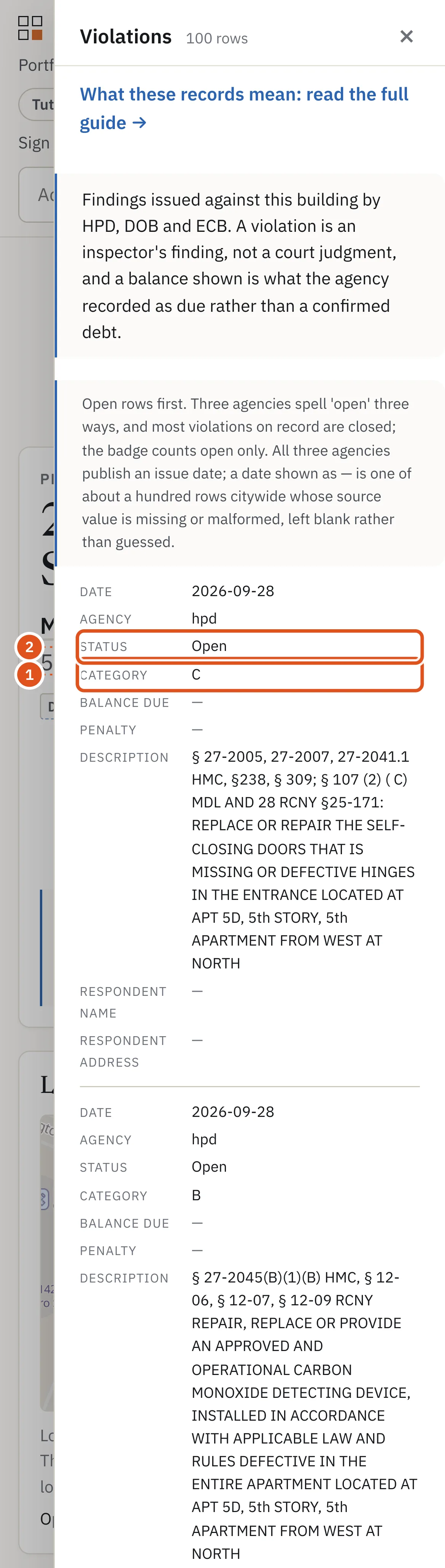
- The violation's class
- Open or closed
Questions people ask
Does my landlord have to install window guards? Yes, in a building with three or more apartments, if a child aged 10 or younger lives with you — or if you ask in writing for any reason. Not on a window onto a fire escape.
Who replaces the smoke detector battery? The tenant keeps the detector working. But every alarm installed since April 2014 has a sealed ten-year battery, so there is no battery to change; the owner replaces the whole alarm at the end of its life.
Do I need a carbon monoxide detector? If anything in the building burns fuel — gas, oil — or it has an attached garage, the owner must provide one in each apartment.
What is a self-closing door violation? HPD's finding that a door that should shut and latch by itself does not. It is Class C: the owner has 14 days to fix it, and the penalty runs $250 a day until it is fixed.
Can my landlord charge me for a detector? In most apartment buildings, up to $25 a device ($50 for a combined smoke and carbon monoxide unit), with a year to pay.
When are natural gas detectors required? By January 1, 2027, in apartments with gas piping or a gas appliance.
Related
- HPD violations: Class A, B, C and I — What HPD housing violations are, what Class A, B, C and I mean, how long an owner has to fix and certify each, how a violation is closed or dismissed, and what happens when a Class C is ignored.
- HPD emergency repairs, repair charges and 7A administrators — How HPD's Emergency Repair Program fixes hazards an owner ignores and bills the owner, how repair charges become liens, and what a 7A administrator does.
- Gas piping inspections (Local Law 152) and parapet inspections — New York City's Local Law 152 gas piping inspections — which buildings, who inspects, the community-district schedule, the 60-day filing, corrections and penalties, the 2025–2026 changes — and the yearly parapet observation.
- Department of Housing Preservation and Development (HPD) — What New York City's housing agency does — enforcing the Housing Maintenance Code, financing affordable homes, running the lotteries and Section 8 — and how every rental building must register with HPD each year, naming its owner and a managing agent.
- Department of Buildings (DOB) — What New York City's Department of Buildings does, how a building permit works from filing to sign-off, what a Certificate of Occupancy is, and how DOB violations and stop work orders are issued and cleared.
- Lead paint: Local Law 1 of 2004 and an owner's duties — New York City's lead paint law: which homes it covers, the annual notice, yearly inspections where a child under six lives, the 2025 XRF testing deadline, turnover work, HPD's lead violations and what they cost.
Sources
- BlockLot Intelligence — BlockLot's own analysis of the public records below, computed October 10, 2026.
- HPD — Smoke, carbon monoxide and natural gas detectors
- HPD — Window guards
- HPD — Self-closing doors
- HPD — Clear violations
- HPD — Penalties and fees
- HPD — Required signage and notices
- HPD — The ABCs of Housing (2021)
- NYC Health — Window guards
- NYC Health — Window guards, for landlords
- NYC Health — New window guard rules, 24 RCNY Chapter 12 (effective January 1, 2026)
- Local Law 157 of 2016 (detectors)
- Local Law 7 of 2004 (carbon monoxide detectors)
- City Council — Local Law 112 of 2013 (sealed-battery smoke alarms)
- DOB — Natural gas alarms by January 1, 2027, service notice (June 15, 2026)
- City Council — Local Law 111 of 2018 (self-closing doors)
- City Council — Local Law 63 of 2022 (self-closing door repairs)
- City Council — Local Law 71 of 2022 (self-closing door inspections)
- HPD — Inspections of self-closing doors (rule, September 4, 2023)
- City Council — Fire-safety package after the Twin Parks fire (May 19, 2022)
- NYS Department of State — Smoke alarm sales rule (April 1, 2019)
- NYC Open Data — Housing Maintenance Code Violations