Learn NYC property · Building systems and inspections
Elevator inspections: CAT1 and CAT5 tests, periodic inspections and penalties
How New York City inspects elevators, escalators and lifts — the yearly periodic inspection, the Category 1 no-load test, the five-year Category 5 full-load test, the filing deadlines, the penalties and the retrofit deadlines.
New York City's Department of Buildings (DOB) requires every elevator to be inspected once a year and safety-tested once a year, and given a heavier test every five years. The rules cover far more than passenger elevators: in DOB's rule an "elevator" includes escalators, moving walks, dumbwaiters, wheelchair lifts and other conveying machines. The owner hires a private agency licensed by DOB to do the work and files each report in DOB's online system, DOB NOW: Safety.
For an owner the program is three deadlines a year and a set of penalties for missing them. For a tenant or a buyer, the filings say whether a building's elevators are being looked after on paper — and a broken elevator is reported to 311.
The devices
DOB lists every elevator device with a number, a kind and a status, and its elevator devices include escalators, lifts and dumbwaiters as well as elevators. An active device is one in service — not removed, dismantled or still being installed.
By BlockLot Intelligence's count of DOB's records, 93,405 devices are active in the city, 81,168 of them elevators. DOB's own round figure is "more than 70,000 elevators"; in 2023 it put the rides at about a billion a year.
Devices DOB lists as active in DOB NOW: Safety's elevator records. BlockLot Intelligence, computed October 11, 2026.
The yearly inspection and test
- The periodic inspection — once each calendar year, a visual inspection of the whole installation. Since January 1, 2022 the owner hires the agency that does it, and that agency may not be affiliated with the company that maintains the elevator. The report is due within 14 days, and is not accepted after January 14 of the next year.
- The Category 1 test (CAT1) — once each calendar year, a no-load safety test, at least six months after the last one and three months after a periodic inspection. It is performed by one approved agency and witnessed by another. The report is due within 21 days and is not accepted after January 21 of the next year.
DOB's compliance page sums the two up as an elevator "inspected and tested twice annually". (DOB's older FAQ page still describes the rules before 2022.)
Both are done by an approved elevator agency: a company whose director and inspectors hold DOB licenses. Since 2022 elevator work itself may be done only under a licensed elevator agency director.
The five-year test
The Category 5 test (CAT5) is a full-load test at rated load and speed, due within five years of the month of the last one — or of the month a new elevator was approved for use. The testing agency gives DOB five days' notice, and the report is due within 21 days.
By BlockLot Intelligence's count, 82.8% of active elevators show a CAT5 report filed in the last five years. Water-hydraulic elevators also have a Category 3 test every three years.
Defects and corrections
Defects found by an inspection or test must be corrected within 90 days, and hazardous conditions at once. The owner then files an affirmation of correction within 14 days of the repair; corrections not filed within 104 days of the inspection draw a violation. Owners may ask for up to two 45-day extensions for a CAT1 defect. These deadlines date from January 1, 2022; before then they were 120 days to correct and 60 to file.
By BlockLot Intelligence's count, 96.4% of active elevators have a CAT1 report for 2025 or later; 2,935 do not.
Penalties
| Failure | 1–2 family | Other buildings |
|---|---|---|
| CAT1 report not filed | $1,000 | $3,000 |
| CAT5 report not filed | $1,000 | $5,000 |
| Periodic report not filed | — | $3,000 |
| Correction not filed | $1,000 | $3,000 |
Penalties are per elevator, from DOB's rule. A late report costs $150 a month in a commercial, mixed-use or multi-family building (up to $1,800; $250 a month up to $3,000 for a CAT5), and $50 a month (up to $600) in a one- or two-family home. DOB issues the violations in batches: in September and October 2025 for reports missing from the 2024 cycle. A violation stays until the penalty is paid or waived and a current report is filed, and it holds up a final Certificate of Occupancy. On DOB's older system the code LL10/81 marks the elevator test violations of Local Law 10 of 1981. Active elevator violations are counted with the other DOB safety violations.
Retrofits
Two equipment deadlines apply to existing elevators. Since January 1, 2020 automatic passenger and freight elevators must have door lock monitoring, and DOB writes summonses for devices without it. By January 1, 2027, traction elevators with single-plunger brakes must be converted to dual-plunger brakes or given protection against unintended car movement; DOB sent its final reminder in July 2026.
A worked example: the Empire State Building
The Empire State Building, owned by a company, is one of the city's largest elevator installations. DOB's records list 76 active elevators there, plus 10 escalators, a dumbwaiter, a conveyor and an accessibility lift. Every active elevator has a CAT1 report for 2025 or 2026, and the newest CAT5 report was filed in July 2026. Of the 61 safety violations DOB has written about the building's elevators, 59 have been dismissed.
Where you see this in BlockLot
A building's Compliance & distress signals card has an Elevators row: how many active devices the lot has, and the oldest CAT1 report year among them — a year well behind the current one points to a device whose test is overdue. Missed filings appear in the Active DOB safety violations row above it.
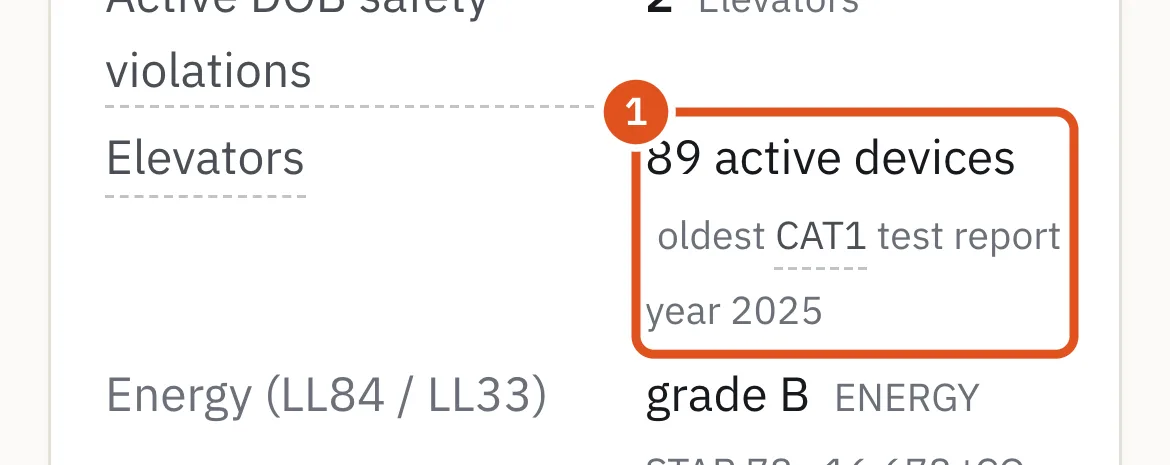
- Active devices and the oldest CAT1 year
Questions people ask
How often are elevators inspected in New York City? Twice a year in practice: a periodic inspection and a Category 1 safety test each calendar year, plus a full-load Category 5 test every five years.
Who is responsible for elevator inspections? The owner. The owner hires an approved agency licensed by DOB, files the reports and pays any penalties.
What is the difference between CAT1 and CAT5? CAT1 is the yearly test without a load; CAT5 is the five-yearly test with the car loaded to its rated capacity and run at rated speed.
What happens if the owner doesn't file? DOB writes a violation — up to $3,000 per elevator for a missing CAT1 or periodic report and $5,000 for a missing CAT5 in most buildings — which stays until the penalty is settled and a current report is filed.
The elevator in my building is broken. Who do I call? Report it to 311, or 911 in an emergency. DOB inspects but does not repair; where DOB has ordered service restored and the owner does not act, HPD can make the repair and bill the owner.
Related
- Department of Buildings (DOB) — What New York City's Department of Buildings does, how a building permit works from filing to sign-off, what a Certificate of Occupancy is, and how DOB violations and stop work orders are issued and cleared.
- Boiler inspections: who files, when, defects and penalties — Which New York City boilers must be inspected every year, who may inspect them, the 14-day filing deadline, how defects are corrected and affirmed, the penalties for late or missing reports, and how DEP's boiler rules differ.
- DOB violations and ECB summonses: classes, cures and penalties — DOB violations and ECB summonses explained: Class 1, 2 and 3, cures, penalties and defaults, and why paying a fine does not close a violation.
- HPD emergency repairs, repair charges and 7A administrators — How HPD's Emergency Repair Program fixes hazards an owner ignores and bills the owner, how repair charges become liens, and what a 7A administrator does.
- Certificate of Occupancy, temporary CO, Letter of No Objection and Letter of Completion — What a New York City Certificate of Occupancy says, when a building needs one, how temporary COs are renewed until the final one, and what a Letter of No Objection or a Letter of Completion is for.
Sources
- BlockLot Intelligence — BlockLot's own analysis of the public records below, computed October 11, 2026.
- DOB — Elevator compliance
- DOB — Elevator inspections and tests, 1 RCNY §103-02
- DOB — Periodic inspections by an approved agency for the owner (November 30, 2021)
- DOB — New requirements for category testing (December 30, 2021)
- DOB — Changes to elevator inspections in DOB NOW: Safety (2022)
- DOB — Violations for the 2024 cycles (August 25, 2025)
- DOB — Elevator door lock monitoring deadline (December 2019)
- DOB — Single-plunger brakes, final reminder (July 29, 2026)
- DOB — New license requirements for elevator work (November 30, 2021)
- DOB — Elevator issues, for tenants
- DOB — Elevator and Escalator Safety Week (November 14, 2023)
- DOB — Types of DOB violations
- NYC Open Data — DOB NOW Elevator Safety Compliance